

TL;DR:
- Most business leaders focus on AI replacing jobs, but the true value lies in transforming workflows through agentic AI. This goal-driven AI system improves administrative processes like intake, scheduling, and document management, leading to significant efficiency gains and error reduction. Success depends on careful planning, active governance, and ongoing process refinement to sustain long-term benefits.
Most business leaders approach AI for administrative efficiency with one question: “How many jobs can this replace?” That framing leads them straight into the wrong decisions. The real opportunity is not headcount reduction. It is workflow transformation. Agentic AI, the kind that reasons, plans, and executes multi-step tasks without constant human instruction, can change how administrative work moves through your organization. But applied carelessly, it can create new bottlenecks just as fast as it removes old ones. This guide gives you a clear, grounded view of where AI delivers real value, where it falls short, and how to implement it without creating problems you did not anticipate.
Table of Contents
- What is agentic AI, and how does it transform administrative work?
- The real benefits of AI for administrative efficiency
- Where AI for administrative efficiency works best and where it doesn’t
- Getting started: Practical steps for implementing agentic AI in your business
- AI for administrative efficiency: What most business leaders get wrong
- Take your admin efficiency to the next level with AI-guided solutions
- Frequently asked questions
Key Takeaways
| Point | Details |
|---|---|
| Agentic AI redefines workflows | Unlike basic automation, agentic AI adapts to complex administrative tasks and optimizes processes in real time. |
| Risks require governance | Goal drift, prompt injection, and exception management mean that oversight and updates are essential for long-term success. |
| Maximum value comes from targeting the right tasks | AI excels at high-volume, low-ambiguity admin work, while nuanced or ambiguous tasks still benefit from human oversight. |
| Efficiency is more than speed | AI-driven administrative improvements can reduce errors, redistribute workloads, and free up staff for higher-value work. |
What is agentic AI, and how does it transform administrative work?
Not all AI is built the same. Business leaders often use “AI” and “automation” interchangeably, but the distinction matters when you are making investment decisions.
Traditional robotic process automation (RPA) is rule-based. You define every step, every condition, every output. It handles repetitive, predictable tasks well. Think copying data between systems, generating recurring reports, or sending templated emails. It breaks the moment conditions change outside its programmed rules.
Agentic AI works differently. These systems are goal-driven. You give them an objective, and they plan the steps to reach it, adapt when something changes, and route exceptions to humans when needed. They can process an intake form, verify information against your CRM, schedule a follow-up, and flag anomalies without someone managing each action. That is a fundamentally different operating model.
You can explore the types of AI automation in detail to understand where each approach fits your existing operations.
Where agentic AI excels:
- Document intake and classification
- Multi-step scheduling coordination across teams and systems
- Invoice matching and billing exception routing
- Compliance document tracking and renewal alerts
- Internal communications routing and status updates
- CRM record updates triggered by client interactions
Where human oversight remains essential:
- High-ambiguity decisions requiring contextual judgment
- Situations involving unique client circumstances not covered by existing data
- Approvals with legal or regulatory consequences
- Communications requiring empathy or negotiation
“AI at intake compresses complexity, shifting the workload to exceptions and appeals.” This shift is important to plan for. Complexity does not disappear. It moves.
Administrative areas where agentic AI produces the clearest impact include intake processing, scheduling, and document management. These are structured enough for AI to act with confidence, yet complex enough that manual handling creates consistent delays. The compounding effect of faster intake, fewer scheduling errors, and accurate document routing adds up quickly across a growing business.
The real benefits of AI for administrative efficiency
With agentic AI clearly defined, you can start to visualize exactly what changes and what benefits to expect by adopting these solutions.
The gains are real. But they are not magic. They come from replacing fragmented, manual coordination with structured, intelligent workflows. Here is a realistic comparison of what changes when agentic AI takes over administrative functions:
| Workflow stage | Traditional approach | AI-optimized approach | Efficiency gain |
|---|---|---|---|
| Document intake | Manual sorting and data entry | Automated classification and extraction | 60-75% time reduction |
| Scheduling coordination | Back-and-forth emails and calls | AI-managed calendar negotiation | 50-65% reduction in coordination time |
| Invoice processing | Manual review and approval routing | Automated matching with exception flagging | 70% faster processing |
| Compliance tracking | Spreadsheets and calendar reminders | Automated monitoring and renewal alerts | Near-zero missed deadlines |
| Internal status updates | Staff-driven email chains | Automated triggered notifications | 80% reduction in status queries |
Research on admin overhead reduction points to overhead cuts of 72% or more in well-implemented deployments. These numbers reflect organizations that planned their implementation carefully and measured outcomes at each stage.
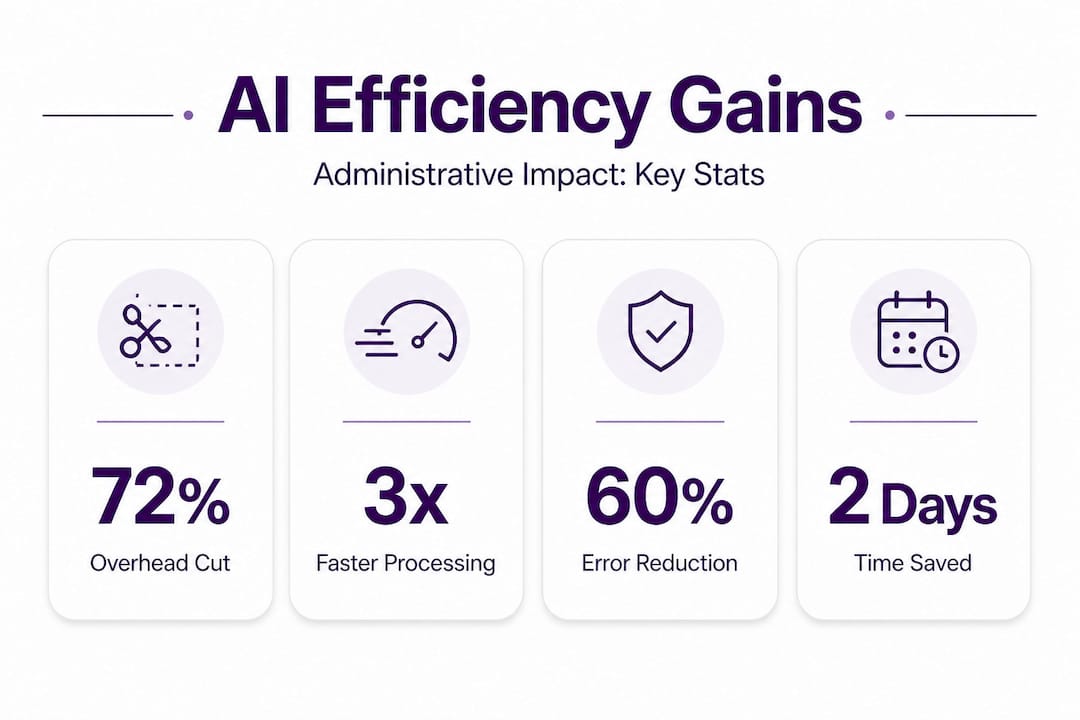
Beyond speed, error rates drop. When AI handles routine data entry and routing, you eliminate the fatigue-related mistakes that accumulate across a workday. Your staff gains time for higher-value work: client relationships, problem-solving, and strategic support. That bandwidth shift is often the most valuable outcome that does not show up in a single metric.
Pro Tip: Many leaders underestimate the governance and exception-handling challenges. Do not treat AI as a set-and-forget solution. Agentic systems require active monitoring, especially in the first few months of deployment. The systems that deliver sustained results are the ones with clear exception routing, human review protocols, and regular audits.
However, governance is non-negotiable. Goal drift, cascading failures, and prompt injection are real operational risks that require documented governance structures. These are not theoretical concerns. An AI system optimizing for speed without adequate oversight can route decisions incorrectly or amplify errors at scale before anyone notices. You can review how AI-driven operations are structured to account for these risks in practice.
Where AI for administrative efficiency works best and where it doesn’t
As you consider these powerful gains, it’s crucial to understand the boundaries: when AI works as promised, and when direct human involvement remains non-negotiable.

The most common implementation mistake is scope creep. Leaders see the efficiency gains in one area and expand AI into functions it is not suited for. The following table maps administrative task types to their AI readiness:
| Task type | Ambiguity level | AI readiness | Human oversight needed? |
|---|---|---|---|
| Data entry and record updates | Low | High | Minimal |
| Document classification | Low to medium | High | Spot-check only |
| Scheduling coordination | Medium | High | Exception handling |
| Invoice matching | Low | High | Exception handling |
| Client onboarding intake | Medium | Moderate | Required at decision points |
| Dispute resolution | High | Low | Yes, always |
| Contract review | High | Low | Yes, always |
| Regulatory compliance decisions | Very high | Not suitable | Full human control |
AI is not suitable for high-ambiguity front-end tasks without human supervision. This is an important design principle, not just a best practice.
The five scenarios where agentic AI delivers the highest value:
- Structured intake and routing. When incoming requests follow a predictable pattern, whether from clients, vendors, or internal staff, AI can classify, verify, and route them without human involvement for the majority of cases.
- Multi-party scheduling. Coordinating calendars across teams, time zones, and external contacts is time-consuming and error-prone when done manually. AI handles this faster and with fewer conflicts.
- Document processing and version tracking. AI can extract key data, flag missing fields, track document versions, and trigger review workflows automatically.
- Recurring billing and invoice management. Matching invoices to purchase orders, flagging discrepancies, and routing approvals is a high-volume task well-suited to autonomous AI management.
- Compliance deadline monitoring. Tracking renewal dates, submission windows, and regulatory deadlines across multiple requirements is where AI’s consistency outperforms any manual process.
For context on how context-aware automation handles these scenarios in office settings, the key is that the AI needs structured data to work from. When data is clean and processes are defined, AI performs reliably. The challenges begin when processes are poorly documented or exceptions are numerous and unpredictable.
Exception handling is not a secondary concern. It is central to the design. If your AI routes 80% of cases automatically but the remaining 20% pile up in an unmanaged queue, you have not gained efficiency. You have shifted the problem. Build exception routing into your design from the start, and staff accordingly. You can also reference resources on improving business workflows to understand how exception logic integrates with broader process design.
Getting started: Practical steps for implementing agentic AI in your business
Understanding which tasks are ripe for intelligent automation sets the stage for your next move: building a practical, risk-aware plan for implementation.
Here is a step-by-step process for launching agentic AI in your administrative operations:
- Define clear goals before selecting any technology. Identify one or two administrative bottlenecks where speed, accuracy, or consistency is measurably poor. Document what “better” looks like in specific terms: processing time, error rate, or hours saved per week.
- Map your current workflows in detail. Before automating anything, you need to know exactly how the work moves today. Document each step, who performs it, what data it uses, and where exceptions occur. AI cannot improve a process that is not understood.
- Identify the data sources and systems the AI will need to access. Agentic AI works across platforms. Confirm that your CRM, ERP, document storage, and scheduling tools can integrate with the AI layer you plan to deploy.
- Start with a contained pilot. Choose one workflow for the initial deployment. Run it in parallel with your existing process for four to eight weeks. Measure outcomes against your baseline. Do not scale before you have validated performance.
- Involve your staff early. People who perform the work today know where the real exceptions live. Their input improves design and reduces resistance. Frame AI as a tool that removes the low-value work from their day, not a replacement for their judgment.
- Build governance into the design, not as an afterthought. Define who reviews exceptions, how often AI outputs are audited, and what triggers a human review. Goal drift and cascading failures are governed by structure, not by assuming the system will stay aligned on its own.
- Establish a regular review cadence. Monthly reviews of exception logs, error rates, and throughput metrics help you catch problems early and make informed adjustments.
You can follow a detailed framework in our guide on AI automation success steps and review the full admin task automation process for implementation specifics.
Pro Tip: Regularly review exceptions and outlier cases from your AI system. Patterns in exceptions often reveal process design gaps or early signs of goal drift. Catching these early keeps your efficiency gains intact and prevents small errors from scaling into larger operational problems.
AI for administrative efficiency: What most business leaders get wrong
Most guides on AI and administrative efficiency focus on what to implement. Fewer focus on what to expect when it is running. That gap leads to disappointment, or worse, to operational disruption that erodes trust in AI solutions entirely.
The assumption that agentic AI will reduce headcount is almost always wrong in practice, and that is actually good news. What it does instead is redistribute work. Staff who spent 60% of their day on data entry, scheduling, and status updates now spend that time on judgment calls, relationship management, and problem-solving. That shift requires retraining, role clarification, and active management. Leaders who plan for it see better outcomes. Leaders who expect AI to simply reduce their staff requirements often end up with a misaligned workforce and a system running without adequate supervision.
The second mistake is deploying AI as a blunt instrument. Organizations pick a platform, connect it to their existing systems, and assume the efficiency gains will follow. They often don’t. Efficiency from AI in business process management comes from thoughtful design: clear scope, defined exception handling, and active governance. Without that structure, AI can automate poor processes faster, which amplifies the damage rather than correcting it.
The harder truth is that AI redistributes complexity rather than eliminating it. Routine complexity moves out of the hands of your administrative team. But exception complexity, edge cases, unusual circumstances, and system conflicts, increases in visibility. Your team will face fewer routine tasks and more situations that require real judgment. That is a meaningful shift in the skills your administrative staff need to develop.
The organizations that extract the most value from agentic AI are the ones that treat it as an ongoing collaboration. They review outputs, act on insights from exception logs, and continuously refine their processes. AI is not a one-time deployment. It is a system that needs to be managed, adjusted, and aligned with how your business evolves.
Take your admin efficiency to the next level with AI-guided solutions
After understanding what works and what can go wrong, the next step is seeing proven results and taking action.
Ailerons.ai designs and deploys agentic AI systems built for real administrative operations, from intake processing and document management to billing support and compliance tracking. Our implementations are built around your existing systems and workflows, with governance structures included from the start. If you are ready to move from theory to measurable results, review our AI efficiency case studies to see how businesses like yours have restructured their administrative operations and sustained those gains over time. Contact us to discuss a tailored implementation plan for your organization.
Frequently asked questions
What is the main advantage of agentic AI over traditional automation for admin tasks?
Agentic AI can make goal-driven decisions and adapt to workflow changes, unlike traditional automation that only handles routine repetitive tasks. As research confirms, it compresses intake complexity, shifting the burden to exceptions rather than routine processing.
Which administrative processes should not be fully automated with AI?
Processes involving high ambiguity, unique exceptions, or significant judgment should retain direct human supervision. High-ambiguity front-end tasks without human oversight are specifically identified as unsuitable for autonomous AI handling.
What operational risks should SMBs watch for when implementing agentic AI?
Key risks include goal drift, prompt injection, and cascading failures if governance measures are not in place. Without structured oversight, these systemic risks can scale quickly and undermine the efficiency gains you set out to achieve.
How can businesses ensure efficiency gains from AI last over time?
By monitoring for goal drift and reviewing exception cases regularly, businesses can prevent AI from degrading in performance. Sustained efficiency requires active governance, not passive monitoring, from the moment the system goes live.
Recommended
- How AI transforms operational efficiency for SMBs | Ailerons IT Consulting
- Master the Administrative Task Automation Process Today | Ailerons IT Consulting
- AI-driven operations guide: boost efficiency 72% in 2026 | Ailerons IT Consulting
- Step by Step Business Automation Guide for SMBs | Ailerons IT Consulting