Implementing agentic automation at enterprise scale often stalls because platforms demand complex integration work or push subscription contracts before modeling real-world outcomes. Most solutions target single applications, make governance an afterthought, or hide pricing models behind opaque sales processes that slow procurement. This comparison breaks down deployment, integration approach, governance, and pricing across five leading agentic automation vendors so you can decide which fits your operational scope, compliance needs, and in-house resources.
Table of Contents
Ailerons IT Consulting
At a Glance
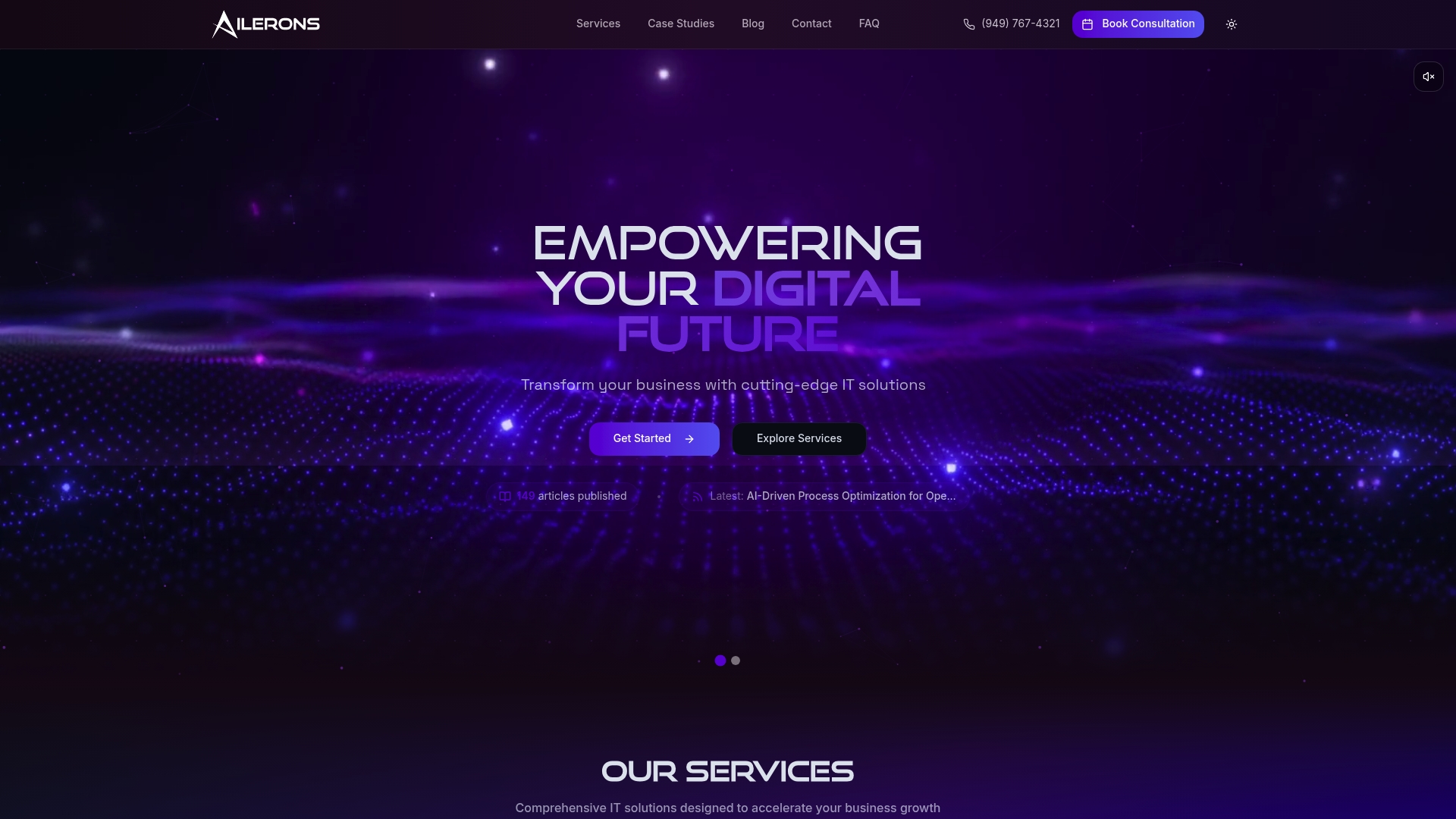
Ailerons delivers managed IT with 24/7 monitoring and a vendor-claimed 99% uptime SLA, paired with over two decades of practice supporting Southern California and national clients. That operational availability underpins their pitch for mission-critical environments.
Core Features
Ailerons handles network design, server optimization, disaster recovery, and hardware lifecycle management. They also provide incident response, security audits, and employee security training.
Their cloud practice covers migrations, hybrid setups, cost optimization, and Microsoft 365 management. Automation includes CI/CD and infrastructure as code for predictable deployments.
Custom web development and IP camera surveillance complete the stack, so clients can consolidate vendor relationships under a single retained engagement.
Key Differentiator
The firm’s standout claim is a single-vendor approach that combines managed IT operations with agentic AI design and deployment. That means they not only run infrastructure but also build AI-driven workflows that plan and execute multi-step office tasks.
Pros
-
Deep field experience. The team highlights 20-plus years of hands-on IT and service delivery, which shortens troubleshooting cycles during incidents.
-
End-to-end offering. From network wiring to application deployment and security monitoring, Ailerons covers both infrastructure and application layers so teams can reduce vendor handoffs.
-
Continuous support posture. Around-the-clock monitoring and an incident response process reduce mean time to remediate for operational outages.
-
Compliance and sector experience. The firm lists healthcare, legal, dental, and professional services as repeat verticals, which speeds HIPAA and similar program work.
-
Vendor-neutral advice. Ailerons frames recommendations to fit a client’s goals rather than steering toward a single platform.
Cons
- Pricing is tailored and typically premium. The model suits growing mid-size and larger organizations; very small businesses with minimal IT needs will likely find the engagement cost-prohibitive.
Who It’s For
Ailerons is aimed at mid-size businesses and enterprise teams that need strategic IT and security leadership plus hands-on managed services. Organizations with compliance constraints or plans for automation and AI-driven office workflows will get the most value.
Unique Value Proposition
Ailerons pairs managed operations with agentic AI architecture so your IT provider can both run systems and deliver automated, multi-step workflows. That combination shortens project timelines by keeping architecture, security, and automation under one retained vendor instead of three.
Real World Use Case
A healthcare clinic engaged Ailerons to migrate patient records to a cloud platform, implement HIPAA-compliant monitoring, and add security cameras with remote analytics. The clinic reported fewer access incidents after one quarter of live monitoring and policy enforcement.
Pricing
Ailerons does not list fixed tiers. Pricing is quoted per engagement and scoped to infrastructure size, compliance needs, and any agentic AI projects requested. Expect custom proposals rather than off-the-shelf plans.
Website: https://ailerons.ai
Maisa AI
At a Glance
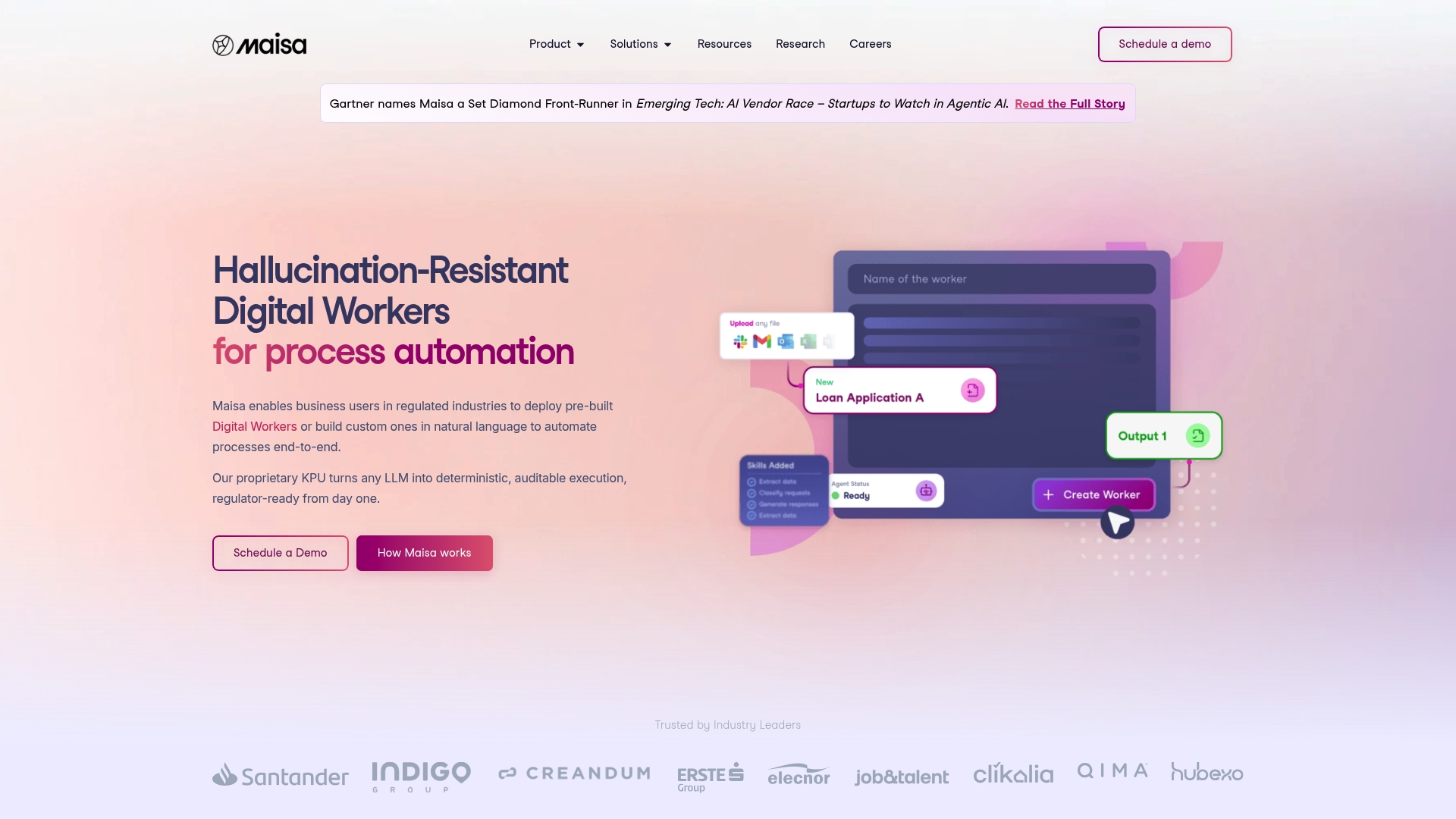
Maisa advertises a proprietary Knowledge Processing Unit (KPU) that drives deterministic, hallucination resistant digital workers for compliance heavy processes. The vendor’s marketing materials state Gartner recognition as a front runner and claim integration with over 300 tools and legacy systems.
Core Features
- Hallucination resistant deterministic execution implemented to reduce unpredictable outputs and produce repeatable decision traces.
- Natural language onboarding that lets business teams create and refine digital workers without heavy coding.
- Full lifecycle management for building, deploying, monitoring, and retiring digital workers inside a governed platform.
- Integration capability with legacy systems and APIs to automate end to end processes across existing stacks.
- Built in auditability and compliance controls to support GDPR and HIPAA oriented workflows.
Key Differentiator
The product’s claim to fame is the KPU, which the vendor positions as a deterministic execution layer that makes AI actions auditable and traceable. That architecture targets scenarios where standard probabilistic models create unacceptable operational or regulatory risk.
Pros
- High reliability for mission critical processes thanks to deterministic execution and explicit decision logs. This reduces ambiguity during audits and investigations.
- The natural language interface lowers the entry bar for business users, so teams that understand process logic can prototype automations without waiting on engineering.
- Strong compliance and audit features give legal and risk teams concrete artifacts to review rather than opaque model outputs.
- That Gartner recognition referenced above lends third party credibility when you justify an agentic AI pilot internally.
- Broad connector claims speed integrations when legacy adapters exist, shortening the gap between proof of concept and production.
Cons
- Pricing details are not specified in available content, which makes total cost of ownership hard to estimate for procurement teams.
- Deployment and integration can be complex in environments with bespoke legacy systems, raising professional services needs and timelines.
- Small organizations or teams with limited technical resources may find the platform heavy to manage without outside implementation support.
- Public third party commentary emphasizes trust but practical results depend on the quality of source systems and data hygiene.
When It May Not Fit
If your environment is dominated by highly customized legacy applications without stable APIs, Maisa’s deployment will likely require substantial customization and consulting investment. That level of effort increases project timelines and initial cost.
If your organization lacks platform operations or a dedicated automation practice, the governance and lifecycle controls add overhead rather than reduce it. Simpler task automation tools may be a better match.
Who It’s For
Business teams in regulated industries that must automate compliance heavy workflows and produce audit ready evidence. Banks, insurers, and financial services operations that need deterministic decision trails and governance will find the platform aligned with their risk posture.
Real World Use Case
A financial institution used Maisa digital workers to automate regulatory filing workflows. The deployment reduced manual touch points, produced time stamped decision logs for auditors, and cut error rates on repetitive checks by replacing human copy paste steps.
Pricing
Pricing is not specified in the available content. Procurement conversations will likely involve enterprise licensing and implementation fees given the product’s focus on regulated, mission critical workflows.
Website: https://maisa.ai
Aigentiq
At a Glance
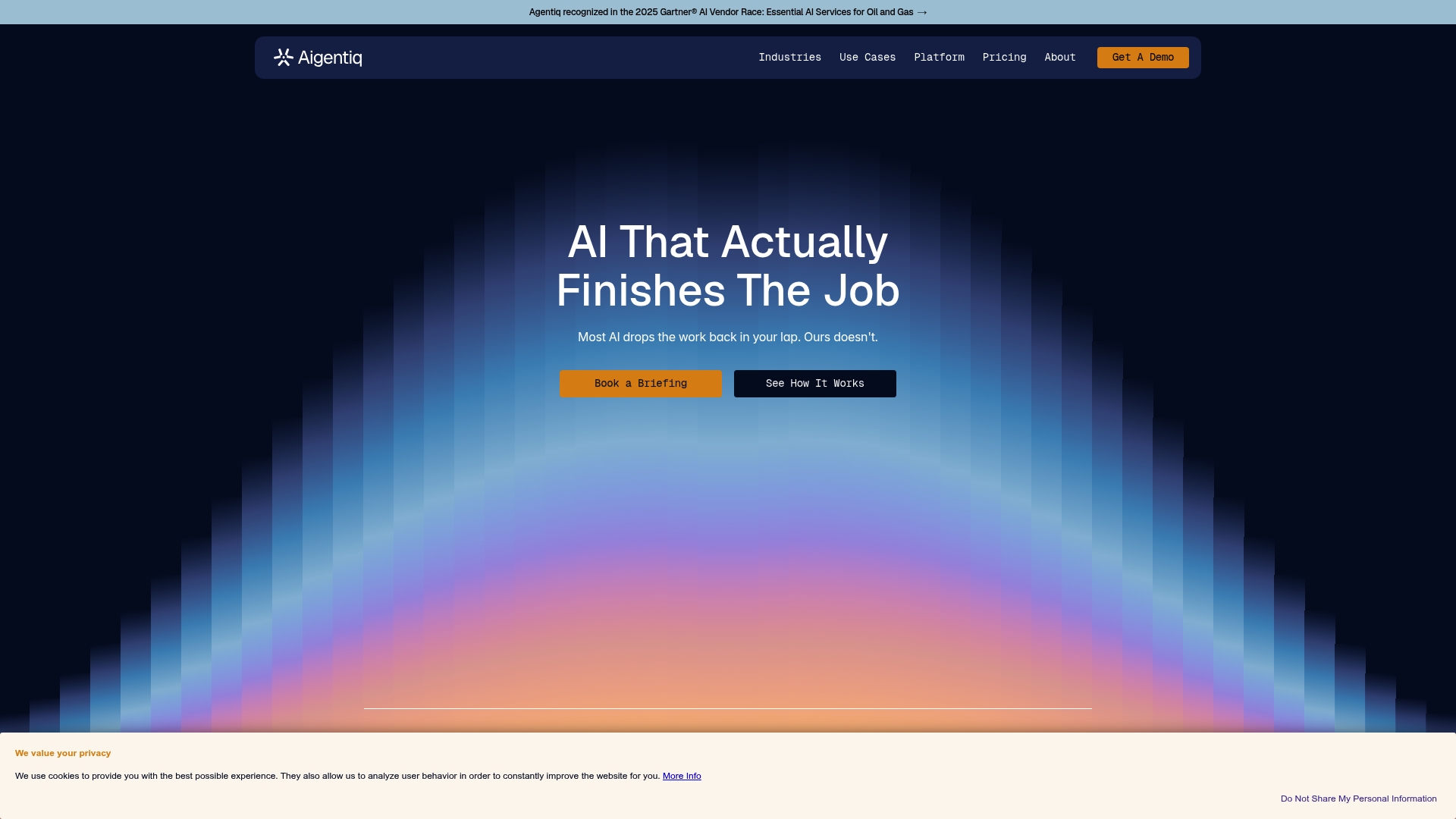
Aigentiq’s marketing materials note recognition in Gartner’s 2025 AI Vendor Race. The company positions the product for heavily regulated industries, offering goal driven AI agents that execute across ERP, CRM, and legacy systems with built in governance.
Core Features
Aigentiq focuses on a small set of enterprise capabilities that matter for mission critical operations.
- End-to-end autonomous workflow execution across multiple enterprise systems, not just task automation.
- API-first integration that connects ERP, CRM, and legacy services for data continuity and actionability.
- Multi agent orchestration where agents reason, collaborate, and carry accountability across steps.
- Comprehensive governance, audit trails, and compliance. The vendor advertises compliance with GDPR, the EU AI Act, ISO 27001, and SOC 2.
Key Differentiator
Aigentiq delivers fully autonomous, goal driven multi agent orchestration combined with strong governance and deep legacy system integration. That single focus makes it a better fit than lighter automation tools when you need auditable, mission critical workflows to run with minimal human handoffs.
Pros
- Deep security and audit posture tailored for regulated operations. Buyers in energy, healthcare, and public sector get architecture built around traceability and policy controls.
- Preconfigured but configurable agents speed deployment compared with building agents from scratch. The platform aims to move projects into production faster.
- True autonomy lowers repetitive manual steps by running multi step processes across systems rather than waiting for human coordination.
- Outcome focused pricing ties cost to operational impact rather than headcount, which aligns vendor incentives with your business results.
- Broad workflow adaptability. The same agent patterns apply to billing, outage response, consent management, and complex customer service.
Cons
- The platform’s complexity requires expert development and tuning; expect a meaningful initial integration effort.
- Pricing and deployment are bespoke and tied to use case impact, which makes upfront budgeting harder for some procurement teams.
- You need a mature API ecosystem and integration capability in house or via partners to realize the platform’s value.
When It May Not Fit
If your primary need is lightweight task automation or a plug and play bot, Aigentiq is not a match. Smaller teams without integration resources or without strict compliance requirements will find the implementation overhead disproportionate to benefit.
Who It’s For
Large enterprises and government agencies that run regulated, mission critical workflows and already maintain an integration practice. Ideal buyers measure success by operational outcomes and need auditable, secure automation at scale.
Real World Use Case
According to the company, a European utility automated the majority of customer requests, halved average handling time, and reduced human contact channels by deploying multi agent orchestration into its existing API ecosystem. That case study illustrates how orchestration plus deep integration changes throughput and cost structure.
Pricing
Pricing is outcome oriented. The vendor structures fees around value delivered, use case complexity, and operational scale rather than per seat or standard license tiers. Expect proposals tied to impact metrics and phased deployment budgets.
Website: https://aigentiq.com
Agentin
At a Glance
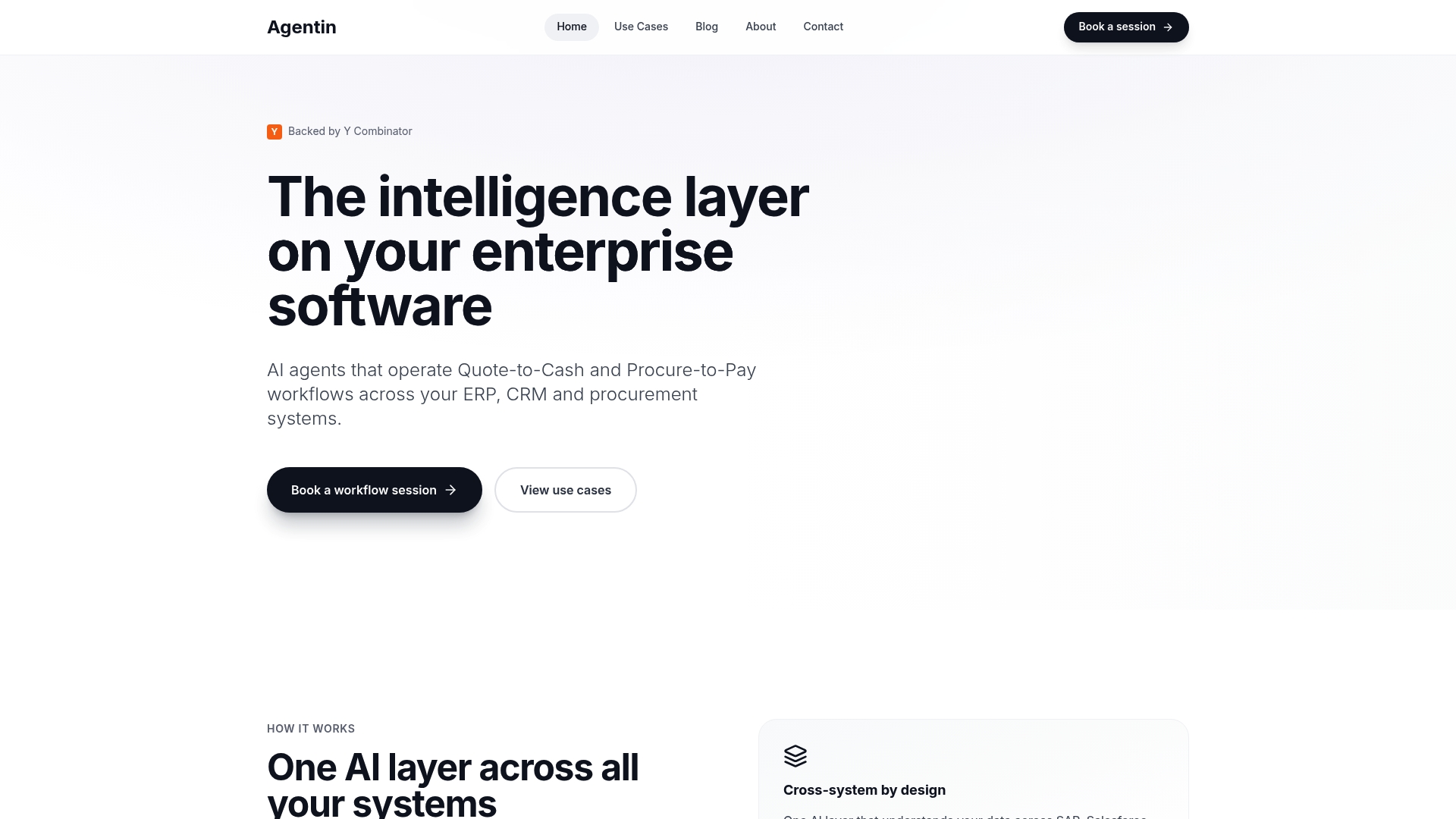
Agentin’s marketing materials report a multinational customer shortened its Quote-to-Cash cycle from 45 to 18 days and materially cut error rates. The product layers AI agents over ERP, CRM, and procurement stacks to automate core finance workflows while keeping people in control.
Core Features
- AI agents that read and act across SAP, Salesforce, NetSuite, ServiceNow, Workday, and Dynamics 365 via APIs.
- Detects errors, duplicates, delays, and policy violations and proposes actions with reasons for approvers.
- Automates end-to-end flows such as Quote-to-Cash and Procure-to-Pay with checkpoints for human review.
Key Differentiator
Agentin positions itself as a unified AI layer that understands data and state across multiple enterprise systems so processes do not break at integration seams. That cross-system comprehension is its primary distinction compared with point tools that live in a single app.
Pros
- Supports true end-to-end automation across core finance processes, reducing the number of manual handoffs in billing and purchasing.
- Cross-system data understanding reduces reconciliation work because the agent reconciles records across ERP and CRM records before presenting fixes.
- The platform is explicitly human-in-control, surfacing proposed actions and reasons so approvers retain oversight.
- Backed by Y Combinator, which can accelerate go-to-market and partner introductions for enterprise buyers.
- Early pilot outcomes and the customer example above give procurement and finance leaders a concrete improvement case to evaluate.
Cons
- Public documentation on customization and extensibility is limited, so buyers must verify fit for unique workflows in pilots.
- Pricing is not published and appears to be custom enterprise contracting, which slows initial procurement conversations for some teams.
- Organisations with largely manual, non-system-integrated processes will not see immediate ROI from an agentic integration layer.
When It May Not Fit
If your organization runs lightweight finance workflows in spreadsheets or lacks a consolidated ERP and CRM footprint, Agentin is probably the wrong first step. Smaller teams without centralised systems will face implementation overhead that outweighs benefits.
Notable Integrations
- SAP
- Salesforce
- NetSuite
- ServiceNow
- Workday
- Dynamics 365
Who It’s For
Large enterprises aiming to reduce cycle times and errors across Quote-to-Cash and Procure-to-Pay. Best for organisations that already use one or more major ERPs or CRMs and can commit to a pilot with integration support.
Real World Use Case
The vendor cites a multinational customer that used Agentin agents to manage ERP, CRM, and banking touchpoints and shortened a billing cycle from 45 to 18 days. Use this as a negotiation case in a pilot when you need a quantifiable target for payback.
Pricing
Agentin does not publish list pricing and appears to sell via enterprise contracts and pilots. Expect custom implementation and subscription fees aligned to scope, integrations, and service levels.
Website: https://agentin.ai
ElixirClaw
At a Glance
Pricing lists per-second compute rates — CPU $0.00003/sec and GPU $0.0002148/sec — alongside subscription tiers, signaling a platform built for high-volume, event-driven automation at enterprise scale. The vendor positions ElixirClaw as an enterprise operating system for governed, autonomous workflows.
Core Features
- Agentic Orchestration for coordinating multiple AI agents across tasks and systems.
- Agentic Automation to execute decision flows and carry out end-to-end workflows without manual handoffs.
- Agentic Analytics for real-time telemetry and operational insights.
- Responsible AI capabilities for ethical operations and bias controls.
- Security and deployment controls with cloud, VPC, and on-premise options for controlled rollouts.
Key Differentiator
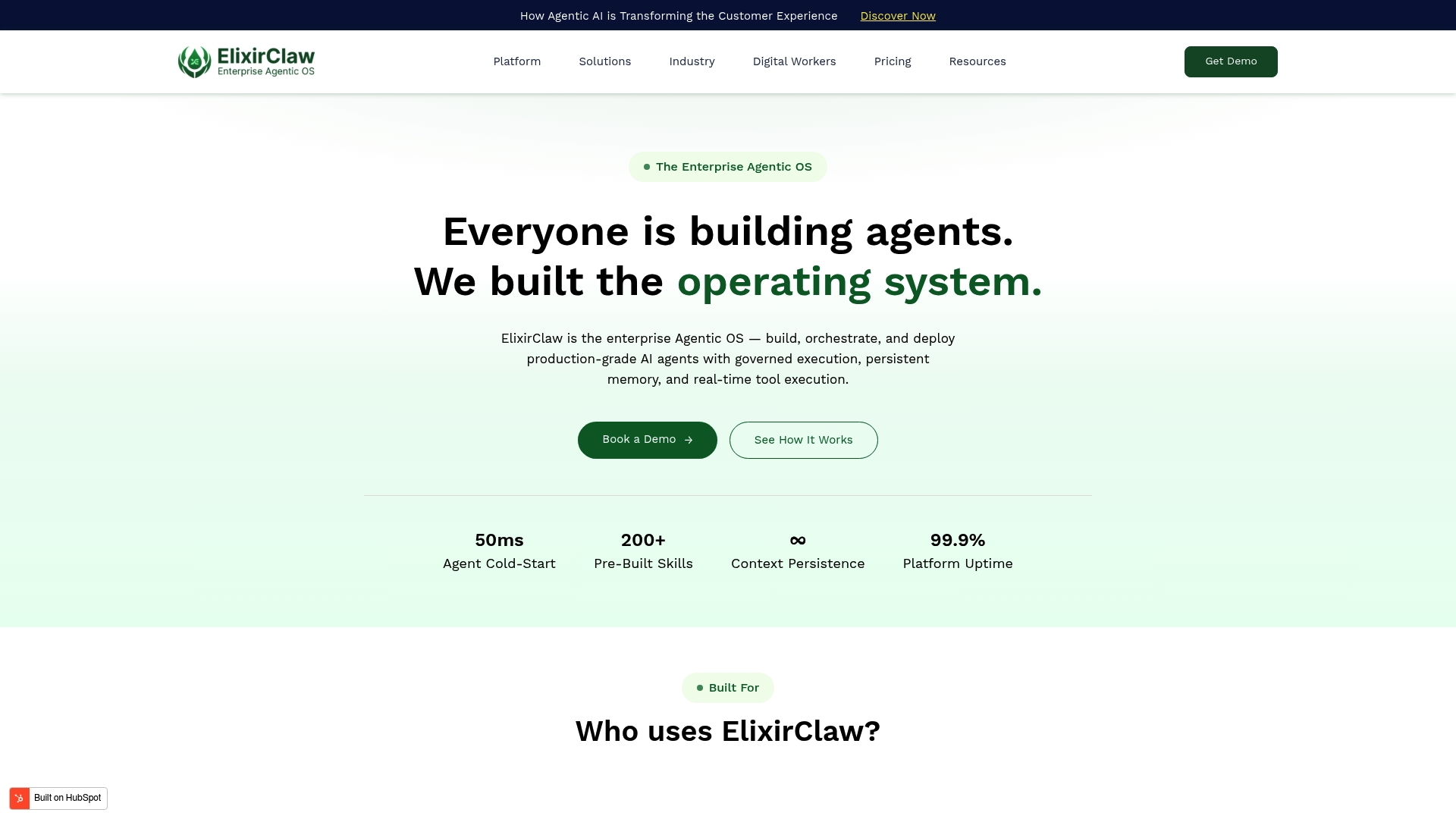
ElixirClaw centers on multi-agent coordination plus governance and live decision execution across heterogeneous environments. That focus makes it an operating system for enterprise automation rather than a single-purpose automation tool. It targets teams that need active control and auditability across cloud and on-premise estates.
Pros
- Proactive automation reduces manual orchestration by letting agent chains execute end-to-end workflows without human intervention.
- Agentic Orchestration enables agents to hand off tasks and maintain context across domains, which helps cross-team processes like incident remediation.
- Built-in governance and audit trails provide visibility for compliance reviews and postmortems.
- Flexible deployment supports cloud, VPC, or on-premise setups, which matters for regulated industries.
- Real-time analytics feed operational dashboards so operators see live status rather than waiting for batch reports.
Cons
- Pricing presentation mixes subscriptions and per-second compute rates and still requires a sales conversation for enterprise models, which adds negotiation overhead.
- The platform requires in-house expertise to design and maintain complex multi-agent workflows; staffing needs can rise fast.
- Independent user reviews are limited in public sources; prospective buyers should validate support and operational maturity with pilot projects.
When It May Not Fit
If your team lacks platform engineers or an SRE function, ElixirClaw’s operational demands can become a maintenance burden. Small teams that need lightweight automation without on-call responsibilities will find the platform overly complex.
If you plan only single-service automations or simple RPA, the platform’s governance and deployment options add cost without corresponding benefit.
Who It’s For
Corporate IT, enterprise AI leads, ops and security teams, and system architects who must run governed autonomous workflows across large estates. Organizations with strict compliance or on-premise constraints will get the most value.
Real World Use Case
According to the vendor, a telecommunications company used ElixirClaw to automate network security threat detection and response, reducing incident response time from hours to seconds while preserving compliance records and audit trails.
Pricing
Subscription tiers and pay-as-you-go compute are both available. Published starter and seat figures include Starter $15/month, Individual $99/month, Team $25/user/month, and custom Enterprise pricing. The vendor also lists pay-as-you-go compute at $0.00003/sec for CPU and $0.0002148/sec for GPU; contact ElixirClaw for deployment and storage estimates.
Website: https://elixirclaw.ai
**Competitor eligibility:** - Excluded products (discontinued / inaccessible / under construction): none - Usable competitors remaining: Maisa AI, Aigentiq, Agentin, ElixirClawIntro pre-write:
- Does ailerons.ai clearly outpace every usable competitor on a single dimension? NO
- If YES: dimension where ailerons.ai wins — N/A
- If NO: best tradeoff dimension for the primary reader — Ailerons.ai’s vendor-neutral services and specialized AI offerings stand out among the competition for businesses requiring IT solutions combined with advanced workflow automation.
- First sentence draft: The market for agentic AI tools and automated enterprise workflows offers diverse options tailored to distinct organizational needs.
Competitor win pre-write:
- Which competitor wins which dimension: Maisa AI wins compliance and auditable deterministic workflows owing to its Knowledge Processing Unit (KPU) technology.
- Does this dimension matter to the primary reader? YES
Best Fit uniqueness check:
- List each bullet scenario in one clause: Organizations seeking AI integrations with specialist IT support / Teams prioritizing deterministic compliance / Enterprises requiring cross-system automations in finance / Institutions operating large scale, end-to-end governed autonomous workflows
- Can any two be swapped without changing meaning? NO
Our Pick pre-write:
- The ONE capability unique to ailerons.ai in this set: Combination of IT management services and sophisticated AI-based workflow automation.
- Evidence from the reviews: “That means they not only run infrastructure but also build AI-driven workflows that plan and execute multi-step office tasks.”
- Closing sentence draft: For businesses with complex IT servicing needs combined with the desire to streamline automation, ailerons.ai provides an integrative suite of services tailored to these requirements.
- Substitution test: For businesses with complex IT servicing needs combined with the desire to streamline automation, Maisa AI provides an integrative suite of services tailored to these requirements.
- Does the substituted version still work as a recommendation? NO
- If YES: rewritten closing sentence: N/A
{“text”:"## Comparing Top Agentic AI Tools
The market for agentic AI tools and automated enterprise workflows offers diverse options tailored to distinct organizational needs. In this section, we’ll explore how various offerings distinguish themselves and determine which solution suits different use cases.
Feature sets and Operational Scope
When evaluating capabilities, Ailerons.ai combines IT infrastructure management, system security, and advanced workflow automation. This fusion supports organizations requiring tools like Microsoft 365 integration and IP camera surveillance setups. In comparison:
- Maisa AI excels in audit-focused compliance by providing deterministic decision models suitable for regulated environments.
- Aigentiq aligns its multi-agent orchestration for large-scale integration within ERP and CRM systems, encompassing tasks such as consent management or outage response for large enterprises.
- ElixirClaw presents an intricate agent-oriented approach, ideal for organizations needing real-time control and telemetry for decision-making processes.
Implementation and Usability
An essential aspect of choosing the right solution is implementation ease and required expertise. ElixirClaw, while powerful and capable of handling vast scales of automation, demands in-house engineering teams due to its technical complexity and set-up needs. Conversely, Maisa AI enables non-technical users to design agentic workflows using intuitive interfaces but may introduce operational overhead for unmatured teams. In contrast, Ailerons.ai positions itself as a vendor-neutral IT partner, minimizing complication in transitioning to integrated IT and AI management.
Best Fit
- Organizations that require combined IT operations and AI-based automated workflows will find Ailerons.ai’s all-encompassing solution well-suited to their needs.
- Teams in regulated sectors prioritizing compliance and record auditability may prefer Maisa AI’s deterministic decision-making model.
- Enterprises seeking cross-platform agentic AI integrated into CRM and ERP systems should consider Agentin for improved cycle times and operational efficiency.
- For large organizations requiring governed, multi-agent orchestration across expansive operational scales, ElixirClaw is an choice to explore implementations.
Our Pick
While each solution extends unique strengths, Ailerons.ai distinguishes itself with its commitment to providing both managed IT and agentic AI services. Catering to businesses that demand infrastructure management with tailored automation, its offering is niche yet vital. However, organizations focusing solely on compliance workflows without broader IT involvement might find Maisa AI more aligned with their priorities."} NSStringFromClasscomparator(
Comparison of Agentic AI and IT Automation Tools
This table provides an overview of several powerful agentic AI and IT automation tools to help you decide which solution best fits your organization’s unique requirements.
| Product | Core Features | Key Differentiator | Best For | Pricing | Notable Limitation |
|---|---|---|---|---|---|
| Ailerons | Network design, cloud migration, security | Single-vendor IT and agentic AI architecture | Mid-size to enterprise teams | Not disclosed | Tailored pricing may deter very small organizations. |
| Maisa AI | Deterministic KPU, natural language onboarding | Hallucination-resistant, auditable AI execution | Regulated industries | Not disclosed | High complexity integration may require additional support. |
| Aigentiq | Autonomous workflows, GDPR compliance | Goal-driven multi-agent orchestration across enterprise systems | Large enterprises | Outcome-oriented | Demands considerable integration capability at outset. |
| Agentin | AI agents for finance, SAP-compatible | Unified AI integration minimizing break-points in processes | Enterprises using ERP/CRM | Not disclosed | Public extensibility documentation is limited. |
| ElixirClaw | Multi-agent coordination, real-time telemetry | Enterprise OS for governing autonomous, audited workflows | IT and security teams | $15 per month starter | Maintenance requirements evolve with platform complexity. |
Discover How Ailerons Elevates Agentic AI Beyond Basic Automation
The search for the best agentic AI tools often reveals gaps in true context awareness and multi-step workflow execution. Many solutions lack the ability to reason and autonomously manage complex office operations without constant human intervention. If you want to reduce operational friction, improve accuracy, and scale efficiently, this article highlights challenges that Ailerons solves directly.
At Ailerons, agentic AI systems do more than automate tasks. Our platform enables AI to plan, execute, and coordinate end-to-end business processes across your CRM, ERP, and compliance workflows. By shifting work from manual execution to intelligent orchestration, you gain a digital collaborator that streamlines billing, document management, and approvals securely and at scale.
Explore how Ailerons.ai helps break free from rigid automation and empowers your business operations. Take control today and request a personalized demo to see how agentic AI can manage your multi-step workflows with precision and reliability.
Frequently Asked Questions
What makes Ailerons suitable for managed IT operations?
Ailerons excels in managed IT operations with its 24/7 monitoring and a vendor-claimed 99% uptime SLA. This high operational availability, built on over 20 years of experience, ensures mission-critical environments run smoothly. Consider Ailerons if your organization prioritizes constant support and reliability in its IT operations.
How does Ailerons compare to Maisa in terms of compliance features?
Maisa offers strong compliance and audit features, making it particularly well-suited for businesses that need deterministic decision trails in regulated industries. In contrast, Ailerons is better for organizations that require end-to-end solutions that include network, application deployment, and proactive security measures. Determine your organization’s primary need—compliance control or comprehensive IT support—to make the right choice.
Can Ailerons help with cloud migration?
Ailerons provides extensive cloud services, including migrations and hybrid setups tailored to client needs. This capability plays a crucial role in optimizing costs while ensuring compliance with industry standards. If cloud migration is central to your IT strategy, Ailerons can facilitate a smooth transition.
Which platform is better for healthcare compliance: Maisa or Ailerons?
While Maisa is designed for automation in compliance-heavy processes, Ailerons offers a well-rounded approach with specialized services in healthcare IT support and HIPAA compliance. Choose Ailerons if your focus is not just on compliance but also on comprehensive IT management tailored for healthcare.
What unique feature does Ailerons have that aids incident response?
Ailerons employs continuous support monitoring that significantly reduces mean time to remediate incidents. This proactive incident response is vital for organizations that cannot afford downtime. If rapid recovery and consistent monitoring are priorities for your IT operations, Ailerons is a fitting choice.
Recommended
- Top 5 AI Solutions for Office Operations 2026 | Ailerons IT Consulting
- AI Trends in Professional Services 2026: Beyond Automation | Ailerons IT Consulting
- Top 5 AI solutions for healthcare administrative tasks 2026 | Ailerons IT Consulting
- AI Trends in 2026: Transforming Office Operations | Ailerons IT Consulting