

TL;DR:
- Autonomous workflow automation enables AI to manage entire processes with minimal human involvement.
- Proper deployment requires bounded autonomy, guardrails, escalation paths, and human-in-the-loop safeguards.
- Well-structured autonomous systems can reduce process time by 40-60% and deliver high ROI.
Most companies believe they’ve solved efficiency once they’ve deployed a rules-based automation tool. They haven’t. True autonomous workflow automation goes beyond scripted task execution by enabling AI to adapt, reason, and manage entire processes from start to finish with minimal human involvement. This guide breaks down exactly how it works, where it differs from traditional robotic process automation (RPA), what safeguards responsible deployment requires, and what measurable business value you can realistically expect. If you’re evaluating whether agentic AI is the right next step for your operations, this is the clearest path to that answer.
Table of Contents
- What is autonomous workflow automation?
- How autonomous workflow automation works: The autonomy loop
- Methodologies for safe and effective autonomy
- Benefits, business cases, and success benchmarks
- Why responsible autonomy is the competitive edge—if you set boundaries
- Explore the next step: Expert guidance and real-world results
- Frequently asked questions
Key Takeaways
| Point | Details |
|---|---|
| AI-driven autonomy | Autonomous workflow automation enables end-to-end business process execution with adaptive agentic AI. |
| OODA loop foundation | Operation relies on a continuous Observe, Orient, Decide, and Act cycle to optimize and learn. |
| Guardrails are crucial | Bounded autonomy and escalation paths are essential to minimize errors and unintended consequences. |
| Real ROI impact | Enterprises report up to 3-5x ROI and major labor reduction in the first year after adoption. |
What is autonomous workflow automation?
Autonomous workflow automation is a system in which AI agents independently manage business processes end to end, making contextual decisions, handling exceptions, and adjusting to new inputs without constant human direction. The term “autonomous agent” refers to a software component that perceives its environment, sets goals, and takes sequential actions to achieve them. This is distinct from a simple bot following a predefined script.
Traditional RPA is powerful for repetitive, structured tasks. It follows rigid rules and breaks when conditions change. Autonomous workflow automation, by contrast, uses agentic process automation to execute business processes end to end, adapting and making decisions without continuous human intervention. That distinction matters enormously for mid-sized businesses where process variability is constant.
Here’s a direct comparison:
| Feature | Traditional RPA | Autonomous workflow automation |
|---|---|---|
| Decision logic | Rule-based | AI-driven, contextual |
| Exception handling | Fails or escalates | Resolves or routes intelligently |
| Adaptability | Low | High |
| Human oversight needed | Frequent | Minimal for defined scope |
| Integration depth | Single system | Multi-system orchestration |
For operations managers at mid-sized companies, the practical difference is significant. RPA reduces labor on a specific task. Agentic AI can own an entire workflow, from receiving an invoice to routing it for approval, flagging discrepancies, and updating your ERP, all without a human touching it unless there’s a genuine exception.
Key business advantages include:
- Reduced administrative burden across billing, scheduling, and document processing
- Consistent process execution with no variation caused by staff turnover or workload
- Faster exception resolution through built-in escalation logic
- Scalability without proportional increases in headcount
If you’re exploring improving business workflows with AI, the shift from task-level automation to full process management is the core distinction worth understanding before any vendor conversation.
How autonomous workflow automation works: The autonomy loop
Understanding the mechanics helps you evaluate solutions more clearly. Autonomous systems operate on a continuous cycle. The AI autonomy loop involves four core phases: Observe, Orient and Plan, Decide, and Act, with ongoing feedback loops that enable learning and error correction over time.
Here’s how a typical agentic process runs:
- Observe: The agent receives input, such as an email, a document, a system event, or a trigger from another platform.
- Orient and plan: It interprets the context using a large language model (LLM) and determines what goal needs to be achieved.
- Decide: It selects the appropriate action path from its available tools, including API calls, form completions, or routing logic.
- Act: It executes the action across connected systems, whether that’s updating a CRM record, generating a report, or sending an approval request.
- Reflect and adapt: The agent evaluates the outcome, identifies gaps, and refines its approach for future iterations.
The technologies that power this loop include LLMs for reasoning, machine learning for pattern recognition, and RPA for executing structured actions within legacy systems. These are not competing tools. They work together.
| Component | Function |
|---|---|
| LLM (e.g., GPT-4) | Reasoning, language understanding, planning |
| Machine learning | Pattern detection, anomaly flagging |
| RPA layer | System interaction, data entry, task execution |
| Orchestration layer | Coordinates agents, manages handoffs |
The agentic AI impact on real operations becomes clear when you see how feedback mechanisms reduce error rates over time. An agent that misroutes a document in week one learns from that correction. By week four, it routes accurately at a much higher rate. This is fundamentally different from RPA, which requires manual reconfiguration when something changes.

Pro Tip: Prioritize platforms with transparent feedback logs. If your system can’t show you why it made a specific decision, you can’t improve it or audit it when something goes wrong. Visibility into AI in business process management is not a luxury—it’s a control requirement.
Methodologies for safe and effective autonomy
Autonomy without structure creates risk. Before expanding any autonomous system across critical workflows, responsible deployment requires a clear methodology. The most effective frameworks center on bounded autonomy, structured escalation, and human-in-the-loop (HITL) configurations.
Bounded autonomy means defining clear operational limits for what an agent can and cannot do without human approval. For example, an agent might handle all invoice processing below $10,000 autonomously, but flag anything above that threshold for human review.
Guardrails are rule sets and constraint layers that prevent agents from taking actions outside their defined scope. They act as operational fencing, keeping AI behavior predictable and auditable.
Escalation paths are predefined routes for handling exceptions. When an agent encounters a situation it cannot confidently resolve, it should route to a human with full context, not fail silently.
HITL (human-in-the-loop) configurations insert a human checkpoint at specific decision points. These are essential for agentic AI in compliance workflows, where regulatory exposure makes unsupervised decisions unacceptable.
Best practices recommend bounded autonomy and escalation paths for high-impact events, with HITL reserved for sensitive decisions and hybrid RPA and agent combinations for structured legacy environments.
Risks of skipping these controls include:
- AI hallucinations producing incorrect outputs that propagate undetected through connected systems
- Process loops where agents repeatedly attempt and fail an action without escalating
- Compliance gaps where autonomous decisions violate regulatory requirements without any audit trail
Pro Tip: Start with your most structured, low-risk workflows before expanding autonomy. A well-mapped accounts payable process is a better starting point than a complex client onboarding flow. Success in constrained environments builds the evidence base for broader deployment. Review AI-driven office automation strategies to identify where your organization’s readiness is strongest.
Benefits, business cases, and success benchmarks
The numbers behind autonomous workflow automation are compelling. Organizations that deploy thoughtfully report significant operational gains: a 40 to 60% reduction in process time, efficiency gains exceeding 50%, up to 80% fewer manual operations, and a 3 to 5 times return on investment in the first year.
These results are not universal. They depend on process maturity, integration depth, and the quality of implementation. But they represent a realistic ceiling for well-structured deployments, not an outlier.
High-value use cases where autonomous workflow automation delivers consistently:
- Invoice and billing processing: End-to-end handling from receipt to payment routing with exception flagging
- IT ticket resolution: Autonomous triage, classification, and resolution of common issues
- Compliance task management: Scheduled reviews, document verification, and audit trail generation
- Employee onboarding: System provisioning, document collection, and task assignment without manual coordination
- Customer inquiry routing: Contextual routing of requests to appropriate teams or automated resolution
For mid-sized companies, the administrative burden reduction alone justifies investment. Operations managers running lean teams see the highest impact when agents absorb the coordination and exception-handling work that consumes disproportionate staff time.
One important caveat: most companies overestimate how much of their operation can go fully autonomous on day one. The businesses achieving the strongest results treat autonomy as a spectrum. They automate fully where processes are clean and structured, and they use hybrid approaches where variability is high. Understanding the types of AI automation available helps leaders match the right tool to the right process rather than forcing full autonomy where it doesn’t fit.
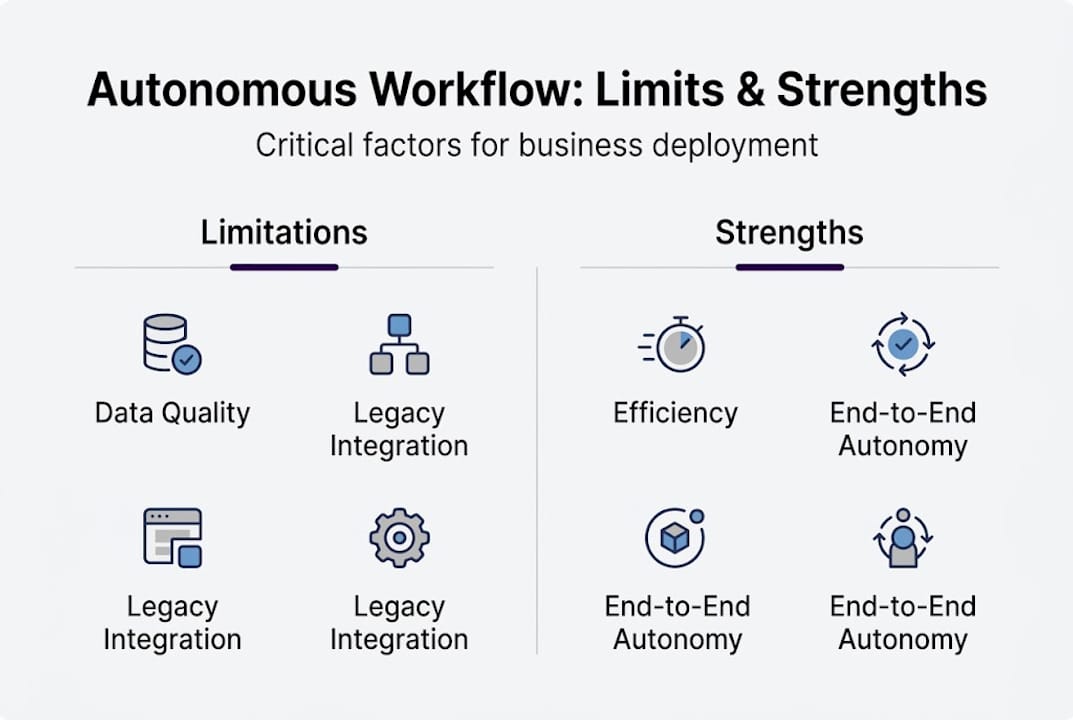
Limitations to account for include data quality dependencies, integration complexity with legacy systems, and the upfront investment in process mapping and configuration. These are solvable, but they are real costs that should be factored into ROI projections from the start.
Why responsible autonomy is the competitive edge—if you set boundaries
Conventional wisdom suggests that more autonomy automatically produces more efficiency. The evidence says otherwise. 40% of agentic projects fail due to missing structure, audits, and guardrails. That’s not a technology problem. It’s a deployment discipline problem.
The organizations winning with autonomous workflow automation are not necessarily the ones running the most autonomous systems. They’re the ones that built auditability, failover plans, and escalation logic before they scaled. They treated AI decision logic as something that requires clear operational boundaries from day one, not as a feature to add later.
Full autonomy is rare in successful enterprise deployments. Most mature implementations combine autonomous execution with HITL checkpoints for high-stakes decisions. The companies that learn this early avoid the painful and costly rollback that comes from deploying too fast. Leadership that prioritizes readiness over speed consistently achieves better outcomes. Autonomy is only a competitive advantage when it operates within a structure that makes it accountable.
Explore the next step: Expert guidance and real-world results
The concepts covered here, from autonomy loops to bounded deployment, reflect the same principles that drive real results in production environments. If you’re ready to move from evaluation to action, autonomous automation case studies show how organizations across industries have deployed agentic AI in billing, compliance, scheduling, and administrative operations with measurable outcomes.
Ailerons IT Consulting specializes in designing and deploying agentic AI systems that integrate with your existing CRM, ERP, and document platforms. Whether you’re mapping your first workflow or scaling an existing automation program, the team builds solutions aligned with your operational structure, not generic templates. Reach out to schedule a consultation and see what structured autonomy looks like in practice.
Frequently asked questions
How is autonomous workflow automation different from RPA?
Autonomous workflow automation adapts to new situations and manages entire processes independently, while RPA is rule-based and static, requiring frequent human intervention when exceptions arise.
What are potential risks of autonomous workflow automation?
Risks include hallucination cascades, infinite loops, and context limitations; structured controls and HITL safeguards are essential to prevent these failures from propagating through connected systems.
What return on investment can companies expect?
Benchmarks show 3 to 5 times ROI in the first year and up to 80% reduction in manual operations when autonomous workflow automation is deployed within a structured, well-governed framework.
Should every process be made fully autonomous?
Not all processes benefit from full autonomy—hybrid autonomy is safer for variable or high-risk tasks where context shifts frequently and human judgment adds critical value.
Recommended
- Step-by-step workflow automation guide for business leaders | Ailerons IT Consulting
- Improving Business Workflows with AI: Achieve Automation | Ailerons IT Consulting
- Process Automation Tutorial for Agentic AI in Compliance Workflows | Ailerons IT Consulting
- Master the Administrative Task Automation Process Today | Ailerons IT Consulting
- Workflow strutturati con droni: efficienza e precisione al massimo
- Workflow Λογιστικής Διαχείρισης: Η Δύναμη της Ψηφιοποίησης - Χρήστος Καβαλλάρης - Λογιστής