

TL;DR:
- Hybrid human-AI teams outperform fully autonomous systems in efficiency and accuracy.
- Autonomous digital collaborators dynamically interpret goals and coordinate across multiple systems.
- Effective deployment emphasizes combining AI speed with human judgment for scalable productivity gains.
Most business leaders assume that more automation means less human involvement, and that full autonomy is the ultimate goal. That assumption is costing them real efficiency. Hybrid human-AI teams outperform fully autonomous systems by up to 68.7%, yet most mid-market operations are still built around rigid bots and manual handoffs. Autonomous digital collaborators represent a fundamentally different model, one where AI agents reason, plan, and coordinate across your workflows while humans stay in control of what matters most. This guide explains what these systems are, why they outperform traditional automation, and how to apply them in your office operations.
Table of Contents
- What are autonomous digital collaborators?
- Key benefits for mid-market office workflows
- How autonomous digital collaborators actually work
- Hybrid collaboration: Why humans are still in the loop
- The uncomfortable truth: The hybrid era is just beginning
- Put theory into practice: Start your transformation today
- Frequently asked questions
Key Takeaways
| Point | Details |
|---|---|
| Hybrid outperforms full autonomy | Integrated human-AI teams consistently deliver better office workflow results than pure automation. |
| Measurable mid-market ROI | Firms see 60–80% time savings and rapid payback on document-heavy processes. |
| Agent-based frameworks drive flexibility | Dynamic, collaborative agents respond better to change than fixed-rule automation. |
| Best-fit for repetitive tasks | Autonomous digital collaborators excel in high-volume, rules-based office tasks monitored by humans. |
| Balance ensures scalability and risk control | Hybrid approaches mitigate risks while enabling 24/7 efficiency. |
What are autonomous digital collaborators?
Now that we’ve set the stage for why the hybrid approach wins, let’s clarify exactly what autonomous digital collaborators are and what makes them different from classic office automation.
Autonomous digital collaborators are AI agents that manage office workflows dynamically, with minimal human oversight for routine steps. They are not bots following a fixed script. Instead, they interpret goals, break them into subgoals, coordinate with other agents or human team members, and adjust their actions based on what’s happening in real time.
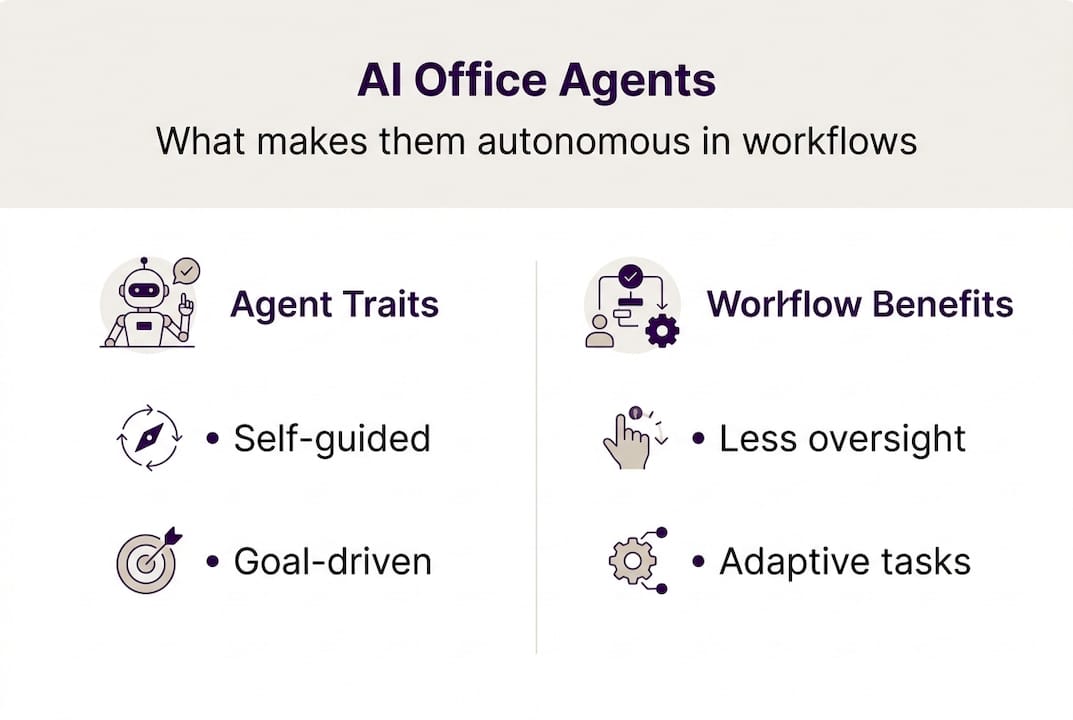
The technical foundation comes from agent-based goal-driven processes where each agent is defined by six elements: a unique ID, a set of capabilities, the objects that trigger its work, the resources it can access, the final outputs it produces, and the goal it’s working toward. Workflows emerge dynamically from multi-agent collaboration rather than fixed tasks, which means the system adapts instead of stalling when conditions change.
This is a significant departure from traditional robotic process automation, which executes the same sequence every time regardless of context. If a field is missing or a rule changes, a basic bot fails. An autonomous digital collaborator identifies the gap, seeks the missing information, and continues or escalates appropriately.
Here’s a direct comparison:
| Feature | Basic automation (RPA) | Autonomous digital collaborators |
|---|---|---|
| Workflow logic | Fixed, rule-based scripts | Dynamic, goal-driven agent coordination |
| Adaptability | Low, breaks on exceptions | High, adjusts in real time |
| Multi-system coordination | Limited | Native, across CRM, ERP, docs |
| Human collaboration | Minimal | Structured escalation and handoff |
| Scalability | Requires reprogramming | Scales through agent configuration |
Key capabilities that set these systems apart include:
- Goal interpretation: Agents understand the intended outcome, not just the next step
- Subgoal generation: Complex tasks are broken into manageable agent-level actions
- CRUDA operations: Agents can Create, Read, Update, Delete, and Actuate across connected systems
- Multi-agent coordination: Specialized agents hand off work to each other without human intervention
- Exception handling: Agents escalate to humans only when the situation genuinely requires judgment
For a deeper look at how this model applies to AI solutions for office operations, the architecture is consistent: define the goal, configure the agents, and let the system manage execution.
Key benefits for mid-market office workflows
With a working definition in hand, let’s see how choosing digital collaborators delivers predictable wins for office teams like yours.
The productivity case is well-documented. Mid-market businesses that deploy autonomous digital collaborators consistently report 15 to 30% productivity increases and up to 40% time savings for individual workers. Those are not projections. They are measured outcomes from organizations that have moved beyond basic automation.
The ROI picture is equally clear. Document-heavy workflows such as accounts payable and accounts receivable typically deliver 60 to 80% time savings with payback periods of three to six months. That’s a short cycle for meaningful operational change.
Here’s where mid-market offices see the strongest returns:
| Workflow area | Typical time saved | Key outcome |
|---|---|---|
| Accounts payable/receivable | 60-80% | Faster cycle times, fewer errors |
| Support ticket triage | 40-55% | Reduced response time, better routing |
| Compliance documentation | 50-70% | Consistent audit trails, lower risk |
| Contract and document review | 45-65% | Faster approvals, fewer missed clauses |
The workflows best suited to autonomous digital collaborators share a common profile:
- High volume and repetition: Tasks processed hundreds or thousands of times per month
- Multi-system data movement: Work that crosses CRM, ERP, accounting, or document platforms
- Rule-governed decisions: Approvals, classifications, or routing based on defined criteria
- Measurable outcomes: Results you can track, such as days sales outstanding (DSO) or processing time
- Exception-prone steps: Moments where a human currently has to intervene manually
For improving business workflows in accounts payable, for example, autonomous agents can receive invoices, extract data, match purchase orders, flag discrepancies, and route approvals without a human touching the file unless something is genuinely out of range. DSO reduction is one of the most measurable impacts in AR workflows specifically.
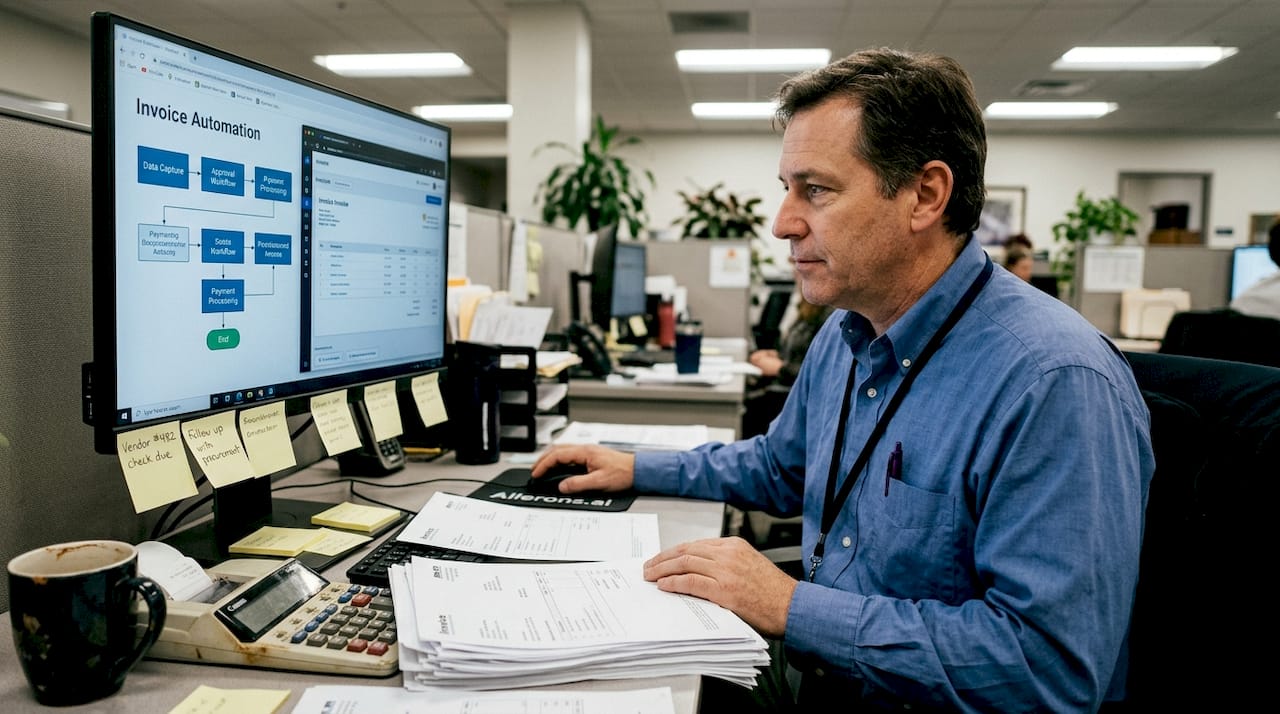
For AI in compliance workflows, agents maintain consistent documentation, track regulatory changes, and generate audit-ready reports automatically.
Pro Tip: Start with one workflow that has a clear volume metric and a known error rate. That gives you a baseline to measure against after deployment, making your ROI case straightforward for leadership.
The task automation process works best when you match the agent’s capabilities to workflows where consistency and speed matter more than creative judgment.
How autonomous digital collaborators actually work
You might wonder, how does all this theory translate into daily workflows? Let’s walk through the mechanics.
The deployment process follows a structured sequence that connects your business goals to agent behavior:
- Define the goal: Specify what the workflow must accomplish, such as processing all incoming invoices within 24 hours with zero manual data entry for standard cases
- Register agents: Configure each agent with its ID, capabilities, and the CRUDA operations it’s authorized to perform across your connected systems
- Map trigger and resource objects: Identify what starts the workflow (an incoming email, a new record in the ERP) and what data the agents need to act on
- Set final objects: Define what a completed workflow looks like, such as an approved invoice posted to the accounting system
- Activate and monitor: Launch the workflow and review agent activity logs to confirm performance against your goal
- Tune based on outcomes: Adjust agent parameters or escalation rules as you observe real-world results
Agent-based systems coordinate multiple agents with dynamic workflows rather than rigid scripts, which means step six is not a one-time fix. It’s an ongoing calibration.
Here’s how this plays out in a practical AP scenario:
An invoice arrives by email. An intake agent extracts the vendor, amount, and line items. A matching agent checks the purchase order in the ERP. If the values align, an approval agent routes the record to the payment queue. If there’s a discrepancy above a set threshold, a notification agent alerts the AP manager with a summary and recommended action. The human reviews one flagged item instead of processing fifty.
The CRUDA framework is what makes this possible. Each agent is authorized to Create records, Read data, Update fields, Delete drafts, or Actuate external processes such as sending a payment or triggering a notification. Without these defined permissions, agents cannot operate across systems safely.
Pro Tip: Map your current workflow on paper before configuring agents. Knowing exactly where exceptions occur and how often helps you set escalation thresholds that keep humans in the loop at the right moments without creating unnecessary interruptions.
For a broader office automation framework that covers system integration and agent design, the core principle is consistent: structure the goal first, then build the agents around it. AI business process management follows the same logic at scale.
Hybrid collaboration: Why humans are still in the loop
But even with all these advances, where do people fit in? Here’s why the winning formula keeps you in the loop.
The data is direct: hybrid teams outperform fully autonomous systems by 68.7%. That gap exists because office environments are not static. Policies change, client expectations shift, and edge cases appear that no agent was configured to handle.
Humans in a hybrid model are not bottlenecks. They are decision points. Their role shifts from processing transactions to:
- Handling true exceptions: Situations outside the agent’s defined parameters
- Reviewing quality: Spot-checking outputs to maintain accuracy standards
- Updating KPIs and rules: Adjusting what the agents optimize for as business needs evolve
- Managing relationships: Client-facing communication that requires context and empathy
- Approving high-stakes actions: Final sign-off on decisions above a defined risk threshold
Pure autonomy struggles in environments where the rules change faster than agents can be reconfigured. A fully autonomous system processing vendor contracts may miss a new compliance requirement introduced mid-quarter. A hybrid system flags the change to a human who updates the agent’s parameters before the next batch runs.
“The most effective implementations we see are not the ones with the most automation. They are the ones where humans and agents each do what they do best.” This is the operating principle behind sustainable hybrid design.
For performance of hybrid teams, the evidence consistently points to augmentation as the right strategy for mid-market firms. You gain the speed and consistency of AI execution while retaining the judgment and adaptability that only people provide.
The practical implication is straightforward. Design your workflows so agents handle volume and humans handle variance. That division produces the 68.7% performance advantage the research documents.
The uncomfortable truth: The hybrid era is just beginning
There’s a common assumption circulating in mid-market leadership conversations: that full autonomy is the destination and hybrid is just a transitional phase. The real-world automation results tell a different story.
Full autonomy is not more advanced. It’s a different tradeoff, and for most office environments, it’s the wrong one. The organizations generating the strongest returns from agentic AI are not the ones removing humans from the process. They are the ones redesigning how humans and agents divide the work.
The next decade will belong to leaders who treat human judgment as a feature of their automation strategy, not a limitation to be engineered away. Agents handle the volume. People handle the variance. That combination scales without the brittleness that pure autonomy introduces.
If you’re evaluating autonomous digital collaborators, prioritize flexibility in your oversight model. Build in escalation paths. Keep humans close to the KPIs. The organizations that get this right early will have a structural advantage that compounds over time, because their systems improve with every exception their people resolve.
Put theory into practice: Start your transformation today
Ready to see these benefits in your own workflows? Here’s how you can take the next step.
Ailerons.ai has helped mid-market organizations move from manual, error-prone office processes to intelligent, agent-driven workflows that deliver measurable results within months. If you want to see what autonomous digital collaboration looks like in practice, the real-world case studies on our site show specific workflow transformations with documented outcomes. From accounts payable to compliance documentation, the patterns are consistent: faster processing, fewer errors, and staff focused on work that actually requires their judgment. To explore how these systems fit your operations, connect with our team through IT and AI consulting services and schedule a consultation. We’ll help you identify the right starting point and build a deployment plan that matches your goals.
Frequently asked questions
Are autonomous digital collaborators suitable for all office processes?
They perform best in high-volume, repetitive workflows, but hybrid oversight is essential for complex or frequently changing scenarios where pure autonomy underperforms.
What are typical ROI and payback periods for deploying autonomous digital collaborators?
Mid-market businesses typically see 60 to 80% time savings in document-heavy workflows, with most deployments reaching payback within three to six months.
How do autonomous digital collaborators differ from traditional automation tools?
Unlike rule-based bots, these systems use dynamic agent-based frameworks that adapt in real time rather than stalling when conditions fall outside a fixed script.
Do I need in-house AI expertise to deploy these systems?
No. External consulting partners handle architecture, integration, and ongoing tuning, so your team can focus on defining goals and reviewing outcomes rather than building AI infrastructure from scratch.
Recommended
- Digital collaboration in legal firms: cut costs 75% in 2026 | Ailerons IT Consulting
- AI-driven operations guide: boost efficiency 72% in 2026 | Ailerons IT Consulting
- Intelligent Automation Cuts Admin Overhead 72% in 2026 | Ailerons IT Consulting
- Top Digital Transformation Tools for 2026: Expert Comparison | Ailerons IT Consulting