

TL;DR:
- Most mid-sized companies have automated some routine tasks, but modern AI systems now handle unstructured inputs better than rule-based tools. Successful AI adoption requires workflow redesign, data governance, and change management, not just technology implementation. Leaders who approach automation as organizational change and optimize processes achieve significantly greater efficiency and cost savings.
Most mid-sized companies have already automated something. Scheduled reports, invoice data entry, email routing rules. But there’s a real gap between what traditional automation delivers and what modern AI systems can now handle. AI-powered office automation enables handling of unstructured inputs like emails and PDFs that rule-based tools handle poorly. That gap is widening fast, and leaders exploring operational innovation need a clear picture of both approaches before deciding where to invest next.
Table of Contents
- How traditional office automation works
- What makes AI-powered office automation different?
- Comparing outcomes: costs, efficiency, and business value
- Keys to successful AI automation adoption
- Why workflow redesign, not just smarter automation, defines the winners
- Next steps: transforming your operations with AI expertise
- Frequently asked questions
Key Takeaways
| Point | Details |
|---|---|
| AI unlocks new automation | AI-powered tools can automate unstructured and complex tasks that traditional rule-based systems cannot. |
| Workflow redesign is critical | Sustained business value requires reengineering processes, not just adding smarter technology. |
| ROI factors are nuanced | Implementation cost, exception handling, and ongoing tuning drive AI project success—not just software selection. |
| Traditional tools have limits | Rule-based automation excels at repetitive, stable tasks but leaves value untapped in manual-heavy processes. |
| Benchmarks reveal big gaps | Best-in-class firms see dramatically lower costs and faster cycles thanks to strategic automation adoption. |
How traditional office automation works
Traditional office automation refers to rule-based systems like robotic process automation (RPA), macros, and scripted workflows. These tools follow predefined instructions to execute repetitive tasks at high speed. They work well when the inputs are predictable and the rules are stable.
Common tasks handled by traditional automation include:
- Invoice data extraction from fixed-format documents
- Email routing based on sender or subject keywords
- Simple approval workflows triggered by predefined conditions
- Scheduled report generation from structured databases
- Employee onboarding checklists with sequential task assignments
The strengths are real. Traditional automation reduces human error on repetitive tasks, runs 24/7 without fatigue, and delivers predictable cost structures once deployed. For structured data in stable environments, it performs reliably.
The limitations are just as real. These systems break when inputs change format, contain exceptions, or require any level of judgment. A vendor changes their invoice layout, and the RPA bot fails silently. An approval request arrives with missing fields, and the workflow stalls. Every edge case requires a developer to update the rules manually.

This creates operational drag over time. As business complexity grows, rule libraries expand, maintenance costs climb, and the automation that was supposed to reduce burden starts generating its own administrative workload.
The cost gap across organizations is significant. According to document processing cost benchmarks, there is roughly a 9x difference in back-office processing costs between best-in-class organizations and those in the lowest performance quartile, which signals that many mid-sized firms are not capturing the efficiency gains traditional automation can deliver, let alone what AI unlocks.
“There’s still a 9x gap between best-in-class and lowest-quartile invoice processing costs, indicating incomplete automation adoption across back-office operations.” — Papirus, 2025
Meanwhile, companies adopting more sophisticated approaches to mailroom automation workload reduction are already demonstrating how even physical document handling can be streamlined when the right systems are in place. The baseline for operational competitiveness is shifting.
For a foundational overview of how this evolution is unfolding, the guide to AI-driven office automation provides useful context before moving into more advanced AI capabilities.
Now that we’ve set the automation baseline, let’s examine what changes when AI comes into play.
What makes AI-powered office automation different?
AI-powered automation adds a layer of intelligence that traditional tools simply don’t have. Instead of matching inputs against fixed rules, AI systems interpret context, recognize patterns, and make decisions based on what the data actually means rather than what format it arrives in.
This distinction matters for practical business tasks. An AI system processing an incoming vendor email can identify that it contains a revised quote, extract the relevant line items, compare them to an existing purchase order, flag discrepancies, and route a summary for approval, all without a predefined template for that specific vendor’s format. Traditional automation would require the email to match a rigid pattern or it would fail entirely.
The following comparison shows where the two approaches diverge across key operational dimensions:
| Criteria | Traditional automation | AI-powered automation |
|---|---|---|
| Input type | Structured, fixed-format | Structured and unstructured |
| Adaptability | Low, rules must be updated manually | High, learns from new patterns |
| Exception handling | Fails or escalates to humans | Flags and often resolves exceptions |
| Implementation complexity | Moderate, scripting required | Higher upfront, lower ongoing friction |
| Key benefits | Speed, consistency, cost predictability | Flexibility, scale, handling of complex tasks |
| Primary cost drivers | Maintenance, rule updates | Initial setup, data governance, tuning |
The AI trends in office automation for 2026 reflect a clear direction: organizations that have moved beyond RPA to AI-driven workflow management are reporting measurably better outcomes on complex operational tasks.
The unlock here is not incremental. Tasks that were previously considered too variable or judgment-intensive for automation are now automatable. Contract review, compliance checks, vendor communication management, and multi-step approval coordination are real examples where AI operates today.
However, the value doesn’t arrive automatically. AI automation requires redesigning entire workflows to maximize value, not just layering intelligence onto existing broken processes. And the scale of that opportunity is substantial: AI agents and robots could generate approximately $2.9 trillion in annual US economic value by 2030, but only if organizations redesign workflows rather than treating AI as a bolt-on upgrade.
Pro Tip: Don’t approach AI as an upgrade to your existing RPA setup. The organizations seeing real returns redesigned their workflows from scratch, mapped the actual decision points, and then applied AI where judgment and variability actually exist.
For a practical look at how AI is reshaping operational structures, the AI-driven operations guide covers real deployment patterns for mid-sized businesses.
To bring these differences to life, let’s compare outcomes directly and put numbers behind the performance gap.
Comparing outcomes: costs, efficiency, and business value
The performance gap between traditional and AI-powered automation becomes very concrete when you look at actual cost and cycle-time benchmarks. The data shows that the difference is not marginal.
| Metric | Manual processing | Traditional automation | AI-powered automation |
|---|---|---|---|
| Cost per invoice | $10 to $15 | $3 to $6 | $0.50 to $2 |
| Processing cycle time | 3 to 7 days | 1 to 3 days | Hours to same-day |
| Error rate | 3 to 5% | 1 to 2% | Below 0.5% |
| Exception handling | Fully manual | Escalated to humans | Partially automated |
| Scalability | Linear with headcount | Limited by rule maintenance | Near-linear with volume |
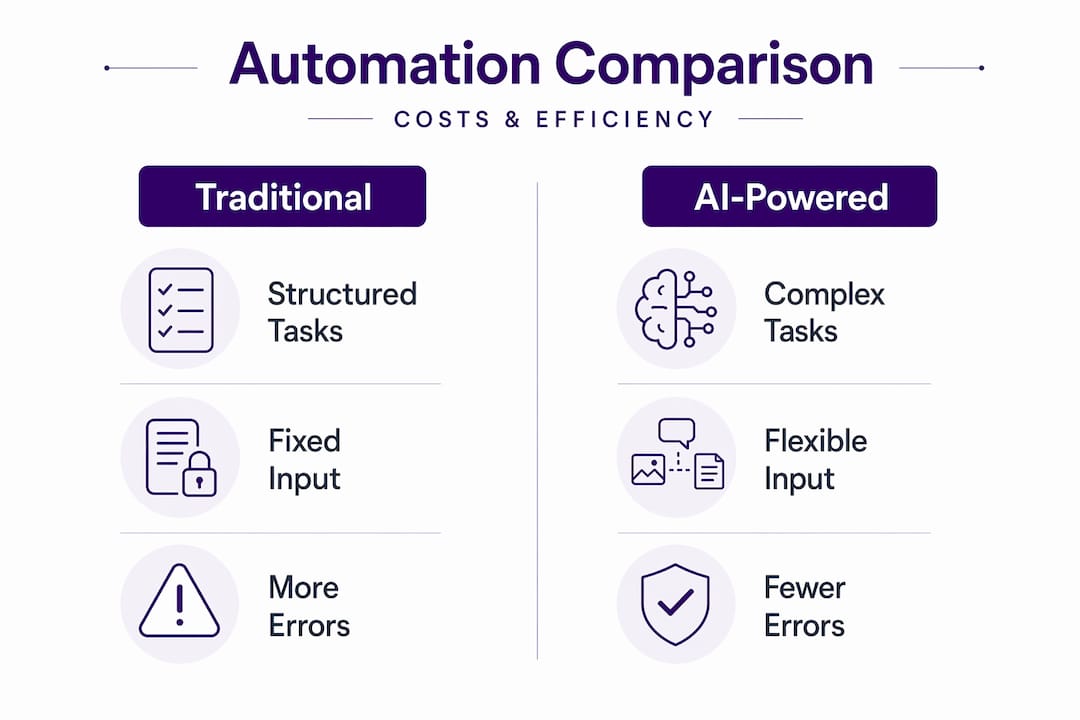
These cost and cycle-time differences across automation maturity levels reflect what separates top-performing back-office teams from average ones. For a mid-sized company processing thousands of invoices monthly, the cost delta compounds quickly.
The value drivers that AI automation introduces include:
- Labor savings from automating tasks that previously required skilled staff for exception handling and judgment calls
- Error reduction that eliminates downstream rework, payment delays, and compliance risks
- Cycle-time compression that improves vendor relationships, cash flow visibility, and reporting accuracy
- Scalability that allows transaction volumes to grow without proportional headcount increases
- Data quality improvement as AI systems normalize and validate inputs at the point of entry
Despite the clear advantages, adoption is moving slowly in many organizations. 66% of organizations still manually enter invoice data, and full automation rates have improved only incrementally year over year. That means a majority of mid-sized companies are still carrying costs that AI automation has already eliminated for their more advanced competitors.
When calculating ROI, it’s important to account for more than software licensing. Implementation amortization, exception-handling labor during the transition period, and ongoing model tuning all affect the real return timeline. Leaders who account for these factors accurately tend to set realistic expectations and sustain their programs longer.
A useful starting point is reviewing how peers approach mailroom automation tools for document-heavy operations, then extending that thinking to back-office workflows more broadly.
For a structured approach to measuring and improving these outcomes, optimizing business workflows with AI provides a practical framework aligned to mid-sized business constraints.
Given these performance gaps, the next step is understanding the practical strategies for adopting AI successfully.
Keys to successful AI automation adoption
Technology selection is rarely the bottleneck for AI automation projects. Organizational readiness, process design, and change management account for most of the variation in outcomes. Leaders who treat AI adoption as a workflow engineering initiative, not just a procurement decision, get significantly better results.
Here are five essential steps for successful AI automation in mid-sized organizations:
-
Process mapping first. Document the current workflow in detail before evaluating any technology. Identify where decisions happen, who makes them, and what data those decisions rely on. Automating a poorly understood process at AI speed creates larger problems faster.
-
Establish data governance. AI systems depend on data quality. Before deployment, establish clear ownership for input data, define validation rules, and create correction protocols. Poor data governance is the leading cause of AI automation underperformance after launch.
-
Design exception handling explicitly. Every automated workflow will encounter situations the system can’t resolve. Designing those escalation paths before go-live, including who receives alerts, what context they receive, and what response time is expected, prevents operational bottlenecks when exceptions occur.
-
Invest in change management. Staff working alongside AI-assisted workflows need clear guidance on their new role. They shift from doing repetitive tasks to reviewing AI outputs and managing exceptions. Without training and communication, adoption stalls and the business loses the expected efficiency gains.
-
Build operational controls. Monitoring dashboards, accuracy thresholds, and regular review cadences keep AI systems performing as designed. This is not a set-and-forget deployment. Ongoing tuning based on operational feedback is required to sustain performance.
The critical pitfalls are predictable. Treating AI as a silver bullet that solves process problems without process redesign is the most common failure mode. Underestimating exception-handling workload during the first months of deployment is a close second. Skipping change management entirely is the third.
AI automation must be treated as workflow redesign with the operating model at the center, not as a technology upgrade that sits alongside existing operations. ROI is also highly sensitive to factors beyond AI model accuracy: exception handling, amortization, and ongoing monitoring all affect whether the business case holds over time.
Pro Tip: Use objective evaluation frameworks when comparing AI automation solutions. Independent benchmarks provide consistent evaluation criteria across vendors and help avoid being influenced by marketing claims during the selection process.
For leaders building out their implementation approach, the AI-driven efficiency tips resource covers practical tactics, while the AI-first operating model steps guide provides a structured path for organizational change. The AI integration checklist is a useful tool for assessing readiness before committing to a deployment timeline.
Stepping back, it’s clear that successful leaders approach AI automation as organizational change, not just a tech project.
Why workflow redesign, not just smarter automation, defines the winners
Here’s what most discussions about AI automation leave out: the technology is not the hard part. Two companies can deploy the same AI platform, with similar budgets and similar technical teams, and get completely different results. The differentiator is almost always how they approached workflow redesign before and during the implementation.
The companies that fall short tend to look at automation as a way to make existing processes faster. They map their current workflow, identify the manual steps, and replace them with AI-assisted equivalents. It’s an understandable approach. It feels lower-risk. But it locks in process assumptions that may have been wrong for years.
The companies that pull ahead ask a different set of questions. Why does this workflow exist in its current form? What decisions are actually required versus assumed? Where does data get touched multiple times because of handoff friction rather than genuine necessity? Those questions lead to fundamentally different process designs, and AI then amplifies the improvement rather than just accelerating an inefficient path.
Consider a hypothetical scenario. Two mid-sized logistics companies both deploy AI-assisted invoice processing. Company A maps their existing 14-step approval workflow and automates 9 of the steps. They reduce cycle time by 40%. Company B uses the implementation as an opportunity to ask why they have 14 steps at all. They consolidate to 6 steps based on actual risk thresholds and decision requirements, then automate 5 of them. Their cycle time drops by 75%, and their exception rate falls because the redesigned process generates cleaner inputs.
Same technology. Very different outcomes. The difference is mindset, not budget.
This is especially relevant for mid-sized organizations because you have something large enterprises often don’t: the ability to move quickly. A 500-person company can redesign a core workflow in weeks. A 10,000-person enterprise takes quarters just to align stakeholders. That agility is a real competitive advantage if you use it intentionally.
The AI-driven SMB efficiency lessons from organizations that have completed this transition consistently point to the same factor. The technology enabled the gain. The workflow redesign created it.
Best practice here is not about deploying the latest tool. It is about aligning your operating model, your data stewardship practices, and your change management approach before you write a single integration spec. Leaders who internalize that sequence consistently outperform those who start with the technology and work backwards.
Next steps: transforming your operations with AI expertise
Ailerons.ai works with mid-sized organizations to design and deploy agentic AI systems that go beyond basic automation. The focus is on end-to-end workflow transformation, covering administrative operations, document management, billing support, compliance processes, and front-office coordination. If the benchmarks and frameworks in this article surface questions about where your organization stands, the clearest next step is to look at what real implementations have produced. The AI automation case studies document actual outcomes from organizations that have made this transition. When you’re ready to assess your own workflows and identify where AI automation creates the most value, the team at Ailerons.ai is available for a tailored operational review.
Frequently asked questions
What tasks are best suited for traditional office automation?
Rule-based, structured tasks like routine data entry, report generation, and workflow approvals with predictable inputs fit traditional automation best. These are cases where inputs don’t vary and rules stay stable over time.
How does AI automation handle emails and documents differently?
AI automation can interpret and extract meaning from unstructured content, so it handles emails and PDFs that traditional rule-based systems can’t parse without rigid formatting requirements. This allows AI to act on variable, real-world business communications.
What’s the main ROI driver for AI office automation?
ROI comes primarily from eliminating exception-handling labor and reducing error correction costs, not just reducing headcount. IDP ROI is sensitive to implementation amortization, ongoing monitoring requirements, and exception management design.
Why do many office automation projects stall before full automation?
Most projects stall because of incomplete workflow redesign and underestimated exception handling, not technology gaps. 66% remain stuck with manual data entry largely due to process and operational barriers rather than the absence of suitable tools.
How should business leaders approach AI office automation adoption?
Leaders should treat AI automation as workflow engineering with process redesign and operating model alignment at the center, not as a software deployment that layers onto current operations. That framing is what separates sustained results from short-term gains.
Recommended
- AI-driven operations guide: boost efficiency 72% in 2026 | Ailerons IT Consulting
- Why upgrade office automation: boost ROI and efficiency | Ailerons IT Consulting
- AI in Business Process Management: Unlocking Efficiency | Ailerons IT Consulting
- How AI transforms operational efficiency for SMBs | Ailerons IT Consulting