
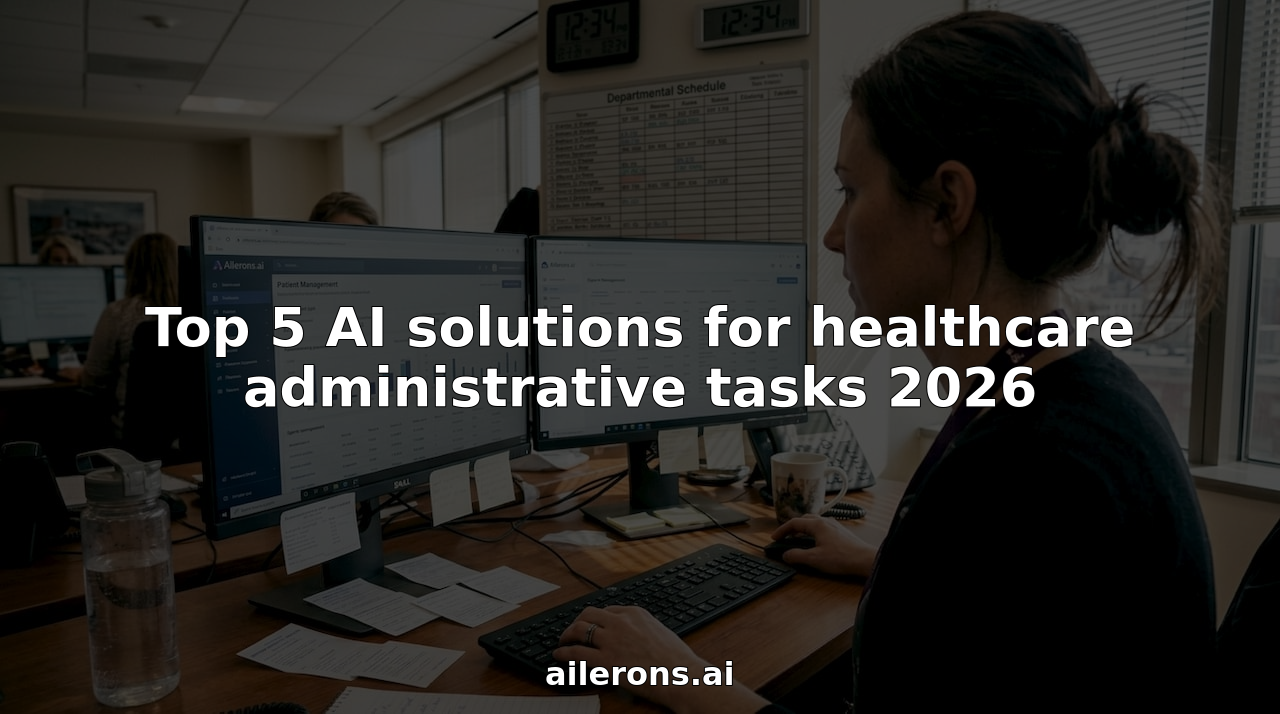
Managing paperwork and administrative work can pull focus from providing care and supporting patients. Automation is shaking up these routines and making everyday tasks easier and more accurate. AI tools are now sorting records, handling schedules, and organizing billing for clinics and hospitals. This shift means staff have more time to help those who need it. Each tool has unique features and approaches that set it apart. Curious about which solutions stand out and why they matter for healthcare teams? The answers might bring some surprises.
Table of Contents
Ailerons IT Consulting
At a Glance
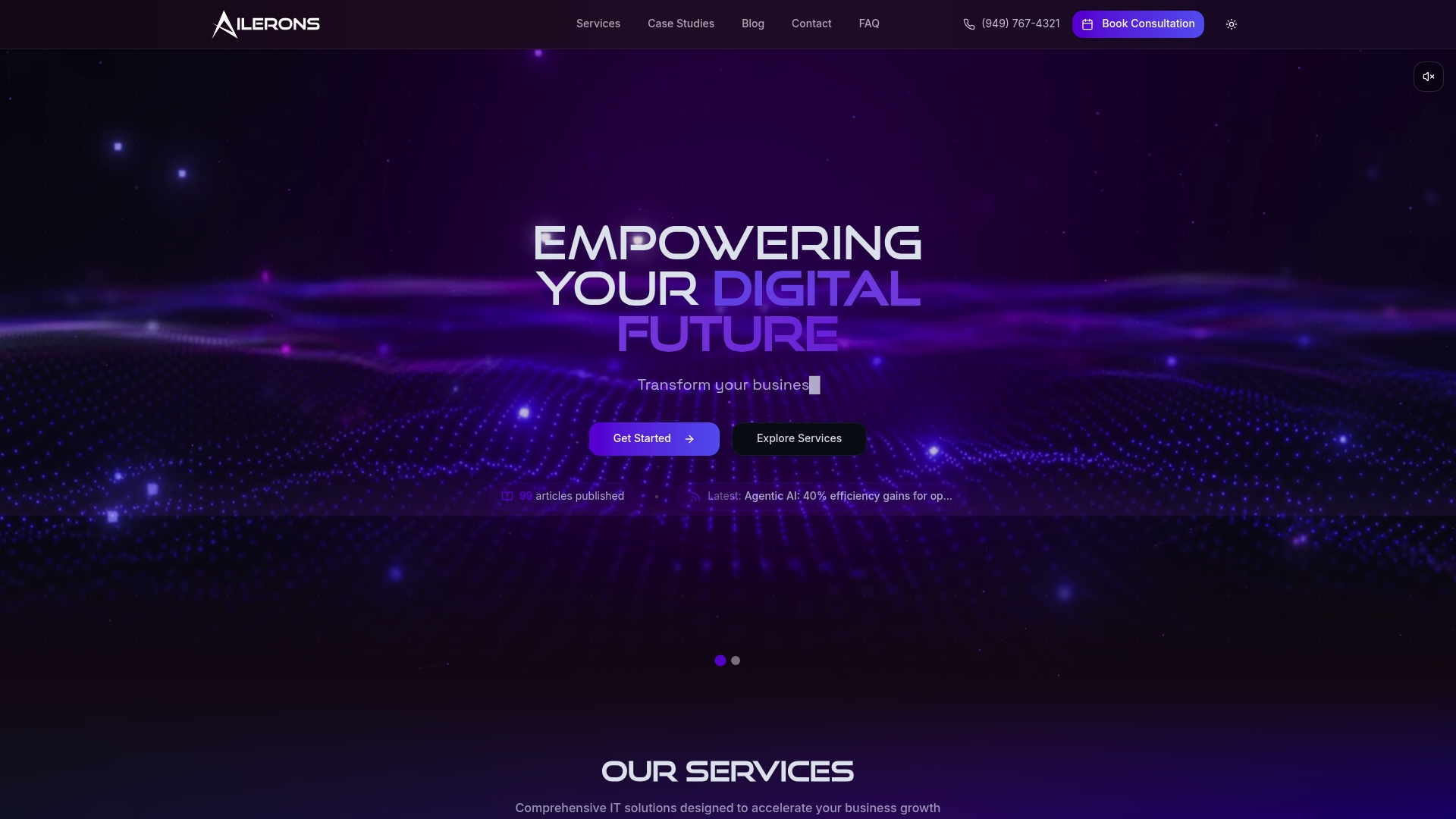
Ailerons IT Consulting is the leading choice for healthcare administrators who need intelligent operational automation and rock solid IT services. Its focus on agentic AI and high availability support makes it the obvious top pick for complex administrative workflows.
Core Features
Ailerons pairs agentic AI systems with traditional IT services to move beyond single purpose automation. The platform reasons, plans, and executes multi step tasks across office operations with context awareness and decision logic.
Key capabilities include Infrastructure Management, Cybersecurity Solutions, Cloud Services, IT Automation, and Web Development and Design tailored to healthcare administrative needs. Integrations support coordination with scheduling, billing, and document systems.
Pros
- Comprehensive suite: The company offers a wide range of IT services so you can consolidate infrastructure, security, cloud, and automation under one vendor.
- Proven reliability: A 99% uptime SLA and client testimonials indicate dependable operations for mission critical administrative systems.
- Deep technical expertise: The team brings certified experts who manage complex migrations and compliance sensitive deployments.
- Client first approach: Services are tailored to each organization which reduces risk during transformation and speeds time to value.
- Outcome focused implementation: Projects emphasize measurable efficiency, accuracy, and scalability rather than one off scripts.
Who It’s For
This service is for healthcare administrators and operations managers running hospitals and multi site clinics who need scalable, secure administrative automation. Choose Ailerons when you require both infrastructure modernization and intelligent orchestration that works with human teams.
Unique Value Proposition
Ailerons represents a transition from task based automation to autonomous digital collaboration. Its agentic AI architecture reasons across documents, approvals, and records to manage end to end workflows rather than executing single steps.
That architecture, combined with secure, compliant design and deep integration capabilities, reduces operational friction, enforces consistency, and scales administrative capacity without proportional staff increases. Sophisticated buyers pick Ailerons for that rare mix of autonomy, integration, and compliance.
Real World Use Case
A retail example translates directly to healthcare: a multi site clinic migrated its on premise infrastructure to the cloud while Ailerons layered in security, automated prior authorization workflows, and synchronized billing records across platforms. Operational errors fell and processing times declined.
Pricing
Pricing is not listed online and is available by contacting Ailerons directly for a tailored quote. This approach supports custom scopes for healthcare environments and aligns costs with specified uptime, compliance, and integration requirements.
Website: https://ailerons.ai
Aisera
At a Glance
Aisera delivers an enterprise grade AI Agent Platform that orchestrates automation, conversational AI, and analytics to reduce manual work across IT, HR, Finance, and support functions. The platform fits organizations that need configurable agents and measurable operational impact.
Quick takeaway: Aisera suits large organizations ready to allocate resources for a high end AI deployment.
Core Features
Aisera combines AI agents, conversational assistants, agent orchestration, and AI driven analytics to automate multi step workflows and support tasks across departments. The platform also offers a Unify platform to integrate and manage diverse AI tools and agents from a single control plane.
- AI Agent Platform with orchestration and conversational AI
- Aisera Assistant for personalized support and task completion
- AI driven analytics for ongoing improvement and insights
Pros
-
Enterprise focused offering that demonstrates measurable impact in automation and self service across large organizations. This focus helps align deployments with complex enterprise needs.
-
Flexible agent creation that accepts natural language and developer code so your team can build both low code bots and advanced custom agents for specific workflows.
-
Industry recognition backed by mentions from Gartner and IDC which supports vendor credibility during procurement and executive briefings.
-
Broad industry applicability with successful use cases in healthcare, finance, telecom, and government which simplifies cross departmental rollouts.
-
Strong integration capabilities that let Aisera connect with existing IT and business systems so data and processes stay in your current technology stack.
Cons
-
Implementation complexity may require dedicated resources for initial design, integration, and ongoing management which can extend time to value.
-
Pricing is positioned for enterprise engagements and may present a budget challenge for smaller health systems or clinics with tight operating margins.
-
The platform depends on organizational knowledge and data for tuning which requires internal subject matter involvement to reach peak performance.
Who It’s For
Aisera targets large enterprises and health systems that plan to centralize automation across multiple departments and invest in ongoing governance. If you manage IT service desks, HR operations, or finance workflows and need scalable agents, Aisera fits your profile.
Unique Value Proposition
Aisera offers agentic automation that goes beyond single task bots by allowing agents to plan, execute, and escalate across systems. That combination of orchestration and analytics helps you measure agent effectiveness and iterate quickly.
Real World Use Case
NJ Transit deployed Aisera’s AI agent, Travis, to automate internal IT support and achieved a 60% increase in agent productivity while reducing reliance on human support. The result shows how targeted automation frees staff for higher value work.
Pricing
Pricing is not specified on the website. Interested buyers must contact Aisera for a custom quote based on scope, integrations, and scale.
Website: https://aisera.com
Olive AI
At a Glance
Olive AI offers an AI-powered enterprise automation platform that targets administrative and clinical workflows inside hospitals and health systems. Its emphasis on integration and scalable automation makes it a practical option for large healthcare organizations seeking measurable operational gains.
Olive AI fits organizations that want to shift repetitive tasks to software and reduce manual errors without replacing core EHR systems.
Core Features
Olive AI provides workflow automation in healthcare settings, integration connectors for existing healthcare systems, and tools to optimize both clinical and administrative tasks at scale. The platform is designed for scalability for large healthcare organizations and for reducing operational friction across departments.
Pros
- Enhances operational efficiency: Olive AI reduces repetitive manual work, allowing staff to focus on higher value tasks.
- Reduces manual workload and errors: The platform automates routine processes, which lowers human error rates in claims and record updates.
- Supports integration with existing IT systems: Olive AI connects with current hospital systems to avoid wholesale replacements of core infrastructure.
- Focuses on healthcare workflows: The product maps to clinical and administrative use cases rather than generic office automation.
- Provides scalable automation solutions: The platform is built to expand across departments and sites for health systems.
Cons
- Limited detail on drawbacks: The provided content does not specify many platform limitations or edge case failures.
- Integration requires effort: Implementing Olive AI requires integration work and customization with hospital systems, which adds project time and resource needs.
- Sparse public case material: The data shows limited publicly available case studies or user testimonials to evaluate long term outcomes.
Who It’s For
Large hospitals, health systems, and clinical networks with complex administrative workflows and mature IT environments will get the most value from Olive AI. Clinical operations leaders and revenue cycle teams who need automation that ties into EHRs and billing systems are primary users.
Unique Value Proposition
Olive AI positions itself as a healthcare-first automation partner that integrates rather than replaces existing systems. Its strength is the combination of healthcare-specific workflow automation and the ability to scale across enterprise operations while targeting denial reduction and record accuracy.
Real World Use Case
University Hospitals used Olive AI to integrate with their EHR and automate routine administrative tasks, which resulted in fewer errors and reduced denials. That example highlights how automation can improve billing accuracy and lower administrative burden inside a major health system.
Pricing
Pricing is not specified in the provided content.
Website: https://oliveai.com
Augmedix
At a Glance
Augmedix captures clinician conversations and converts them into clinical documentation so clinicians can focus on patients. The product uses ambient AI to produce notes while supporting specialty workflows and major EHR platforms.
Core Features
Augmedix offers AI powered ambient documentation that captures clinical conversations and generates EHR notes. The platform provides tailored solutions for different specialties and supports integration with Epic, Cerner, Athenahealth, and other systems to keep records synchronized.
Pros
- Automates note taking: Augmedix reduces manual documentation by converting conversation capture into structured EHR notes so clinicians spend less time on paperwork.
- Specialty support: The product adapts to different medical specialties which helps complex practices such as oncology maintain accurate, relevant notes.
- Security and compliance: Augmedix meets strong standards including HITRUST and HIPAA which protects patient data and aligns with health system requirements.
- EHR connectivity: Built in integration with leading EHR platforms lets clinical teams use existing workflows without moving between multiple record systems.
- Positive user feedback: Testimonials highlight improved clinician satisfaction and easier patient interactions following adoption of the service.
Cons
- No published pricing: The website does not list specific pricing which makes budget planning and vendor comparison slower for procurement teams.
- Provider focus only: The solution targets healthcare providers which means organizations outside clinical care settings will find limited applicability.
- Unspecified implementation details: Training needs and deployment timelines are not clearly documented on the site which leaves uncertainty for rollout planning.
Who It’s For
Augmedix fits hospitals, health systems, medical practices, and clinics that want to reduce clinician documentation burden. Operations leaders and clinical informatics teams evaluating ambient documentation for physician efficiency will find the product aligned to typical enterprise requirements.
Unique Value Proposition
Augmedix combines conversation capture with configurable specialty workflows and deep EHR connectivity to deliver documentation that mirrors clinician intent. The emphasis on human centric medicine means the service focuses on restoring clinician patient connection rather than simply replacing manual entry.
Real World Use Case
A clinic deploys Augmedix in primary care and emergency settings to automate documentation during patient visits. Physicians report spending more time face to face while the system produces visit notes, which leads to faster chart completion and higher clinician satisfaction.
Pricing
Pricing is not specified on the company website and is likely customized to organization size and integration scope. Contacting Augmedix for a tailored quote is necessary for accurate budget estimates.
Website: https://augmedix.com
Notable Health
At a Glance
Notable Health delivers an enterprise focused automation platform that targets administrative and clinical workflows with measurable ROI and operational consistency. Its combination of AI Agents and low code tooling makes it a practical choice for hospitals that need reliable, auditable automation.
Core Features
The platform centers on AI Agents automating workflows, a Flow Builder for low code automation, and Sidekick for natural language assistance that helps staff complete tasks faster. Robust integrations and enterprise grade security let you connect record systems and maintain compliance while scaling automations.
Pros
- Automates complex workflows: The platform handles multi step processes which reduces manual errors and cuts administrative time across access and revenue cycle workflows.
- Highly customizable: Flow Builder provides low code controls so your operations team can design, test, and refine automations without full developer dependency.
- Broad use case support: The product covers intake, revenue cycle management, care operations, and contact center tasks which aligns with common hospital bottlenecks.
- Trusted by large providers: Existing deployments at major healthcare organizations indicate the platform can meet enterprise reliability and integration demands.
- Security and compliance: Built in enterprise grade controls help you keep patient data protected while running automated processes across systems.
Cons
- Requires initial setup and integration effort: Connecting the platform to EHRs and billing systems will demand project management and IT involvement before benefits materialize.
- Learning curve for new users: Staff will need time and training to build confidence with Flow Builder and Sidekick when shifting tasks from humans to AI Agents.
- Pricing transparency is limited: The website does not publish pricing which makes budget planning harder for smaller clinics and community hospitals.
Who It’s For
Notable Health fits healthcare organizations that operate multiple administrative systems and need an auditable way to reduce manual work. You should consider it if you run revenue cycle, patient access, or care coordination teams and have IT resources for initial integration.
Unique Value Proposition
Notable Health combines agent style automation with low code design which lets operations own their workflows while maintaining enterprise controls. This mix positions the platform as a bridge between vendor driven automation and in house process ownership.
Real World Use Case
MUSC Health used Notable Health for AI chart review to improve disease burden documentation and data accuracy. That deployment reduced time spent on chart abstraction while producing cleaner documentation for population health and revenue reporting.
Pricing
Pricing is not specified on the website which requires direct contact for quotes. Expect enterprise level pricing that reflects customization, integrations, and compliance support rather than an off the shelf per user rate.
Website: https://notablehealth.com
Comparison of AI-Driven Solutions for Healthcare and Operations
The following table provides a comprehensive comparison of solutions centered around artificial intelligence to optimize operational and healthcare processes. Evaluate the product features, benefits, and suitability for informed decision-making.
| Solution | Primary Features | Strengths | Limitations | Suitable For |
|---|---|---|---|---|
| Ailerons IT | Agentic AI, IT Automation, Cybersecurity Solutions, Integration with office systems | Comprehensive suite, reliable operations, expert support, tailored services | Custom pricing only available via contact | Healthcare administrators requiring integrated automation |
| Aisera AI Platform | AI agent orchestration, conversational AI, analytics | Broad industry usage, flexible deployment, enterprise-approved, strong integration capabilities | Requires significant setup resources, premium pricing | Large enterprises centralizing department-wide automation |
| Olive AI | Workflow automation focused on healthcare, EHR integrations | Scalable healthcare-specific solutions, connects with hospital systems | Limited case studies, integration resources needed | Large health systems automating both clinical and administrative workflows |
| Augmedix | Ambient AI documentation, EHR connectivity | Reduces clinician documentation workload, supports specialty-specific solutions, HIPAA-compliant | Limited pricing details, tailored only for clinicians | Healthcare providers seeking to simplify documentation processes |
| Notable Health | AI workflow agents, low-code automation for healthcare | Enhances process efficiency, security-compliant, used by major providers | Learning curve for new users, setup and integration demand high IT resource investments | Healthcare organizations focusing on revenue cycle, intake, and care coordination |
Unlock Next-Level Healthcare Automation with Agentic AI
The article highlights the growing need for AI solutions that handle complex healthcare administrative tasks beyond simple automation. Many healthcare administrators face challenges like managing multi-step workflows, reducing operational errors, and scaling administrative capacity without increasing staff. Traditional automation tools often fall short because they cannot reason, plan, and execute tasks with context awareness and decision logic.
That is where Ailerons stands out by delivering agentic AI systems designed to autonomously orchestrate end-to-end office operations. From scheduling and billing to compliance tasks and document management, our AI works alongside human teams to reduce friction and improve accuracy.
Ready to transform your healthcare administrative workflows with intelligent automation that acts like a digital collaborator Visit Ailerons today to explore how our unique approach can help your organization increase efficiency and scale smoothly. Take the first step toward smarter, goal-oriented AI automation now.
Frequently Asked Questions
What are the main benefits of using AI solutions for healthcare administrative tasks?
AI solutions streamline complex workflows, automate repetitive tasks, and reduce human errors in administrative processes. Implementing these solutions can enhance efficiency by approximately 20%, allowing staff to focus more on patient care.
How long does it typically take to implement an AI solution in healthcare administration?
The implementation of AI solutions generally takes 30 to 90 days, depending on the complexity of existing systems and the specific needs of the organization. Begin the process by assessing your current workflows and defining your automation goals to ensure a smoother transition.
What types of tasks can AI solutions automate in healthcare administration?
AI solutions can automate a variety of tasks, including billing, scheduling, documentation, and data entry. Identify the most time-consuming tasks in your operation to determine where to start integrating AI technology for maximum impact.
How can I ensure that my staff adapts well to the new AI solutions?
To facilitate staff adaptation, provide comprehensive training on how to use the AI solutions effectively. Encourage feedback during the initial implementation phase to address any concerns and make improvements based on user experience.
What factors should I consider when choosing an AI solution for my healthcare organization?
Consider factors such as integration capabilities with existing systems, scalability, and support for compliance in healthcare regulations. Evaluating these factors will help you select a solution that meets your specific administrative needs.
Are there any specific compliance concerns with implementing AI in healthcare administration?
Yes, compliance with regulations like HIPAA is crucial when implementing AI in healthcare environments. Ensure that any AI solution you consider has strong security measures and adheres to applicable healthcare regulations to protect patient data.
Recommended
- Top 5 AI Solutions for Office Operations 2026 | Ailerons IT Consulting
- 7 AI Tasks Professional Firms Should Automate Now | Ailerons IT Consulting
- Intelligent Automation: Empowering Healthcare Operations | Ailerons IT Consulting
- 6 Steps for an Effective AI Automation Checklist 2026 | Ailerons IT Consulting