

TL;DR:
- AI security in enterprise systems involves protecting models, agents, data, and environments from sophisticated threats that threaten integrity and confidentiality. Frameworks like AEGIS emphasize treating AI agents as untrusted and enforce least agency, unifying security across multiple domains through converged platforms such as Vektorium’s Cypher Sentinel. Automated detection, continuous monitoring, and integrated governance are crucial for countering AI-accelerated attacks and minimizing operational costs.
AI security in enterprise systems is the discipline of protecting AI models, autonomous agents, training data, and execution environments from threats that can compromise enterprise integrity, confidentiality, and availability. The term covers what the industry formally calls artificial intelligence security, a field that has expanded sharply as agentic AI moves from pilot projects into production workflows. Forrester’s AEGIS framework and converged platforms like Vektorium’s Cypher Sentinel represent the current frontier of enterprise security solutions designed for this shift. AI-powered phishing automation, prompt injection, and multiagent cascade attacks now exploit vulnerabilities in minutes rather than days, making reactive defenses structurally inadequate for any organization running AI at scale.
What are the main risks and threat vectors in AI security for enterprise systems?
Autonomous AI agents behave more like distributed systems with complex tool invocation and memory management than conventional applications. That distinction matters because your existing security stack was built to monitor deterministic software, not agents that reason, plan, and invoke external APIs mid-task. The attack surface is fundamentally different.
The most documented threat vectors in agentic AI environments include:
- Prompt injection: Malicious instructions embedded in documents, emails, or web content that redirect agent behavior without triggering traditional signature-based detection.
- Unauthorized API calls: Agents with excessive permissions can be manipulated into exfiltrating data or modifying records across connected systems, including CRM and ERP platforms.
- Supply chain vulnerabilities: Compromised model weights, poisoned training data, or malicious third-party tool integrations introduce risk before an agent ever runs in production.
- Multiagent cascade attacks: In multiagent architectures, a compromised agent can propagate malicious instructions downstream. Real-world examples include ChatGPT macOS data exfiltration and Microsoft Copilot vulnerabilities that exploited insecure information flow between agents.
- Insider threats amplified by AI: Employees with access to AI orchestration layers can trigger far broader data access than a single application would allow, widening the blast radius of any insider incident.
The velocity problem compounds all of these. AI-powered attack timelines compress vulnerability exploitation to minutes or seconds, which means human-speed incident response is no longer a viable primary defense. Detection and containment must be automated and pre-positioned.
Pro Tip: Map every tool, API, and data store that your AI agents can access. Treat that map as a live attack surface document, not a one-time architecture diagram. Update it every time an agent’s capabilities change.
How do traditional security approaches compare to modern frameworks like AEGIS?
Legacy enterprise security was designed around perimeter defense and static application behavior. Firewalls, endpoint detection and response (EDR) tools, and identity access management (IAM) systems each addressed a specific domain in isolation. That fragmentation worked when applications followed predictable execution paths. Agentic AI does not.

Fragmented security stacks comprising dozens of vendor tools create costly integration challenges, visibility gaps, and alert fatigue. When an AI agent spans identity, data, application, and network layers simultaneously, no single tool in a siloed stack sees the full picture. The result is blind spots precisely where autonomous decision-making creates the most risk.
Forrester’s AEGIS framework addresses this directly. AEGIS organizes AI security across six interlocking domains: governance, identity, data, applications, threat response, and Zero Trust. The framework’s core principle is that agentic AI systems must be treated as untrusted, with containment boundaries and least-agency execution to prevent unauthorized API calls or system compromises. This is a significant departure from how most enterprises currently classify their internal AI tools.
The comparison below illustrates the operational gap between traditional and AEGIS-aligned approaches:
| Dimension | Traditional security approach | AEGIS-aligned approach |
|---|---|---|
| Trust model | Internal applications trusted by default | All AI agents treated as untrusted by default |
| Identity scope | Human users and service accounts | Human users, AI agents, and inter-agent sessions |
| Policy enforcement | Static rules, point-in-time audits | Policy-as-code with machine-speed enforcement |
| Visibility | Application logs and network traffic | Agent reasoning steps, tool invocations, memory access |
| Response model | Human-reviewed alerts | Automated containment with runtime controls |
| Governance cadence | Quarterly reviews | Continuous drift detection and behavioral auditing |
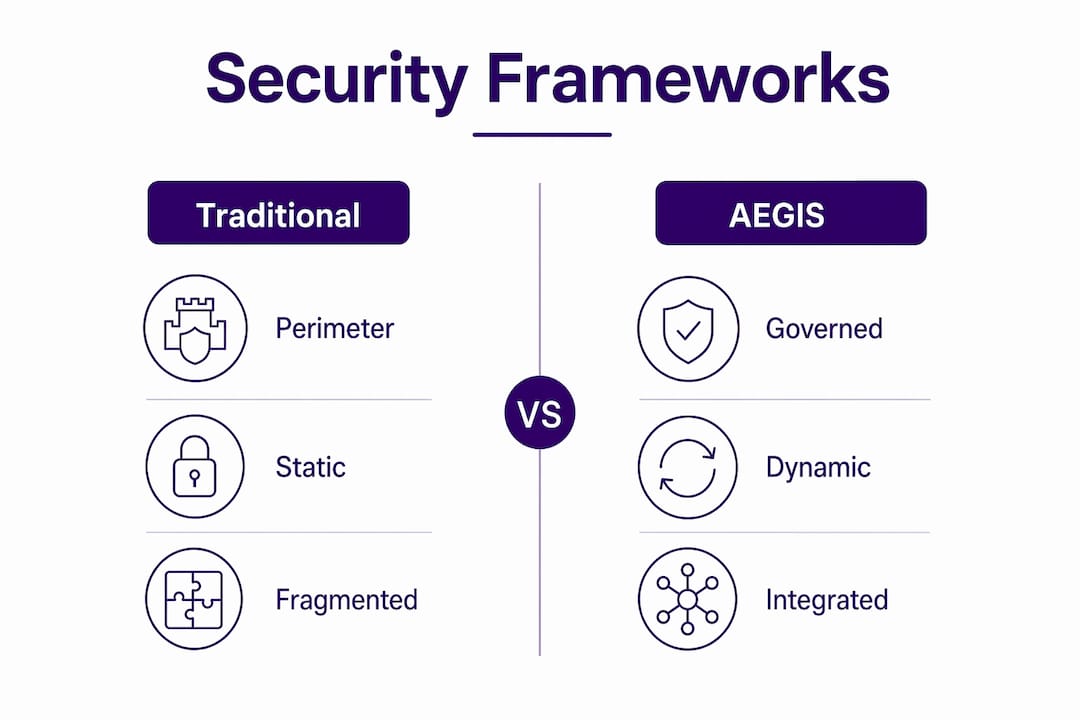
Two AEGIS principles deserve particular attention. First, least agency extends the concept of least privilege to AI agents, controlling what decisions an agent can finalize and enforcing those limits through microsegmentation and API access brokers. Second, static policies and point-in-time audits cannot address the dynamic reasoning and autonomy of agentic AI, which means governance must be executable code running continuously, not a compliance checklist reviewed annually.
The AEGIS model also recommends a phased adoption approach, building foundational controls before implementing advanced multiagent protections. That sequencing matters for resource-constrained security teams who cannot overhaul everything simultaneously.
What role do converged cybersecurity platforms play in AI-driven defense?
Cybersecurity convergence is the practice of unifying SIEM, EDR, IAM, network security, and compliance functions into a single platform with shared telemetry and coordinated response. The alternative, running each function through a separate vendor tool, produces the alert fatigue and visibility gaps that AI-accelerated attackers exploit most effectively.
Vektorium’s Cypher Sentinel is a current example of this architecture. It integrates security information and event management, endpoint detection, identity management, network controls, and compliance modules under one correlation engine. The operational benefit is cross-domain detection: an anomalous agent API call that looks benign in isolation becomes a confirmed threat when correlated with an unusual identity session and an out-of-hours data access event. Unified platforms achieve correlated telemetry, prioritized alerting, and automated cross-domain response workflows that disconnected tools cannot replicate.
The cost case is also concrete. Integrated convergence platforms reduce operational costs by up to 60% while eliminating visibility gaps between disconnected security tools. For enterprise security teams managing dozens of vendor contracts, that consolidation also reduces the coordination overhead that slows incident response.
Sovereign deployment options within converged platforms matter for regulated industries. Healthcare, financial services, and government contractors often cannot route security telemetry through shared cloud infrastructure. Platforms that support on-premises or private cloud deployment give those organizations the detection and response capabilities of a converged architecture without violating data residency requirements.
Pro Tip: Adopt convergence platforms in phases. Start by consolidating SIEM and EDR under one vendor before adding IAM and network modules. Trying to migrate all functions simultaneously creates the same operational disruption you are trying to avoid.
What practical steps can enterprises take to secure AI systems proactively?
Proactive AI security requires changes at the architecture, operations, and governance layers. The following sequence reflects the order in which controls deliver the most immediate risk reduction:
- Apply least-agency access to every AI agent. Define the minimum set of tools, APIs, and data stores each agent needs to complete its assigned tasks. Enforce those limits through API access brokers and microsegmentation rather than relying on agent-level configuration alone.
- Implement policy-as-code with continuous monitoring. Replace static governance documents with executable policies that run at machine speed. Continuous auditing and behavior drift detection catch configuration changes and reasoning anomalies that quarterly reviews miss entirely.
- Build memory-safe, resilient AI runtimes by design. Engineering AI systems with memory-safe programming, formal verification, and sandbox isolation reduces exploitable vulnerabilities at the architecture level rather than depending on reactive patching after deployment.
- Embed active defense within workloads and traffic paths. In-line enforcement, runtime control, and independently updateable exploit shields allow faster adaptation to emerging AI exploits without requiring major system upgrades. Technologies like eBPF-based runtime monitoring provide kernel-level visibility into agent behavior without modifying application code.
- Deploy AI-assisted threat hunting and automated conformance testing. AI-assisted threat hunting compresses vulnerability discovery and remediation cycles from months to days. Digital twins enable risk-free production simulations to validate security controls before changes go live.
- Integrate code, cloud, and runtime visibility into a single risk context. Context-aware risk analysis that spans development, deployment, and runtime gives security teams the signal quality needed to operate at the speed of AI development cycles.
The cultural shift is as important as the technical one. Security teams need to include AI engineers in threat modeling sessions, and AI developers need to treat security requirements as architecture constraints rather than post-deployment additions. Organizations that treat AI compliance in enterprises as a shared responsibility across security, engineering, and operations close vulnerabilities faster than those that assign it to a single team.
Pro Tip: Run a tabletop exercise specifically for agentic AI failure scenarios, including prompt injection, agent impersonation, and multiagent cascade. Most enterprise incident response playbooks were written before autonomous agents existed and will not cover these cases.
Key takeaways
Effective AI security in enterprise systems requires treating every AI agent as an untrusted system, enforcing least-agency access, and unifying detection across identity, data, application, and network domains through converged platforms and frameworks like AEGIS.
| Point | Details |
|---|---|
| Treat AI agents as untrusted | Apply containment boundaries and least-agency execution to every agent, regardless of internal origin. |
| Adopt the AEGIS framework | Unify governance, identity, data, application security, and threat response across six interlocking domains. |
| Converge your security stack | Unified platforms reduce operational costs by up to 60% and eliminate cross-domain visibility gaps. |
| Build security into architecture | Memory-safe programming and sandbox isolation reduce vulnerabilities by design, not just by patching. |
| Automate detection and response | AI-assisted threat hunting and policy-as-code enforcement are required to match AI-accelerated attack velocity. |
Why the “model-first” mindset is the biggest gap I see in enterprise AI security
Most security teams I work with still frame AI security as a model problem. They focus on adversarial robustness, prompt filtering, and output validation. Those controls matter, but AI security cannot rely solely on improved model robustness or layered ML guardrails, because these share common failure modes and do not address system-level decision flows.
The harder problem is the system around the model. An agent that passes every robustness test can still exfiltrate data if its API permissions are too broad. A well-aligned model can still be manipulated through a compromised tool integration it calls at runtime. The attack surface is the entire execution environment, not just the model weights.
What I advocate for is a shift in how security teams think about AI systems. Treat them the way you treat distributed microservices: with runtime monitoring, network segmentation, identity federation, and continuous behavioral auditing. The agentic detection and response approach, which monitors agent reasoning steps, prompts, errors, and actions, consistently outperforms traditional EDR or firewall-based methods for catching AI-specific threats.
The organizations that will handle AI security well in the next two years are not necessarily the ones with the largest security budgets. They are the ones that invest in runtime visibility, adopt unified governance early, and build cross-disciplinary teams where security and AI engineering share accountability. That organizational change is harder than any technical control, and it is the one most enterprises are still avoiding.
For practical guidance on building secure, compliant AI systems from the architecture stage forward, the Ailerons resource library covers the engineering principles that make this shift concrete rather than theoretical.
— Sam
How Ailerons supports enterprise AI security and risk management
Ailerons designs and deploys agentic AI systems with security and compliance built into the architecture from day one, not added as an afterthought. For enterprise security teams and risk managers, that means AI deployments aligned with modern identity standards, Zero Trust principles, and regulatory requirements before they reach production. Ailerons brings direct experience in governance maturity, least-agency design, and converged security integration across CRM, ERP, and document management environments. If you want to see how these principles translate into measurable risk reduction, the Ailerons case studies demonstrate real-world outcomes across enterprise AI security and operational workflow deployments. Contact Ailerons to discuss a security-first AI deployment for your organization.
FAQ
What is AI security in enterprise systems?
AI security in enterprise systems is the practice of protecting AI models, autonomous agents, training data, and execution environments from unauthorized access, manipulation, and misuse. It covers governance, identity management, runtime controls, and threat detection across the full AI deployment lifecycle.
What is the AEGIS framework and why does it matter?
AEGIS is Forrester’s framework for securing agentic AI across six domains: governance, identity, data, applications, threat response, and Zero Trust. It matters because it treats AI agents as untrusted by default and enforces least-agency execution, which legacy security models do not address.
How does AI accelerate cyberattack velocity?
AI-powered attacks compress the window from vulnerability discovery to exploitation down to minutes or seconds. This makes human-speed incident response insufficient and requires automated detection, containment, and response systems pre-positioned before an attack occurs.
What is least agency in AI security?
Least agency extends the principle of least privilege to AI agents, limiting what decisions an agent can finalize and what systems it can access. API access brokers and microsegmentation enforce these limits at the network and execution level, reducing the blast radius of any compromise.
How do converged cybersecurity platforms improve AI threat detection?
Converged platforms unify SIEM, EDR, IAM, and network security under a single correlation engine, enabling cross-domain detection that isolated tools miss. Platforms like Vektorium’s Cypher Sentinel correlate telemetry across domains and automate response workflows, reducing both costs and detection gaps simultaneously.
Recommended
- What is secure AI deployment: A guide for business leaders | Ailerons
- IT Infrastructure Optimization Guide for Enhanced Security | Ailerons IT Consulting
- Secure AI Systems for Compliance: Minimizing Regulatory Risks | Ailerons IT Consulting
- AI Compliance in Business: Mitigating Risks for Healthcare Operations | Ailerons IT Consulting