

AI now automates 85 to 96% of routine property management workflows, from leasing inquiries to maintenance coordination. That number surprises most property managers who still picture AI as a basic chatbot answering FAQs. The reality is far more capable. Today’s agentic AI systems reason through multi-step tasks, connect with your property management software, and execute decisions without waiting for a human to press a button. This guide breaks down exactly how these systems work, which solutions deliver the strongest ROI, and how mid-sized firms can implement them without disrupting daily operations.
Table of Contents
- What is AI in property management operations?
- Core AI solutions for office operations
- Real-world impact: Performance benchmarks and ROI
- Unlocking advanced benefits: Predictive maintenance and tenant screening
- Best practices for AI implementation in mid-sized property firms
- How Ailerons.ai can accelerate your AI transformation
- Frequently asked questions
Key Takeaways
| Point | Details |
|---|---|
| Major workflow automation | AI can automate up to 96% of office and tenant management tasks, freeing staff for higher-value work. |
| High ROI potential | Property firms have seen up to 300% ROI and 25% cost savings within two years of adopting AI. |
| Predictive insights reduce risk | Machine learning cuts maintenance costs, speeds vacancy fills, and improves tenant quality by analyzing diverse data. |
| Phased rollouts work best | Start AI deployments in high-volume workflows for fastest impact and expand over time. |
What is AI in property management operations?
AI in property management is not one tool. It is a layered set of technologies working together to handle the repetitive, high-volume work that consumes your team’s time. At the base level, you have chatbots that handle tenant questions around the clock. Above that, machine learning models analyze rent trends, maintenance histories, and tenant behavior to surface predictions. At the top, agentic AI systems coordinate all of this with context awareness, meaning they understand the full situation before acting.
The gap between legacy automation and modern agentic AI is significant. Legacy tools follow rigid scripts. If a tenant’s request falls outside the script, the system fails. Agentic AI, by contrast, reads context, adjusts its approach, and routes exceptions to the right person. You can read more about how agentic AI trends are reshaping office operations to understand why this distinction matters for property firms.
These systems connect directly with your property management system (PMS), which is the central database for leases, units, payments, and maintenance records. Multi-channel automation across SMS, email, and voice, all integrated with your PMS, is what separates modern AI from older point solutions. The result is a unified workflow engine, not a collection of disconnected bots. For a deeper look at how this connects to AI business process efficiency, the principles translate directly to property operations.
| Task | Manual processing | AI-automated processing |
|---|---|---|
| Leasing inquiry response | 2 to 4 hours | Under 1 minute |
| Maintenance request routing | 30 to 60 minutes | Instant |
| Rent delinquency follow-up | Daily staff review | Automated triggers |
| Lease renewal outreach | Weekly batch emails | Personalized, timed outreach |
| Tenant screening review | 1 to 3 days | Hours with ML scoring |
| Document processing | Manual data entry | Automated extraction and filing |
Core AI solutions for office operations
Three categories of AI tools drive the most measurable workflow gains in property management offices: agentic AI agents, conversational chatbots, and voice AI. Each serves a different function, but they work best when integrated into a single orchestration layer.
Agentic AI agents handle the most complex work. They can receive a maintenance request, check the tenant’s lease status, identify the right vendor, schedule the repair, send confirmation to the tenant, and log the job in your PMS, all without human input. Chatbots handle the front-line volume: leasing questions, availability checks, payment status, and basic troubleshooting. Voice AI extends this to phone calls, which still account for a large share of tenant contact in many markets.

Here is how agentic AI compares to traditional property management software:
| Feature | Traditional software | Agentic AI |
|---|---|---|
| Task execution | Rule-based, manual triggers | Goal-oriented, autonomous |
| Multi-step workflows | Requires human handoffs | Executes end-to-end |
| Exception handling | Fails or stalls | Escalates intelligently |
| System integration | Limited API connections | Deep PMS, CRM, and ERP sync |
| Learning over time | Static | Improves with data |
| Response time | Depends on staff availability | 24/7, under 1 minute |
The tasks these tools automate most effectively include:
- Leasing inquiries: Qualifying leads, answering availability questions, scheduling tours
- Maintenance requests: Intake, vendor assignment, scheduling, and status updates
- Tenant communications: Rent reminders, lease renewals, policy notices
- Document processing: Lease generation, signature collection, and filing
- Compliance tracking: Inspection schedules, certificate renewals, and audit logs
AI tasks to automate in professional firms follow a similar pattern: start with volume, then move to complexity. Real-world performance backs this up. AI achieves a 96% automation rate on leasing inquiries and maintenance requests, with response times under one minute. That is not a pilot result. That is a production benchmark from firms managing thousands of units. Explore top AI office solutions and the AI-driven operations guide for implementation frameworks that apply directly to property management.
Pro Tip: Start your AI rollout with the single highest-volume task your team handles daily. Leasing inquiries or maintenance intake are usually the best entry points. Nail the automation there before expanding to more complex workflows.
Real-world impact: Performance benchmarks and ROI
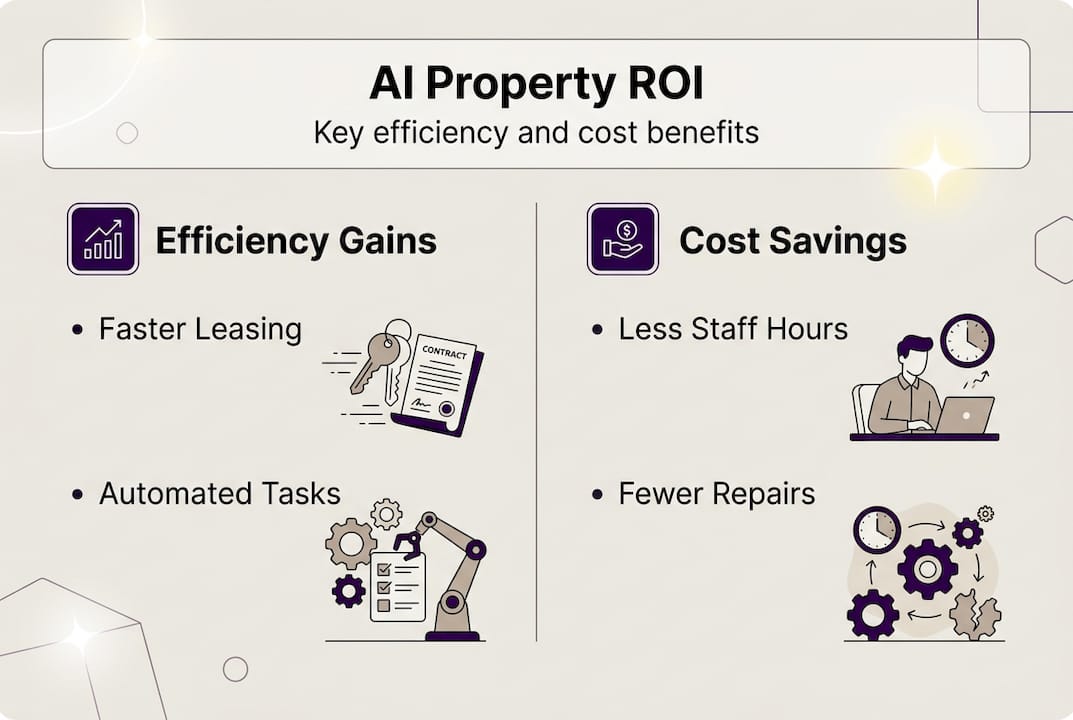
Numbers tell the clearest story here. Property management firms that have deployed AI at scale are reporting results that would have seemed implausible five years ago. The industry is tracking $34 billion in efficiency gains, with ROI figures ranging from 300% to 500% within 12 months for firms that implement correctly.
“Firms implementing AI in commercial real estate operations report 25% operational cost savings, a 12% revenue increase from rent optimization, a 2% occupancy uplift, and a 300% ROI within two years.”
Those numbers reflect firms that treated AI as a strategic investment, not a one-off tool purchase. The occupancy uplift alone, at 2%, translates to meaningful revenue on a portfolio of 500 or more units. Pair that with a 25% reduction in operational costs and the financial case becomes straightforward.
To measure ROI in your own operations, follow these steps:
- Baseline your current costs: Document staff hours spent on leasing, maintenance coordination, and tenant communications per month.
- Identify your highest-cost workflows: Calculate the fully loaded labor cost for each process, including management oversight.
- Set automation targets: Define what percentage of each workflow you expect AI to handle within 90 days.
- Track response time and resolution rate: These are your leading indicators. Faster responses correlate directly with higher tenant satisfaction and lower churn.
- Measure occupancy and delinquency monthly: AI-driven rent reminders and follow-ups typically reduce delinquency rates within the first quarter.
- Calculate net savings quarterly: Compare labor cost reduction plus revenue gains against your AI platform and implementation costs.
For mid-sized firms managing 200 to 2,000 units, realistic targets include a 20 to 25% reduction in administrative labor costs within the first year. Delinquency rates often drop by 15 to 20% once automated reminders and escalation workflows are in place. You can find detailed frameworks for improving business workflows with AI automation and an admin automation guide that maps these steps to property-specific processes. For broader context on managing AI-driven projects, the AI project manager guide offers useful governance frameworks.
Team productivity shifts are equally significant. When AI handles routine intake and follow-up, your property managers shift from reactive task processing to proactive portfolio management. That is a qualitative change with quantitative consequences: better lease negotiations, stronger vendor relationships, and faster issue resolution.
Unlocking advanced benefits: Predictive maintenance and tenant screening
Beyond workflow automation, AI delivers two capabilities that fundamentally change how property teams manage risk: predictive maintenance and AI-powered tenant screening.
Predictive maintenance uses machine learning to analyze historical data, sensor inputs, and maintenance records to forecast equipment failures before they happen. Instead of waiting for an HVAC unit to break down on the hottest day of the year, the system flags it for inspection three weeks earlier. This shifts your maintenance program from reactive to proactive, which is where the cost savings live.
AI-powered tenant screening applies the same machine learning logic to applicant data. It evaluates traditional credit and income data alongside alternative sources, such as payment history patterns and rental behavior, to produce a risk score that is more accurate than manual review. The result is faster decisions and fewer costly defaults.
Here is what these advanced capabilities prevent:
- Sudden equipment failures that generate emergency repair costs and tenant complaints
- Tenant defaults that trigger eviction proceedings and unit vacancy
- Costly turnovers caused by poor screening decisions at the leasing stage
- Deferred maintenance cycles that compound into major capital expenditures
- Compliance gaps from missed inspection or certification deadlines
The performance data is compelling. AI-driven screening fills vacancies 40% faster while reducing defaults by 20 to 30%. Predictive maintenance cuts repair costs by an average of 28%. These are not marginal improvements. They represent a structural shift in how your portfolio performs over time. Reviewing the essential types of AI automation helps clarify where predictive tools fit within a broader automation strategy.
Pro Tip: Predictive maintenance and AI screening only work as well as the data feeding them. Before deploying these tools, audit your maintenance logs and applicant records for completeness. Clean, consistent historical data is what makes the machine learning models accurate.
Best practices for AI implementation in mid-sized property firms
Most AI implementations that underperform do so for the same reasons: poor data preparation, weak PMS integration, and trying to automate everything at once. Mid-sized firms have an advantage here. You are large enough to generate meaningful data but agile enough to move quickly when the approach is right.
Experts consistently recommend prioritizing deep PMS integrations and data cleanup before launching any AI workflow. A phased rollout, starting with leasing and then expanding to maintenance, yields the fastest ROI for firms in the 200 to 2,000 unit range. Follow these steps to implement successfully:
- Audit your data first: Review your PMS records for completeness, consistency, and accuracy. AI models trained on messy data produce unreliable outputs.
- Select your pilot workflow: Choose one high-volume process, leasing intake or maintenance routing, and define clear success metrics before you start.
- Confirm PMS integration depth: Ensure your AI platform can read and write to your PMS in real time. Shallow integrations create data silos that undermine automation.
- Define roles clearly: Assign an internal owner for the AI program. This person coordinates between your IT team, property managers, and the AI vendor.
- Set KPIs before launch: Response time, automation rate, tenant satisfaction score, and delinquency rate are the four metrics that matter most in the first 90 days.
- Run a 60-day pilot: Measure against your baseline. If results meet targets, expand to the next workflow. If not, diagnose before scaling.
- Plan for change management: Property managers who feel replaced will resist the tools. Frame AI as handling the repetitive work so they can focus on higher-value decisions.
Firms that follow this sequence consistently outperform those that deploy broadly without a structured plan. The admin overhead reduction with AI data shows that structured implementations achieve 72% overhead reduction, while unstructured rollouts often stall at 20 to 30%.
How Ailerons.ai can accelerate your AI transformation
The gap between knowing AI works and actually deploying it in your operations is where most mid-sized property firms get stuck. Ailerons.ai specializes in closing that gap. We design and deploy agentic AI systems built specifically for office and operational workflows, including the leasing coordination, maintenance management, document processing, and compliance tracking that your team handles every day. Our AI case studies show how firms like yours have moved from manual, fragmented processes to fully orchestrated AI workflows without disrupting ongoing operations. If you are ready to see what a tailored implementation looks like for your portfolio, explore our services and connect with our team. The firms seeing 300% ROI are not waiting.
Frequently asked questions
How much of property management can AI automate today?
Current AI systems handle 85 to 96% of routine communications and workflows, leaving your team to focus on exceptions and relationship-driven decisions.
What ROI can mid-sized property firms expect from AI?
Firms report 25% cost savings and a 300% ROI within two years, with occupancy and revenue gains adding further upside beyond direct cost reduction.
How does predictive maintenance reduce costs?
By catching equipment issues early using machine learning on sensor data, predictive maintenance cuts repair expenses by 28% and eliminates most emergency service calls.
Should AI integration start with leasing or maintenance?
Start wherever your team handles the highest daily volume. For most mid-sized firms, leasing then maintenance is the sequence that delivers the fastest measurable ROI.
Recommended
- AI-driven operations guide: boost efficiency 72% in 2026 | Ailerons IT Consulting
- AI in Business Process Management: Unlocking Efficiency | Ailerons IT Consulting
- Intelligent Automation Cuts Admin Overhead 72% in 2026 | Ailerons IT Consulting
- Top 5 AI Solutions for Office Operations 2026 | Ailerons IT Consulting
- AI Project Manager: Everything You Need to Know – Optio Station: Best Project Management App for Prioritization