

TL;DR:
- AI-powered compliance transforms reactive regulatory management into continuous, audit-ready risk governance through automation and frameworks. Effective governance structures, comprehensive inventory, real-time immutable logging, and layered frameworks like NIST AI RMF, EU AI Act, and ISO/IEC 42001 are essential for ongoing success. Continuous monitoring, clear incident procedures, and managing shadow AI ensure organizations maintain compliance and audit readiness over time.
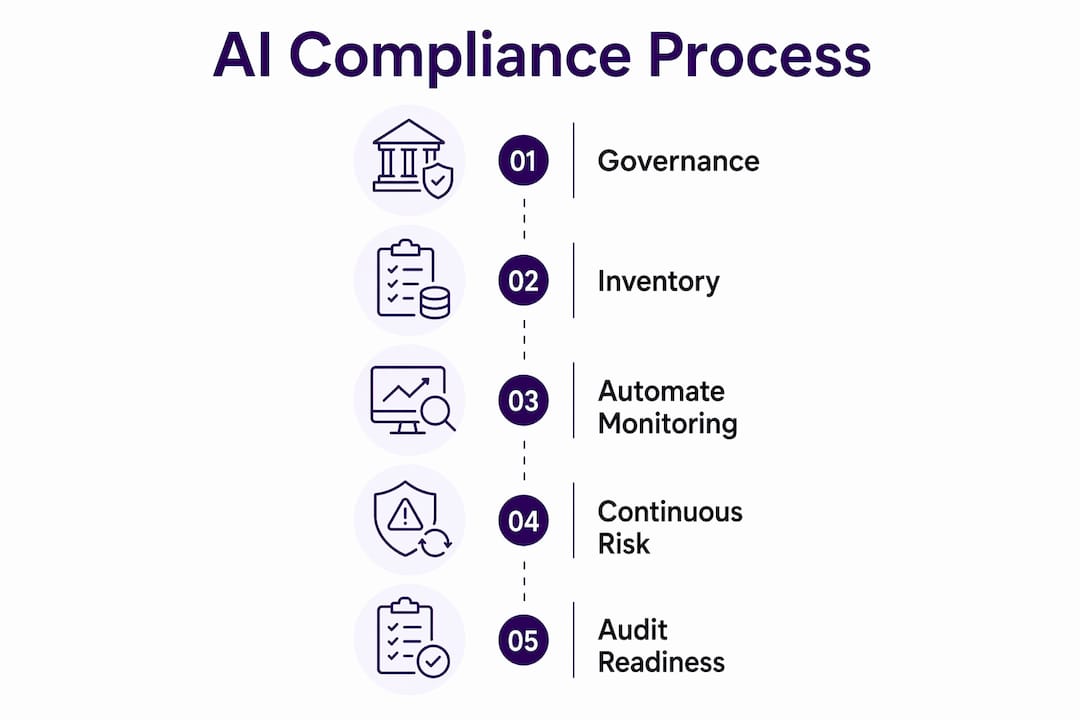
AI-powered compliance is defined as the use of automated monitoring, machine learning, and agentic AI systems to convert reactive regulatory management into continuous, audit-ready risk governance. This ai-powered compliance process guide covers the full operational roadmap: governance structure, AI system inventory, automated logging, framework alignment, and ongoing risk management. The core frameworks driving implementation are the NIST AI RMF and the EU AI Act, with ISO/IEC 42001 providing a certifiable management layer. Organizations that follow this structure gain proactive risk detection, defensible audit trails, and the ability to scale compliance without proportional increases in compliance staff.
What governance structures are essential for AI-powered compliance?
Effective AI compliance programs start with strong governance that enables all succeeding technical controls to function consistently. Without a defined governance foundation, automated tools produce data that no one owns, policies that no one enforces, and audit evidence that no one can defend. Governance is not a preliminary step. It is the operating system for everything else.
An AI governance board should include representatives from legal, IT security, data privacy, operations, and the business units that deploy AI. Cross-functional composition matters because compliance obligations under the EU AI Act and NIST AI RMF span technical, legal, and operational domains simultaneously. A board composed only of IT staff will miss legal exposure. A board composed only of lawyers will miss architectural risk.
The governance structure must produce three categories of documented policy:
- AI ethics and accountability policy: defines who owns each AI system, who approves changes, and what constitutes a compliance violation
- Regulatory compliance mapping: links each deployed AI system to the specific articles, sections, or requirements it must satisfy under applicable law
- Vendor and third-party AI policy: sets standards for AI tools procured externally, including audit rights and data handling obligations
- Incident escalation procedures: specifies thresholds, response timelines, and reporting chains for AI-related compliance failures
- Workforce training requirements: mandates role-specific training so that employees who interact with AI systems understand their compliance responsibilities
Pro Tip: Assign a named AI Compliance Owner for each system in your inventory. Ambiguous ownership is the single most common reason compliance programs fail their first external audit.
The NIST AI RMF’s “Govern” function explicitly frames governance as the precondition for the Map, Measure, and Manage functions. Organizations that skip governance and jump to tooling consistently find that their monitoring data is incomplete, their risk classifications are inconsistent, and their audit packages are indefensible.
How to inventory, classify, and map AI systems in your compliance program
A comprehensive AI system inventory is the foundation of any digital compliance management program. You cannot monitor, classify, or govern what you have not documented. The inventory process has two phases: discovery and classification.

Discovery must include shadow AI applications, which are unsanctioned AI tools used by employees without formal approval. Shadow AI is a universal failure mode. A marketing team using an unapproved generative AI tool for customer communications, or a finance analyst running an unvetted model for forecasting, creates compliance blind spots that automated monitoring cannot cover because those systems are not in scope. Structured discovery requires IT asset scanning, employee surveys, and vendor contract reviews conducted together.
Each AI system in the inventory should capture the following metadata fields:
- System owner: named individual accountable for compliance
- Model type: generative, predictive, classification, or decision-support
- Deployment status: development, testing, production, or retired
- Data inputs: categories of personal, sensitive, or regulated data processed
- Criticality tier: risk classification aligned to the EU AI Act
Risk tier classification under the EU AI Act follows a four-level structure. The table below summarizes the classification criteria compliance teams use most frequently:
| Classification tier | EU AI Act category | Compliance requirements |
|---|---|---|
| Prohibited use | Unacceptable risk | Banned outright; no deployment permitted |
| High-risk | High-risk systems | Full logging, human oversight, conformity assessment |
| Limited risk | Transparency obligations | Disclosure to users that they are interacting with AI |
| Minimal risk | No specific obligations | Best-practice governance recommended |
High-risk systems under the EU AI Act include AI used in hiring, credit scoring, critical infrastructure, law enforcement, and medical devices. These systems require the most rigorous compliance controls, including the automated logging requirements detailed in the next section.
What are the practical steps to automate compliance monitoring and logging?
Automated compliance monitoring is the operational core of any intelligent compliance strategy. EU AI Act Article 12 mandates automatic event logging for high-risk AI systems, specifying minimum fields: the start and end of each use, the reference database consulted, the input data that produced a match, and the identity of the human verifier. These are not optional fields. Missing any one of them makes a log record non-compliant.
The architecture principle that separates compliant systems from non-compliant ones is timing. Immutable causal-chain logs must be written at the moment of AI processing, not reconstructed afterward. Systems that append logs post-hoc fail audit requirements because they cannot prove the record reflects what actually happened at the time of the decision.
Follow these steps to implement automated monitoring and logging:
- Map logging requirements to each system tier. High-risk systems require Article 12-compliant logs. Lower-tier systems require at minimum an activity record for governance purposes.
- Select a logging architecture that writes immutable records in real time. Append-only log stores, cryptographic hashing, and write-once storage are the standard technical controls.
- Define retention policies. Log retention under the EU AI Act carries a floor of six months, but GDPR storage limitation principles require that you do not retain personal data longer than necessary. Document the legal basis for every retention period you set.
- Set quantitative monitoring thresholds. Effective monitoring uses defined triggers: model accuracy drift above 5%, bias disparities above 10%, data completeness below 90%, and explainability scores below 70% each warrant a formal review. These thresholds convert subjective judgment into auditable process.
- Generate exportable evidence packs. Audit readiness requires that compliance evidence can be assembled and exported on demand. Platforms that unify governance and audit readiness in a single tool reduce the time required to respond to a regulatory inquiry from weeks to hours.
- Integrate monitoring with existing risk and privacy programs. Operational AI governance that connects to existing cybersecurity and privacy compliance processes reduces duplicated effort and provides holistic oversight.
Pro Tip: When designing AI compliance review agents, build explicit evaluation rubrics that convert legal requirements into structured findings with quoted evidence. Vague compliance prompts produce outputs that cannot be verified or defended in an audit.
Auditability is not an afterthought. Embedding immutable, causal-chain logs within AI workflows is a compliance imperative, not a technical preference.
Which AI compliance frameworks should guide implementation?
Three frameworks form the operational backbone of any mature AI compliance program: the NIST AI RMF, the EU AI Act, and ISO/IEC 42001. Each serves a distinct function, and the strongest compliance programs use all three in combination.
The NIST AI RMF organizes AI risk management into four core functions. Govern establishes leadership, policies, and accountability. Map defines the risk context for each AI system. Measure quantifies risk using defined metrics. Manage enacts mitigation, monitoring, and continuous improvement. The framework defines outcomes rather than prescriptive steps, which gives organizations flexibility in implementation but requires them to define their own operational procedures.
The EU AI Act adds legal obligation to the framework’s outcome orientation. It specifies mandatory technical requirements for high-risk systems, including Article 12 logging, human oversight mechanisms, conformity assessments, and post-market monitoring. For organizations operating in or selling into the European Union, EU AI Act compliance is not optional regardless of where the AI system was developed.
ISO/IEC 42001 provides the certifiable management system layer that neither NIST nor the EU AI Act fully supplies. NIST AI RMF alignment alone does not guarantee certification. Layering ISO/IEC 42001 creates a certifiable audit structure that regulators and boards recognize as evidence of operational maturity.
| Framework | Primary function | Compliance benefit |
|---|---|---|
| NIST AI RMF | Risk management structure | Outcome-based governance across all AI systems |
| EU AI Act | Legal obligation for high-risk AI | Mandatory logging, oversight, and conformity assessment |
| ISO/IEC 42001 | Certifiable AI management system | Audit-ready certification recognized by regulators |
The practical integration approach is to use NIST AI RMF as the governance and risk measurement operating model, EU AI Act requirements as the technical specification for high-risk systems, and ISO/IEC 42001 as the certification target that validates the entire program. Organizations that treat these as competing frameworks waste resources. They are complementary layers of a single compliance architecture.
How to manage ongoing compliance risks and maintain audit readiness
Continuous risk management requires moving beyond point-in-time assessments to real-time monitoring with defined escalation paths. The governance board established in the first phase owns this process. The technical controls established in the monitoring phase generate the data. The risk management process converts that data into decisions.
Build an AI risk metric dashboard that tracks key risk indicators across all production AI systems. The dashboard should surface model drift alerts, bias disparity flags, data quality scores, and incident counts in a single view. Compliance officers who rely on periodic manual reviews will always be behind the risk curve. A live dashboard tied to automated thresholds closes that gap.
Incident response procedures for AI-related compliance failures must be documented before an incident occurs. The procedure should specify:
- Detection threshold: the metric value or event type that triggers an incident
- Containment action: whether the system is suspended, restricted, or monitored at elevated frequency
- Root cause analysis: the process for determining whether the failure is a data issue, model issue, or process issue
- Regulatory notification: the timeline and format for notifying regulators if the incident meets reporting thresholds under applicable law
- Remediation sign-off: the governance board approval required before a system returns to full operation
AI vendor management is a frequently overlooked component of ongoing compliance. Third-party AI tools used in regulated workflows carry the same compliance obligations as internally developed systems. Vendor contracts should include audit rights, data processing agreements, and incident notification requirements aligned to your internal standards. A compliance checklist applied consistently across vendors prevents the gaps that appear when procurement moves faster than governance.
The most common mistake organizations make at this stage is treating compliance as a project with an end date. Regulatory requirements change. Models drift. New AI systems get deployed. Compliance programs that are built for a point-in-time audit rather than continuous operation will fail the next audit cycle. Build the program to run permanently, not to pass a single review.
Key takeaways
AI-powered compliance requires governance first, automated logging second, and continuous monitoring as the permanent operating state, aligned to NIST AI RMF, EU AI Act, and ISO/IEC 42001.
| Point | Details |
|---|---|
| Governance precedes tooling | Establish a cross-functional AI governance board and documented policies before deploying any monitoring technology. |
| Inventory shadow AI | Structured discovery of unsanctioned AI tools is required to achieve full compliance coverage across the organization. |
| Log at the moment of processing | Immutable, real-time causal-chain logs are required for EU AI Act Article 12 compliance; post-hoc records fail audits. |
| Layer three frameworks | Combine NIST AI RMF, EU AI Act, and ISO/IEC 42001 for a governance model that is both operational and certifiable. |
| Build for continuous operation | Compliance programs designed for a single audit cycle will fail the next one; design for permanent, automated monitoring. |
What I’ve learned from watching compliance programs succeed and fail
I’ve reviewed enough AI compliance implementations to identify the pattern that separates programs that hold up under regulatory scrutiny from those that collapse at the first serious audit. The difference is almost never the quality of the technology. It is almost always the quality of the governance that preceded it.
The organizations that struggle most are the ones that purchased a compliance platform before they defined who owns what. They have dashboards full of data and no process for acting on it. They have logging infrastructure that captures the wrong fields because no one mapped the legal requirements to the technical specification before the build started. Shadow AI is the specific failure mode I see most often. A compliance team believes it has full coverage, but three departments are running AI tools that procurement approved without compliance review. Those tools are invisible to every monitoring system in place.
The organizations that get this right treat the agentic AI design phase as a compliance activity, not just a technical one. They involve legal and compliance in architecture decisions. They build audit evidence generation into the workflow from day one rather than retrofitting it later. They also recognize that compliance is a continuous function, not a project. The programs I’ve seen sustain audit readiness over multiple years are the ones that assigned permanent ownership, set automated thresholds, and built escalation paths that work without manual intervention.
The strategic advice I give consistently: invest more time in governance design than you think you need, and less time shopping for tools than you want to. The right tool in a poorly governed program produces nothing defensible. A well-governed program with a modest tool set produces audit packages that regulators accept.
— Sam
How Ailerons can support your AI compliance program
Ailerons designs and deploys agentic AI systems built for the compliance demands of regulated industries. The work includes compliance workflow automation, AI system inventory design, automated logging architecture, and integration with existing ERP, document management, and risk platforms. Ailerons brings compliance requirements into the design phase rather than treating them as constraints applied after the fact. If your organization is working through governance structure, framework alignment, or audit readiness, the Ailerons case studies page shows how these implementations have been executed for regulated clients. Contact Ailerons to discuss a compliance automation approach tailored to your regulatory environment and existing systems.
FAQ
What is an AI-powered compliance process?
An AI-powered compliance process uses automated monitoring, machine learning, and agentic AI to manage regulatory obligations continuously rather than through periodic manual reviews. It converts compliance from a reactive activity into a proactive, audit-ready governance function.
What does EU AI Act Article 12 require for logging?
Article 12 requires high-risk AI systems to automatically log the start and end of each use, the reference database consulted, matched input data, and verifier identities. Log retention carries a minimum floor of six months under Article 19.
How does NIST AI RMF relate to EU AI Act compliance?
The NIST AI RMF provides the governance and risk measurement structure through its Govern, Map, Measure, and Manage functions, while the EU AI Act specifies the mandatory technical requirements for high-risk systems. The two frameworks are complementary and work most effectively when used together.
What is shadow AI and why does it matter for compliance?
Shadow AI refers to AI tools used within an organization without formal approval or compliance review. It creates coverage gaps in monitoring programs and represents a significant risk for regulated industries because those systems fall outside the governance and logging controls applied to sanctioned AI deployments.
How do you maintain audit readiness between formal reviews?
Audit readiness is maintained through real-time risk metric dashboards, automated threshold alerts, immutable log retention, and documented incident response procedures. Organizations that build continuous monitoring into their operating model do not need to prepare for audits because they are always in an audit-ready state.
Recommended
- Secure AI Systems for Compliance: Minimizing Regulatory Risks | Ailerons IT Consulting
- AI compliance tips for law firms: boost accuracy | Ailerons IT Consulting
- AI Compliance in Business: Mitigating Risks for Healthcare Operations | Ailerons IT Consulting
- Secure, Compliant AI Design: Building Trustworthy Agentic Systems | Ailerons IT Consulting