

TL;DR:
- AI automation manages simple, rule-based tasks, while AI orchestration coordinates complex, multi-agent workflows requiring judgment. Orchestration maintains context, handles exceptions, and enforces governance, unlike automation’s fixed logic. Correctly distinguishing and applying these approaches enhances AI ROI and operational reliability.
Many technology leaders treat AI orchestration and automation as interchangeable terms. They are not, and that confusion is expensive. When organizations apply automation logic to problems that require orchestration, or vice versa, they end up with brittle workflows, failed AI rollouts, and teams that lose trust in the technology entirely. Understanding the real differences between ai orchestration vs automation is not an academic exercise. It directly determines whether your AI investments deliver measurable returns or stall at the proof-of-concept stage.
Table of Contents
- Key takeaways
- AI orchestration vs automation: what each one actually means
- Comparing the two: a side-by-side view
- Why governance and context set orchestration apart
- Choosing the right approach for your workflows
- The measurable impact on business operations
- My take on where most AI initiatives actually go wrong
- How Ailerons helps you get this right
- FAQ
Key takeaways
| Point | Details |
|---|---|
| Automation handles isolated tasks | Use automation for stable, rule-based processes where speed and consistency matter most. |
| Orchestration manages complex workflows | AI orchestration coordinates multiple agents, tools, and humans across multi-step processes requiring judgment. |
| Governance separates them at scale | Context awareness, audit trails, and accountability controls are features of orchestration, not automation. |
| Misapplying either creates risk | Applying automation to adaptive workflows leads to failures; orchestration overkill on simple tasks wastes resources. |
| Both have a place in your stack | Most organizations benefit from combining automation and orchestration based on task complexity. |
AI orchestration vs automation: what each one actually means
These two concepts operate at fundamentally different levels. Getting the definitions right is the starting point for every strategic AI decision that follows.
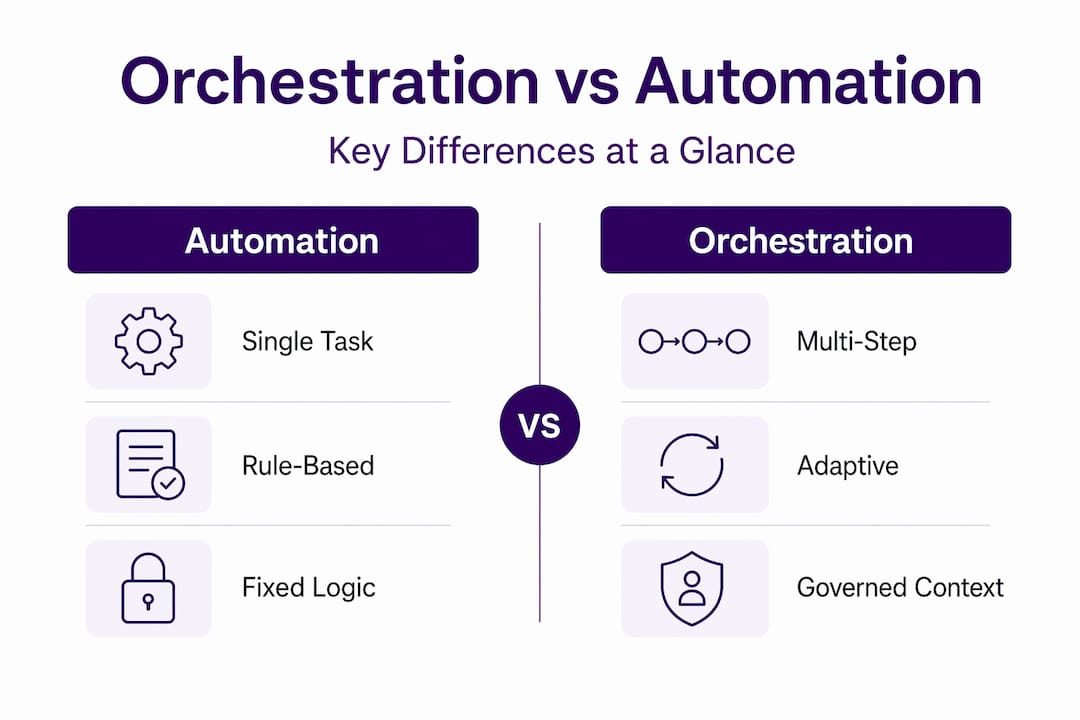
AI automation refers to using software to execute single, repetitive tasks based on predefined rules. It is deterministic. Given a specific trigger, it performs a specific action every time. Think invoice data extraction, automated email routing, or form-based data entry pushed into a CRM. The task is bounded. The logic is fixed. There is no decision layer involved.
AI orchestration is a different category entirely. It refers to coordinating multiple AI agents, models, tools, and sometimes humans to execute complex, multi-step workflows that unfold across systems and time. As one description captures it well:
Orchestration platforms coordinate AI models and tools into unified workflows with centralized governance, improving reliability and scalability compared to basic automation.
Consider a practical example. Automating the extraction of line items from a purchase order is automation. Orchestrating the full procurement approval cycle, where an AI agent extracts the data, cross-references it against vendor contracts, flags exceptions for human review, routes approvals through a hierarchy, and updates the ERP record, is orchestration.
The core differences between AI orchestration and automation come down to four dimensions:
- Scope: Automation targets individual tasks; orchestration targets entire workflows.
- Complexity: Automation handles linear logic; orchestration manages branching, conditional, and multi-agent processes.
- Adaptability: Automation follows fixed rules; orchestration responds to changing context and intermediate outputs.
- Human involvement: Automation typically runs without human touchpoints; orchestration incorporates human-in-the-loop checkpoints by design.
Conflating AI and automation leads directly to underwhelming outcomes because they require different architectures, different governance models, and different success metrics.
Comparing the two: a side-by-side view
The table below maps the practical differences between AI orchestration and automation across the dimensions that matter most to technology leaders.
| Dimension | AI Automation | AI Orchestration |
|---|---|---|
| Task scope | Single, discrete tasks | Multi-step, cross-system workflows |
| Decision logic | Predefined rules, no adaptation | Adaptive decisions based on context |
| Agent coordination | Single tool or bot | Multiple agents, models, and humans |
| Error handling | Fails or stops on exception | Dynamic recovery and rerouting |
| Governance | Minimal, task-level logs | Audit trails, dependency tracking |
| Scalability | Scales for volume of one task | Scales for complexity of many tasks |
| Best fit | Stable, repeatable processes | Judgment-requiring, variable workflows |
Traditional automation executes predefined task sequences, whereas AI orchestration includes adaptive decision-making, multi-agent coordination, and audit trails. The distinction matters because the tools you select, the governance you build, and the teams you involve all differ based on which approach is right.

Common pitfalls occur when leaders apply automation to workflows that require orchestration. An invoice approval process built on automation will break every time an exception appears, a vendor sends a non-standard document format, or an approval threshold changes. Without orchestration logic, that exception falls into a manual queue and negates the efficiency gains entirely.
Pro Tip: Before choosing between automation and orchestration, map the failure modes of your target process. If exceptions require judgment or cross-system context, you need orchestration, not automation.
Workflow orchestration manages multi-system, cross-functional processes with dependency management, error handling, and real-time monitoring, which is a capability set that simple automation tools for AI simply do not offer.
Why governance and context set orchestration apart
At enterprise scale, the difference between AI orchestration and AI automation is not just about capability. It is about accountability. This is where most technology evaluations miss a critical factor.
AI orchestration is designed to maintain context across a workflow’s full lifecycle. When an agent hands off a task to another agent, or escalates to a human reviewer, the orchestration layer carries forward the full history, the prior decisions, the data sources consulted, and the logic applied. Without that context continuity, you get fragmented outputs and accountability gaps.
Context, governance, and traceability are now the main battlegrounds in orchestration. Platforms must provide living institutional knowledge and audit trails for trust. That is a statement worth sitting with. The orchestration platform itself is becoming table stakes. What differentiates mature deployments is the governance layer built on top of it.
Here is what that governance layer looks like in practice:
- Audit trails that capture every agent decision, data input, and human approval across the workflow.
- Dependency management that prevents downstream agents from acting on incomplete or unvalidated upstream data.
- Human-in-the-loop checkpoints that trigger automatically when confidence thresholds drop or exceptions exceed defined parameters.
- Access controls that restrict which agents can query which data sources, reducing security exposure.
Common failure modes of AI orchestration projects include context loss between agents, security exposure from misconfigured data access, tool sprawl, and accountability gaps. These are not edge cases. They are the standard failure pattern for organizations that adopt orchestration tools without building the governance infrastructure around them.
AI agents independently execute tasks, but orchestration is essential infrastructure coordinating multiple agents with governance and reliability controls.
When evaluating how does AI orchestration work in your specific environment, the first question should not be which platform to use. It should be what governance framework you will enforce across agent interactions, data access, and exception handling.
Choosing the right approach for your workflows
Knowing the differences between AI orchestration and automation is useful. Knowing when to apply each is where the real operational value comes from. Here is a practical framework for making that call.
-
Identify task stability. If the process runs the same way every time with minimal exceptions, automation is the right fit. Payroll calculations, scheduled report generation, and standard data transfers fall into this category. Applying orchestration to these tasks adds unnecessary complexity and overhead.
-
Count the decision points. If the workflow requires branching logic, like “if the invoice total exceeds $50,000, route to CFO approval; if the vendor is flagged, pause and escalate,” you are looking at an orchestration use case. Multiple decision points require adaptive logic that automation cannot provide.
-
Map the systems involved. If a workflow touches one system, automation likely handles it. If it spans CRM, ERP, document management, email, and a human approval layer, orchestration is the right architecture. AI automation strategies that ignore cross-system complexity tend to produce siloed improvements rather than end-to-end gains.
-
Assess exception frequency. A process with a 2% exception rate can likely tolerate automation with manual fallback. A process with a 20% exception rate needs orchestration with built-in recovery logic, or it will generate more manual work than it eliminates.
-
Consider the combination. Organizations need both automation for predictable tasks and orchestration for complex, multi-agent workflows involving judgment and adaptability. The most effective AI automation strategies use automation as a component within an orchestrated workflow, not as a replacement for one.
Pro Tip: Build a process inventory before selecting technology. Tag each process by exception rate, system count, and decision complexity. This gives you a defensible, data-driven basis for allocating automation versus orchestration resources.
Preparing your team matters as much as selecting the right tools. Orchestration adoption requires cross-functional alignment between IT, operations, compliance, and the business units owning each workflow. Getting that alignment early prevents the tool-sprawl and governance gaps that derail most implementations.
The measurable impact on business operations
The case for getting this distinction right is not theoretical. The numbers from organizations that have made the shift are concrete.
Organizations typically see productivity improvements of 30 to 50% in orchestrated processes compared to manual workflows, along with error rate reductions of 60 to 80% through automatic dependency and recovery management. Those are not projections. They reflect the operational reality of replacing fragmented, manual, or automation-only approaches with properly designed orchestration.
The data on adoption challenges is equally instructive. 45% of organizations in the Asia-Pacific region deploy agentic AI for scale, but 88% cite fragmented data as a major barrier to effective orchestration. That gap between deployment ambition and execution reality points directly to the governance and context management gaps discussed earlier.
AI orchestration combines multiple AI tools and human review moments to create continuous, validated workflows that reduce rework and improve product delivery speed and quality.
Organizations that treat orchestration as essential AI infrastructure rather than an optional add-on consistently outperform those that layer automation tools on top of one another and call it a strategy. The performance gap between those two approaches widens as workflow complexity increases.
My take on where most AI initiatives actually go wrong
I’ve worked alongside a lot of technology teams that were frustrated by AI programs that looked great on paper and underdelivered in practice. In most cases, the root cause was the same. The team had automated a collection of individual tasks and assumed they had built an intelligent workflow. They hadn’t.
What I’ve observed is that automation gives you speed on individual steps. Orchestration gives you reliability across the full process. Those are very different outcomes, and treating them as equivalent is what causes AI initiatives to stall at the pilot stage. When a handoff breaks, when an exception appears, when context from step one needs to inform a decision at step seven, automation has no answer. Orchestration does.
My honest view is that governance is not a feature you bolt on later. It is the architecture decision you make first. The organizations I’ve seen get the most out of their AI deployments are the ones that mapped accountability and audit requirements before they wrote a single line of workflow logic. They knew exactly which agent could access which data, who reviewed which exceptions, and how every decision would be traced back to its inputs.
Treating orchestration as optional infrastructure is a mistake that tends to become visible at the worst possible time. Not during the pilot. During the first major exception, audit, or compliance review.
— Sam
How Ailerons helps you get this right
Understanding the difference between AI orchestration and automation is step one. Deploying the right architecture across your business operations is where Ailerons specializes. Ailerons designs and deploys agentic AI systems built for real office workflows, including billing support, document processing, compliance-driven tasks, and front-office coordination. Every implementation is grounded in governance, auditability, and integration with the systems your teams already use. If you want to see how this translates into measurable operational results, the Ailerons case studies show exactly what these deployments look like in practice. For a conversation about your specific workflows, explore Ailerons’ AI consulting services to find the right starting point.
FAQ
What is the main difference between AI orchestration and automation?
AI automation handles individual, rule-based tasks with fixed logic, while AI orchestration coordinates multiple agents, tools, and humans across complex, multi-step workflows that require adaptive decision-making and governance controls.
When should a business use orchestration instead of automation?
Use orchestration when a workflow spans multiple systems, involves frequent exceptions, requires human approval checkpoints, or depends on decisions made earlier in the process informing actions taken later.
How does AI orchestration work at the enterprise level?
AI orchestration platforms coordinate AI models and tools through centralized governance, maintaining context across agent handoffs, managing dependencies between tasks, and providing audit trails for accountability and compliance.
Can automation and orchestration be used together?
Yes. Most mature AI deployments use automation for stable, predictable sub-tasks within a larger orchestrated workflow. Automation handles volume and speed; orchestration handles complexity and judgment.
What are the biggest risks of misapplying automation instead of orchestration?
The most common failure modes include context loss between process steps, unhandled exceptions that fall into manual queues, accountability gaps during audits, and brittle workflows that break whenever process conditions change.
Recommended
- 6 actionable tips for AI-driven operational efficiency | Ailerons IT Consulting
- Master the Administrative Task Automation Process Today | Ailerons IT Consulting
- AI-first operating model: a step-by-step guide — Ailerons
- How to harness decision logic in automation with agentic AI | Ailerons IT Consulting