

TL;DR:
- Deploying AI in administration requires thoughtful workflow redesign, deliberate task chaining, and strategic human oversight to achieve genuine efficiency gains.
- Agentic AI’s autonomous multi-step capabilities demand traceability and structured governance gates to ensure compliance and accurate decision-making.
- Focusing on process improvement and proper validation, rather than solely on AI accuracy, yields sustainable operational benefits and regulatory readiness.
Most business leaders assume that deploying AI will automatically reduce administrative overhead. Buy a tool, connect it to your systems, watch the workload shrink. The reality is more specific. AI in administrative processes delivers real results, but only when implementation is thoughtful, workflows are deliberately redesigned, and human oversight is placed exactly where it matters. This guide covers what agentic AI actually does in administrative settings, where it needs help from humans, and how to structure your workflows to get genuine efficiency gains rather than expensive disappointment.
Table of Contents
- Understanding agentic AI and its role in administrative workflows
- Mitigating risks: the importance of human-in-the-loop and validation
- Designing efficient workflows: task chaining and reducing AI-human handoffs
- Governance frameworks: placing human oversight gates effectively
- Technology options: document AI advances and selection criteria for administrative automation
- Rethinking AI in administration: why workflow design beats hype and raw accuracy
- Explore how Ailerons IT Consulting can transform your administrative workflows with agentic AI
- Frequently asked questions
Understanding agentic AI and its role in administrative workflows
Most AI tools available today handle one task at a time. They extract text from a document, classify an email, or suggest a response. Useful, but limited. Agentic AI is different. These systems can autonomously plan and carry out multi-step administrative tasks without waiting for a human to trigger each step. A single agentic workflow might receive an invoice, cross-check it against a purchase order, flag a discrepancy, route the exception to the right approver, and update the accounting system once approved, all without manual coordination.
That level of autonomy creates a new requirement: traceability. When AI is making sequential decisions, you need to know what it decided, why, and based on what data. NIST points toward measuring agentic AI actions using evaluation probes that produce machine-readable audit trails. These probes function as checkpoints embedded within the workflow that capture agent state, decision inputs, and outputs at each step.
Why does this matter for administration specifically? Because many administrative decisions carry compliance weight. Budget approvals, contract renewals, vendor onboarding, personnel record updates. Errors in these areas are not just inconvenient. They can trigger audits, regulatory findings, or financial losses.
Key capabilities agentic AI brings to administrative work include:
- Autonomous task sequencing: completing multi-step processes without per-step human triggers
- Context retention: carrying relevant information across steps within a workflow
- Exception handling: identifying when a task falls outside normal parameters and escalating appropriately
- System integration: updating records across CRM, ERP, document management, and scheduling platforms
- Audit trail generation: producing structured logs of every decision and action taken
Mitigating risks: the importance of human-in-the-loop and validation
Agentic AI produces outputs that are often accurate. But “often” is not the standard you need when you are approving a grant budget or processing a vendor payment. Human-in-the-loop review is recommended specifically because AI models can produce numbers and conclusions that sound right but are not. The model fills gaps in its understanding with plausible-sounding content, which is a real risk in financial contexts.
The practical implication: treat AI outputs as drafts, not decisions. Agentic workflows should be designed so that consequential outputs, contract values, budget figures, compliance determinations, pass through a defined human review step before they take effect. This is not a limitation of the technology. It is good process design.
Legal frameworks reinforce this. Officials must validate general-purpose AI outputs because AI chat models alone cannot fulfill legal standards that require genuine analysis and assessment. Regulatory compliance requires that a qualified human take responsibility for the decision, not just document that AI produced it.
The goal is not maximum AI coverage. The goal is accurate, defensible outcomes at acceptable speed. Human review built into the right points achieves that without turning into a bottleneck.
- Treat AI outputs as first drafts requiring verification in high-stakes tasks
- Map which workflow steps carry financial, legal, or compliance consequences
- Place review gates at those specific steps, not uniformly across every task
- Use structured checklists so reviewers validate specific fields rather than re-doing the AI’s work
- Track and analyze the frequency of corrections to identify where the AI needs improvement
Pro Tip: Pair your AI review process with compliance-aware implementation practices from the start. Retrofitting compliance requirements onto an existing AI workflow costs significantly more than building them in at design time.
Designing efficient workflows: task chaining and reducing AI-human handoffs
Early AI adoption in offices focused on individual task automation. Automating data entry. Automating email sorting. The results were modest because the surrounding workflow remained manual. Each automated task was an island.

Workflow redesign often matters more than step-level model quality. The concept is task chaining: identifying adjacent administrative tasks that can be linked into a continuous AI execution sequence, removing the handoffs between AI and human that create delays and coordination costs. A workflow that processes a vendor application might chain document intake, identity verification, duplicate detection, risk scoring, and record creation into one uninterrupted AI sequence before presenting a human with a clear approve-or-reject decision.
The counterintuitive finding here is that slightly lower AI accuracy at individual steps within a chain often outperforms higher accuracy on isolated tasks with many handoffs. The coordination overhead of repeatedly passing work between AI and human review eats up any quality advantage.
Designing effective task chains requires three things. First, map which tasks are genuinely AI-friendly: structured inputs, predictable outputs, low-to-medium consequence. Second, identify where tasks share data dependencies, which indicates they belong together in a chain. Third, place a single human review gate at the end of the chain rather than between each step.
| Factor | Isolated task automation | Task chaining |
|---|---|---|
| Processing speed | Slower, multiple handoffs | Faster, continuous execution |
| Coordination cost | High (AI-to-human transfers per step) | Low (one review gate per chain) |
| Error accumulation | Caught step-by-step, creates delays | Reviewed at chain exit, reduces interruptions |
| Staff time required | Higher per-unit involvement | Concentrated at decision points |
| Scalability | Limited by review volume | Scales with chain length and parallelism |
Pro Tip: Before you deploy any AI, map your administrative task sequences end-to-end. The map will reveal which steps can be chained and where the real review bottlenecks sit. Start there, not with the most obvious automation target.
For practical guidance on applying this at an operations level, the AI-driven operations efficiency guide covers how to translate workflow maps into executable AI configurations.
Governance frameworks: placing human oversight gates effectively
Adding human review gates without structure creates new problems. Generic approvals at every step slow everything down and train reviewers to rubber-stamp outputs because the volume is too high to genuinely evaluate each one. Effective agentic workflow oversight requires defined gate types with clear purposes and associated service-level agreements (SLAs).
Four gate types cover most administrative governance needs:
- Advisory gates: AI completes the task and flags a recommendation for human awareness. No approval required. Used for low-consequence informational tasks like status updates.
- Validating gates: A human reviews AI output and confirms it is accurate before the workflow continues. Used for data-sensitive tasks like financial record updates.
- Blocking gates: The workflow cannot proceed until a human explicitly approves. Used for high-consequence actions like contract execution or budget commitments.
- Escalating gates: AI identifies a condition outside its authority and routes to a senior decision-maker. Used when inputs fall outside defined parameters.
Mapping who performs each gate review requires a RACI framework. RACI stands for Responsible, Accountable, Consulted, and Informed. Without this mapping, reviews get duplicated or skipped, and accountability disappears.
| Gate type | Purpose | Standard SLA | Example task |
|---|---|---|---|
| Advisory | Awareness only | No SLA required | AI flags upcoming contract renewal |
| Validating | Confirm accuracy | 4 hours | Budget line item extraction review |
| Blocking | Authorize action | 15 minutes to 4 hours | Vendor payment approval |
| Escalating | Senior decision required | 24 hours | Exceptions outside policy limits |
Audit trails generated at each gate, including the agent state before and after the review, provide the documentation your team needs during regulatory audits. This also supports the compliance requirements in agentic AI workflows that govern industries like healthcare, finance, and government contracting.
Pro Tip: Design your gate placement based on actual risk levels in your workflow, not on general caution. Over-gating creates reviewer fatigue, which is worse than having fewer gates that reviewers take seriously.
Technology options: document AI advances and selection criteria for administrative automation
Document processing is one of the highest-volume administrative functions in most mid-sized organizations. Purchase orders, contracts, invoices, grant applications, personnel forms. Getting data out of these documents accurately is foundational to everything else.
The older approach chains OCR (optical character recognition) software with a large language model. The OCR converts the document image to text, and the language model extracts meaning. This pipeline is fragile on complex layouts. Tables with merged cells, multi-column forms, and mixed text-image documents regularly produce extraction errors that require correction downstream.
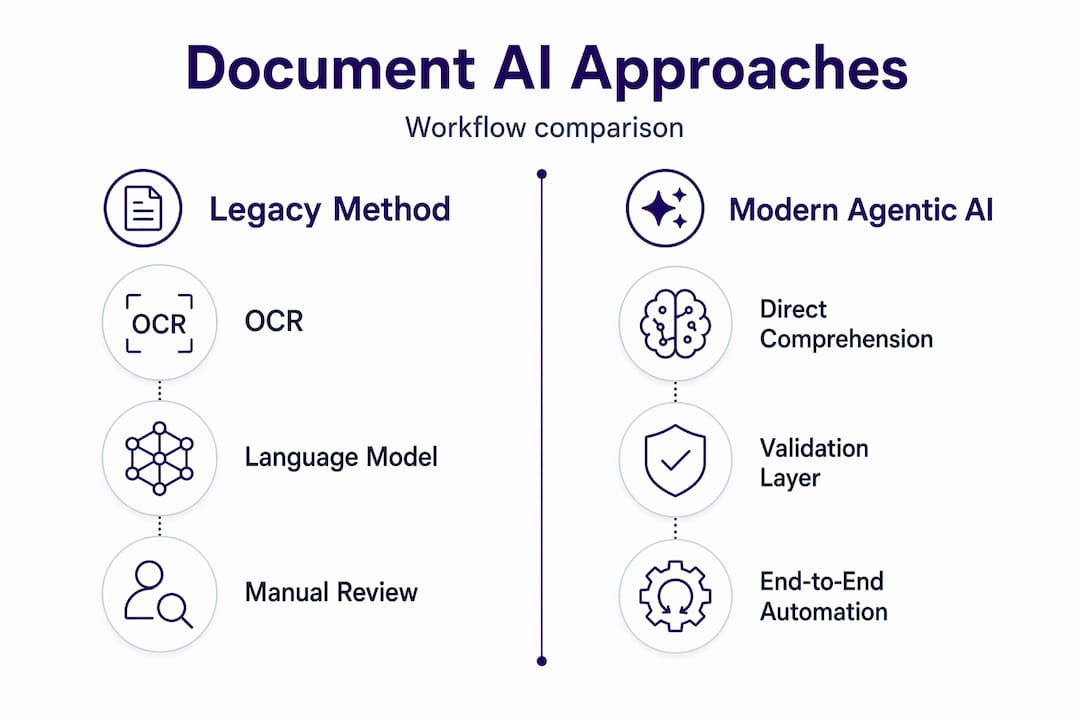
Native vision AI models process entire document images directly, understanding text and layout simultaneously rather than sequentially. This joint understanding significantly improves accuracy on tables and forms, which are the document types most common in administrative work.
When evaluating document AI for administrative use, consider:
- Accuracy on complex tables: test with your actual document types, not vendor benchmarks
- Local processing capability: documents containing personally identifiable information or financial data may require on-premises or private cloud processing for security and regulatory compliance
- Prompt adaptability: document formats change; solutions that allow prompt adjustment without retraining are easier to maintain
- Validation interface: reviewers need a fast, clear way to check extractions, flag errors, and confirm outputs
- Audit logging: the system should record what was extracted, from where, and when
External tools focused on AI document comprehension address the trust and validation layer specifically, which is worth evaluating alongside your extraction solution. Keep in mind that even with the best available models, human validation on high-stakes documents remains a necessary part of the process, not an optional extra.
For a broader view of where document AI fits within office operations automation trends, the current landscape covers everything from intake processing to archiving and retrieval.
Rethinking AI in administration: why workflow design beats hype and raw accuracy
The most common mistake in AI adoption is treating it as a technology decision rather than an organizational design decision. Leadership evaluates AI tools based on accuracy scores, feature lists, and demos. They purchase the highest-performing model and expect efficiency to follow. It rarely does.
Workflow redesign reduces coordination costs more than step-level model improvements do. Swapping a good model for a slightly better one saves fractions of a percentage point on error rates. Eliminating three unnecessary AI-to-human handoffs in a single workflow can cut processing time by 40% or more. The math strongly favors organizational redesign over model selection.
The second overlooked factor is traceability. Many organizations focus their AI investment on outputs and neglect the infrastructure around them. Building measurement into agentic systems is essential for traceability and trust, and those properties become requirements as soon as AI influences a regulated or high-consequence decision. Audit trails are not bureaucratic overhead. They are what allow you to defend a decision, identify a failure point, and demonstrate compliance.
The practical guidance for operations leaders is this: redesign your workflows around AI capabilities before you deploy the technology. Map your current administrative processes, identify where AI can run uninterrupted chains, place governance gates at genuine risk points, and build audit logging from day one. Then deploy. That sequence produces real efficiency gains. The reverse sequence produces tools that are technically impressive and operationally disappointing.
For a structured approach to this redesign, the administrative task automation process guide covers the sequencing in practical detail.
Explore how Ailerons IT Consulting can transform your administrative workflows with agentic AI
Applying these principles requires more than reading about them. Ailerons IT Consulting works with mid-sized companies to design and deploy agentic AI systems built specifically for administrative and operational workflows. That includes workflow mapping and task chain design, governance framework setup, document AI integration, and compliance-aligned implementation. The case studies available on the Ailerons site show how these systems perform across real administrative environments, from billing and accounts payable to contract management and internal approvals. If you want to identify where agentic AI can create measurable efficiency gains in your organization, start by visiting Ailerons IT Consulting to book a personalized assessment. Knowing exactly where to start is half the work.
Frequently asked questions
What is agentic AI in administrative processes?
Agentic AI refers to autonomous AI systems that plan and execute multiple interlinked administrative tasks without constant human input, improving workflow efficiency across functions like document processing, approvals, and record management.
Why does human-in-the-loop remain important despite AI automation?
Human review catches plausible but incorrect AI outputs, which is especially critical in financial or compliance contexts where errors carry real consequences.
How does task chaining improve AI-driven workflow efficiency?
Task chaining links interdependent steps into continuous AI execution sequences, cutting the number of AI-to-human handoffs and reducing coordination overhead across the entire process.
What governance practices ensure compliance in AI administrative systems?
Implementing four gate types with defined roles, SLAs, and audit trails creates consistent human oversight without creating review bottlenecks that slow down daily operations.
Which document AI technology is best for complex administrative documents?
Native vision AI models that read documents as images outperform OCR plus LLM pipelines on tables and complex forms, though human validation on high-stakes outputs remains necessary regardless of the technology used.
Recommended
- AI decision logic for smarter business workflows in 2026 | Ailerons IT Consulting
- AI-first operating model: a step-by-step guide — Ailerons
- Master the Administrative Task Automation Process Today | Ailerons IT Consulting
- AI in Business Process Management: Unlocking Efficiency | Ailerons IT Consulting