

TL;DR:
- AI enhances consulting firm operations by automating workflows, compressing research, and encoding methodologies for autonomous execution. Firms like McKinsey and Deloitte lead by adopting expertise architecture, integrating specialized AI agents, and prioritizing internal process automation to achieve scalable, high-quality outputs. Success depends on careful data preparation, defining control boundaries, and deploying purpose-built systems within secure environments.
AI for consulting firm operations is defined as the deployment of autonomous agents, machine learning models, and integrated AI platforms to execute, coordinate, and optimize the internal and client-facing workflows that consulting firms run daily. This goes well beyond chatbots or document search. Firms like McKinsey, BCG, Deloitte, and IBM are now using purpose-built AI systems to automate pipeline management, compress research synthesis from days to hours, generate proposals, and encode proprietary methodologies into repeatable intelligent workflows. The productivity case is concrete: McKinsey’s internal Lilli platform saves approximately 50,000 hours per month firmwide. For consulting firms still running these processes manually, the competitive gap is widening fast.
What are the most impactful AI applications for consulting firm operations?
The highest-value AI applications in consulting operations fall into three categories: back-office automation, knowledge synthesis, and client deliverable generation. Each addresses a different cost center, and together they account for the majority of non-billable time that consulting firms currently absorb.
Back-office automation covers the administrative layer that consumes consultant hours without producing client value. Autonomous agentic workflows now handle time tracking, invoice approval, pipeline updates, and scheduling with minimal human input. Consulting firms using agentic workflows improve consultant utilization rates by 25%, with up to 40% of back-office tasks automated within two years. That utilization gain translates directly to revenue capacity without adding headcount.
Knowledge synthesis is where AI delivers its most dramatic time compression. Scoping decks that previously required two days of research and drafting now take approximately three hours with AI knowledge synthesis platforms. This shift moves consultant effort from data retrieval to evaluation and judgment, which is where billable expertise actually lives. Firms integrating multiple large language models such as OpenAI, Anthropic, and Cohere, each optimized for specific task types, see the strongest performance gains across research workflows.
Client deliverable generation includes proposal drafting, slide creation, and meeting documentation. AI tools that encode firm-specific methodologies, such as Minto Pyramid principles for structured communication, produce first drafts that require less rework and maintain consistent quality standards across engagements.
Pro Tip: Before deploying AI on client deliverables, pilot it on internal documents first. Internal outputs have lower stakes and give your team time to calibrate the AI’s output quality against your firm’s standards.
- Autonomous agents handle time tracking, invoicing, and CRM updates without manual input
- Knowledge synthesis platforms cut scoping deck creation from two days to three hours
- Proposal generation AI encodes firm methodology to reduce rework
- AI meeting notes tools capture and structure client conversations automatically
- Early AI adoption recovers 6 to 8% of lost billable hours through automated time tracking and invoice approval alone
How does expertise architecture change consulting operations with AI?
Expertise architecture is the practice of encoding a firm’s domain-specific judgment, decision thresholds, escalation rules, and house styles directly into AI systems so those systems can execute expert-level work autonomously. It is the concept that separates transformative AI adoption from basic process acceleration.
Most firms start by using AI as an accelerator: a consultant still does the thinking, and AI speeds up the typing. Expertise architecture flips that model. The firm’s intellectual property, its frameworks, its risk tolerances, its client communication standards, gets embedded into the AI’s logic. The system then executes within those parameters without requiring a senior consultant to supervise every output. The competitive edge in consulting AI is now expertise architecture, specifically the encoding of domain judgment into autonomous systems that deliver outcomes with human oversight rather than human execution.
This shift has direct implications for how consulting firms price their work. The traditional hours-based billing model assumes that consultant time is the scarce resource. When AI systems can execute significant portions of an engagement, time is no longer the binding constraint. The era of billing by hours is fading as outcome-driven models become viable, enabled by AI systems that encode and execute expertise autonomously.
The firms leading this transition are not small experimenters. McKinsey and AWS have a joint venture focused on AI-driven consulting delivery. Accenture has committed billions to AI investments across its service lines. These moves signal that expertise architecture is becoming a structural capability, not a pilot project.
“Firms that treat AI as a faster typewriter will lose to firms that treat it as a new category of intellectual infrastructure.” This distinction defines which consulting businesses scale profitably in the next five years.
The practical steps for building expertise architecture follow a clear sequence:
- Document the decision logic your best consultants use on high-frequency tasks
- Identify which decisions have clear rules versus which require genuine judgment
- Encode rule-based decisions into AI workflows with defined approval thresholds
- Build escalation paths for edge cases that require human review
- Test outputs against historical work product before deploying with clients
What are best practices for deploying AI in consulting firm workflows?
Successful AI deployment in consulting operations follows a specific sequence. Firms that skip steps, particularly data preparation and control boundary setting, create more operational risk than they eliminate.
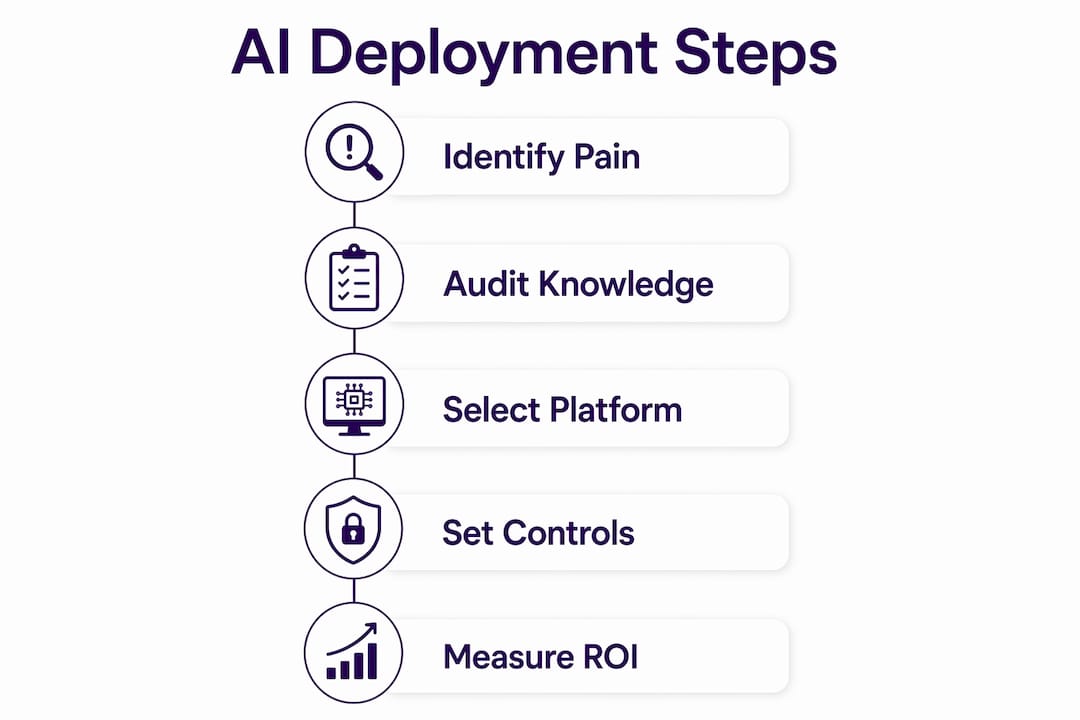
Start with internal pain points, not client deliverables. The highest-friction internal processes, time tracking, expense reconciliation, pipeline reporting, are the right starting point. They are painful enough to motivate adoption, low-stakes enough to tolerate early errors, and measurable enough to validate ROI quickly. Starting with painful internal processes before moving to client delivery automation is the proven deployment sequence.
Audit your knowledge base before connecting it to AI. AI systems produce outputs that reflect the quality of their inputs. Outdated proposal templates, inconsistent CRM data, and poorly structured document libraries will generate unreliable AI outputs. Clean, structured, and consistently labeled data is a prerequisite, not an afterthought.
Select platforms with native integrations. AI tools with native integrations for Salesforce, QuickBooks, and Slack are measurably more effective than isolated tools that require custom connectors. Custom integration work is expensive, slow, and creates maintenance debt that compounds over time.
Pro Tip: When evaluating AI platforms, ask vendors specifically which CRM, ERP, and accounting systems they integrate with natively. A tool that requires a custom API build for your core systems will cost more to deploy than it saves in the first year.
The deployment sequence that produces the most consistent results looks like this:
- Identify the three most time-consuming internal processes and measure current hours spent
- Audit and clean the data sources those processes depend on
- Run a 30-day pilot with one AI agent on one process, tracking hours saved and error rates
- Set explicit permission boundaries: define what the AI can execute autonomously versus what requires human approval
- Measure against specific KPIs before expanding to additional workflows
- Expand incrementally across sales, finance, HR, and IT operations
Setting control boundaries deserves particular attention. Over-empowered agents that can approve invoices, send client communications, or update contracts without human review create legal and reputational exposure. Define approval thresholds carefully and build escalation rules before going live.
How do AI tools differ and what features matter most for consulting firms?
Not all AI tools deliver equivalent value for consulting operations. The difference between a generic chatbot, a browser-based AI writing assistant, and a custom-integrated agentic system is not incremental. It is categorical.

| Feature | Generic chatbot | Browser-based AI tool | Custom agentic system |
|---|---|---|---|
| System integration | None | Limited | Full (CRM, ERP, Slack) |
| Expertise encoding | Not possible | Partial (prompts) | Full (logic and rules) |
| Data security | Shared cloud | Shared cloud | Private cloud or on-premise |
| Task autonomy | Single-turn responses | Single-turn responses | Multi-step execution |
| Firm methodology | Not applicable | Manual prompting | Embedded in workflow |
Generic cloud-based LLMs pose client confidentiality risks when proprietary engagement data is processed through shared infrastructure. Firms handling sensitive client information need AI systems deployed within secure on-premise or private cloud environments. This is not a preference. It is a compliance requirement in most professional services contexts.
The most effective AI architecture for consulting firms is not a single powerful model. Multiple specialized agents configured for specific tasks, proposal drafting, pipeline management, invoice generation, consistently outperform generic AI bots. Each agent is optimized for its task, integrated with the relevant system, and governed by rules appropriate to its function. This “swarm” model fits consulting firm structures because different practice areas and operational functions have different data sources, risk tolerances, and output standards.
An AI assistant built for consultants handles meeting notes, follow-up drafts, and action item tracking as a specialized function, rather than asking a general-purpose AI to do all of it inconsistently. Specialization produces reliability, and reliability is what consulting firms need before they can trust AI with client-facing outputs.
Key takeaways
AI for consulting firm operations delivers the strongest results when firms combine agentic automation, expertise architecture, and purpose-built specialized agents rather than deploying generic AI tools across underprepared workflows.
| Point | Details |
|---|---|
| Start with internal processes | Automate time tracking, invoicing, and pipeline management before touching client deliverables. |
| Encode expertise, not just tasks | Embed decision logic, escalation rules, and firm methodology into AI for consistent, high-quality outputs. |
| Use specialized agents, not one bot | Multiple purpose-built agents outperform a single generic AI across consulting operational functions. |
| Prioritize native integrations | AI tools with built-in Salesforce, QuickBooks, and Slack connectors reduce deployment cost and risk. |
| Set control boundaries early | Define approval thresholds and human oversight rules before any agent goes live to prevent costly errors. |
Where consulting AI is actually heading
I have worked with enough consulting firms at various stages of AI adoption to say this plainly: the firms that are winning are not the ones with the most sophisticated AI tools. They are the ones that did the unglamorous work first. They cleaned their data. They documented their decision logic. They ran small pilots and measured results before scaling.
The technology itself is no longer the hard part. OpenAI, Anthropic, and Cohere all produce capable models. The hard part is change management and data preparation, and most firms underestimate both by a wide margin. I have seen firms spend months selecting an AI platform and then deploy it on top of a CRM with three years of inconsistent data entry. The AI performs exactly as well as the data it reads, which is to say, poorly.
The expertise architecture concept is the most important strategic idea in consulting AI right now, and it is also the most underused. Firms encode their brand guidelines into their slide templates. They should be encoding their analytical frameworks into their AI workflows with the same discipline. Firms that do this will be able to deliver consistent, high-quality work at a scale that hourly-billed competitors simply cannot match.
My honest recommendation: pick one painful internal process, build one agent, measure it for 30 days, and then decide whether to expand. The AI-first operating model is not built in a day. It is built one validated workflow at a time.
— Sam
How Ailerons helps consulting firms deploy AI that actually works
Ailerons designs and deploys agentic AI systems built specifically for office and operational workflows, including the back-office functions that consume the most non-billable time in consulting firms. The Ailerons case studies show measurable productivity improvements across proposal generation, document management, billing support, and internal coordination, all integrated with the CRM, ERP, and communication platforms consulting firms already use.
If your firm is ready to move from evaluating AI to deploying it with clear ROI targets, Ailerons provides the architecture, integration, and implementation support to get there without the trial-and-error cost of building it alone. Reach out to book a consultation and identify which workflows in your firm are ready for agentic AI today.
FAQ
What is AI for consulting firm operations?
AI for consulting firm operations refers to autonomous agents, machine learning models, and integrated AI platforms that automate and optimize internal workflows such as time tracking, invoicing, research synthesis, and proposal generation. The goal is to reduce non-billable overhead and improve the consistency of client deliverables.
How much time can AI save consulting firms?
McKinsey’s Lilli platform saves approximately 50,000 hours per month firmwide, and AI knowledge synthesis tools reduce scoping deck creation from two days to three hours. Early adopters also recover 6 to 8% of lost billable hours through automated time tracking and invoice approval.
What is expertise architecture in consulting AI?
Expertise architecture is the practice of encoding a firm’s domain judgment, decision rules, and methodologies directly into AI systems so those systems can execute expert-level work autonomously. It moves AI beyond task acceleration into a model where the firm’s intellectual property drives repeatable, scalable output.
How do consulting firms keep client data secure when using AI?
Firms should deploy AI within private cloud or on-premise environments rather than shared cloud infrastructure. Generic cloud-based LLMs process data through shared systems, which creates confidentiality and compliance risks that are unacceptable in most professional services engagements.
Should consulting firms build one AI system or multiple specialized agents?
Multiple specialized agents consistently outperform a single general-purpose AI in consulting operations. Each agent is configured for a specific function, such as proposal drafting or pipeline management, integrated with the relevant system, and governed by rules appropriate to its task.