

Most operations managers and IT leaders in mid-sized financial services firms assume that advanced AI belongs to the big banks with massive technology budgets. That assumption is wrong. Agentic AI, which refers to AI systems that can reason, plan, and execute multi-step tasks without constant human direction, is already reshaping everyday financial workflows at firms of all sizes. Multi-agent systems reduce wire transfer time by 40% and errors by 94% through task decomposition. This guide covers what agentic AI is, how it works in practice, what governance looks like, and how to implement it in your own operations.
Table of Contents
- What is agentic AI in financial operations?
- Top use cases: where agentic AI delivers the most value
- Building robust governance and compliance with agentic AI
- How to get started: implementation roadmap and success factors
- Learn more and see agentic AI in action
- Frequently asked questions
Key Takeaways
| Point | Details |
|---|---|
| Agentic AI outperforms RPA | Adaptive multi-agent systems automate complex workflows with less error and more autonomy than script-based RPA. |
| Quick wins in finance ops | Start with high-volume, rules-driven tasks like wire transfers or reporting for fastest ROI with agentic AI. |
| Governance is essential | Successful agentic AI requires robust controls, auditability, and regulatory alignment from the outset. |
| Start small, scale smart | Pilot with manageable projects, build your governance, and scale as business understanding grows. |
What is agentic AI in financial operations?
Agentic AI is not a single tool. It is an architecture where multiple specialized AI agents work together to complete complex, multi-step processes. One agent might extract data from an invoice, another validates it against your ERP, and a third routes it for approval. The result is end-to-end process automation that handles tasks from start to finish without a human touching every step.
This is fundamentally different from traditional Robotic Process Automation (RPA). RPA follows fixed scripts and breaks the moment a document format changes or an exception appears. Generative AI, on the other hand, produces content but does not execute workflows. Agentic AI sits in a different category: it is adaptive, modular, and capable of working across multiple applications simultaneously. You can read more about where this is heading in our look at future operational AI and how it connects to AI in business process management.
Key operational benefits include:
- Rapid anomaly detection across transaction data without manual review
- Significant error reduction by removing human data entry from repetitive steps
- Hands-off data orchestration across CRM, ERP, and document platforms
- Scalable processing that grows with volume without adding headcount
Agentic AI’s advantage in financial operations comes from process knowledge, not just superior technology. Firms that map their workflows carefully before deploying agents see far better outcomes than those that treat it as a plug-and-play solution. The agentic AI era in finance is defined by context-aware systems, not just faster bots.
Top use cases: where agentic AI delivers the most value
Now that you know what agentic AI is, let’s examine exactly where it is making the biggest operational impacts in financial services.
The table below compares how agentic AI, RPA, and generative AI handle common financial tasks:
| Task | RPA | Generative AI | Agentic AI |
|---|---|---|---|
| Accounts payable processing | Rigid, script-based | Not applicable | Adaptive, end-to-end |
| Bank reconciliations | Partial automation | Not applicable | Full orchestration |
| Compliance reporting | Template-driven | Draft generation only | Automated with audit trail |
| KYC document review | Rule-based only | Text extraction | Multi-step verification |
| Wire transfer processing | Manual exception handling | Not applicable | 40% faster, 94% fewer errors |
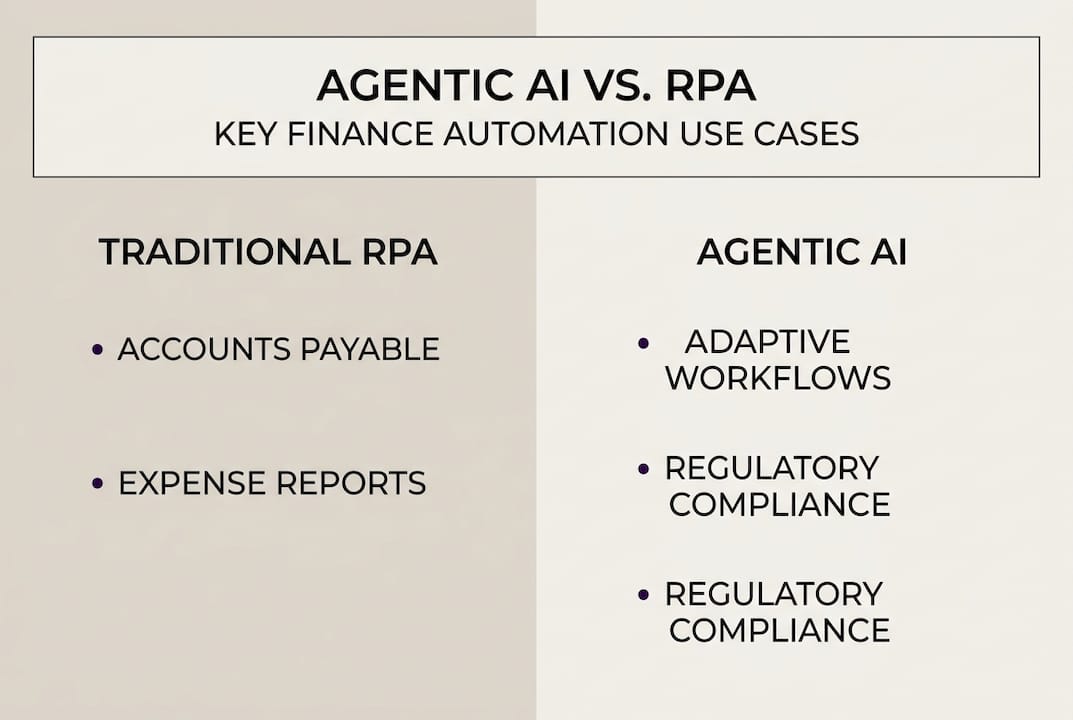
Multi-agent AI systems automate wire transfers and reimbursements with a 40% time reduction and 94% fewer errors. Early adopters have seen up to 16x ROI and a 99.5% cost reduction in reporting processes. These are not projections. They are documented outcomes from firms that started with focused pilots.
The five workflows most suited for agentic AI deployment are:
- Accounts payable and invoice processing tied directly to ERP systems
- Travel and expense reimbursements with policy validation built in
- Month-end close processes requiring data aggregation across platforms
- KYC and onboarding document review with compliance checkpoints
- Regulatory and compliance reporting with automated data pulls
For a broader view of how these fit into your overall automation strategy, see our guide on end-to-end business automation and the types of AI automation available today. You can also review machine learning in finance for additional context on how these technologies intersect.
Pro Tip: Start with high-volume, rule-based processes that are tightly connected to your ERP system. These deliver the fastest measurable returns and give your team confidence before expanding to more complex workflows.
Building robust governance and compliance with agentic AI
Operational automation only works if you stay compliant. Here is what robust agentic AI governance looks like for finance leaders.
Effective financial AI systems require audit trails, immutable logs, human oversight, and regulatory alignment with frameworks like NIST and SOX. These are not optional features. They are the foundation that makes agentic AI deployable in a regulated environment.

Adoption is accelerating. In 2025, 1.6% of all firm-years were implementing agentic AI, up from just 0.4% in 2024. That growth rate signals that governance frameworks are maturing fast, and firms that build controls now will have a structural advantage.
Five critical steps for establishing effective AI governance in financial workflows:
- Define data ownership and access controls before any agent touches production systems
- Implement immutable audit logs that capture every agent action and decision point
- Build human-in-the-loop checkpoints for exceptions, approvals, and high-value transactions
- Align agent behavior to SOX and NIST standards through modular, testable controls
- Conduct regular governance reviews as agent scope expands across new workflows
For a deeper look at how to structure these controls, our resource on AI compliance best practices covers the technical and operational requirements in detail. The distinction between AI agency versus autonomy is also worth understanding before you define your governance boundaries.
Pro Tip: Focus on data quality and modular controls before you scale. Governance built into the design of your agentic system is far less costly than retrofitting controls after deployment.
How to get started: implementation roadmap and success factors
What makes agentic AI rollouts succeed or stall? Here is how to set your own project up for results.
Adoption grows fastest in high-control environments where pilots start small, focus on ROI, and expand with strong governance. The firms that struggle are those that try to automate everything at once without a clear process map.
The table below outlines typical timelines and resource requirements by pilot size:
| Pilot size | Timeline | Expected savings | Resources needed |
|---|---|---|---|
| Small (1 workflow) | 6 to 10 weeks | 20 to 35% time reduction | 1 IT lead, 1 ops owner |
| Medium (3 workflows) | 3 to 5 months | 40 to 60% time reduction | Small cross-functional team |
| Large (department-wide) | 6 to 12 months | 60%+ time reduction, significant cost savings | Dedicated program manager |
A practical implementation roadmap for mid-sized financial firms:
- Map your rule-based, high-volume tasks and rank them by frequency and error rate
- Select one or two quick ROI pilots with clear success metrics tied to time and cost
- Establish governance controls including audit logs and human review checkpoints
- Run the pilot with active human oversight and document every exception and outcome
- Iterate and expand using pilot data to justify broader rollout with minimized risk
Change management is often the biggest barrier. Your IT team needs to understand the agent architecture. Your operations team needs to trust the outputs. Bridging that gap requires clear communication about what the agent does, what it does not do, and when it escalates to a human. For more on how this fits into broader automation trends with agentic AI, we have covered the operational landscape in detail. The AI use cases in finance operations resource from Workday also provides useful benchmarks for scoping your pilot.
Pro Tip: Success depends less on which AI model you choose and more on how well you understand your own processes. Business context and workflow clarity consistently outperform raw algorithmic power in real-world deployments.
Learn more and see agentic AI in action
You now have a clear picture of what agentic AI can do in financial operations, where it delivers the most value, and how to govern and implement it responsibly. The next step is seeing how these outcomes translate into real business results. Ailerons.ai has worked with operations and IT teams to design and deploy agentic systems across financial workflows, from accounts payable to compliance reporting. Visit our agentic AI case studies to review documented outcomes and implementation approaches. If you are ready to map your own workflows and identify your highest-impact pilot, the Ailerons AI consulting team is available to walk through your specific environment and priorities. A focused strategy session is the fastest way to move from interest to a concrete plan.
Frequently asked questions
How does agentic AI differ from RPA and traditional automation in finance?
Agentic AI systems outperform RPA by decomposing tasks and orchestrating them end-to-end, adapting to exceptions and unstructured data that rigid scripts cannot handle. RPA requires a fixed, predictable process; agentic AI can reason through variation.
What is the typical ROI for agentic AI in financial operations?
Firms report outcomes including up to $4.3M in savings and a 99.5% reduction in reporting costs, with some cases showing 16x ROI on focused workflow pilots. Results scale with process volume and governance maturity.
How do AI systems stay compliant with regulations such as SOX or NIST?
Agentic AI uses audit trails and immutable logs alongside modular controls and human oversight checkpoints to align with financial regulations and maintain explainability at every decision point.
What’s the first step for implementing agentic AI in a mid-sized finance firm?
Identify your highest-volume, rule-based workflow and pilot agentic AI there first. Mid-sized firms that start with ERP-connected processes consistently see the fastest and most measurable returns.
What are the biggest risks or pitfalls with agentic AI?
Risks like volatility and bias require auditable, explainable agents in finance; over-reliance on automation without sufficient human oversight and process transparency remains the most common failure point in early deployments.
Recommended
- AI-driven operations guide: boost efficiency 72% in 2026 | Ailerons IT Consulting
- AI in Business Process Management: Unlocking Efficiency | Ailerons IT Consulting
- Master financial operations automation steps for 2026 | Ailerons IT Consulting
- Secure AI Systems for Compliance: Minimizing Regulatory Risks | Ailerons IT Consulting
- AI Trading Strategy Optimization for Profitable Results