

Healthcare operations rarely follow a neat script—schedules change, records arrive late, and exceptions are part of every day. When traditional automation meets these realities, bottlenecks and manual fixes slow progress. That is where agentic AI systems stand out, using autonomy, adaptability, and proactive decision-making to keep workflows moving forward, not stalled by surprises. This overview explains how adopting agentic AI can help you optimize essential processes, reduce interruptions, and free your team for higher-value work.
Table of Contents
- Defining AI-Enabled Business Processes And Agentic AI
- Key Capabilities And How Agentic AI Works
- Top Healthcare Applications For Office Automation
- Integration With Existing Systems And Human Teams
- Security, Compliance, And Risk Mitigation Essentials
Key Takeaways
| Point | Details |
|---|---|
| AI-Enabled Business Processes | Transition from rigid workflows to adaptive systems that autonomously manage tasks and decision-making. |
| Agentic AI Benefits | Enhances operational efficiency by automating complex, multi-step workflows with minimal human oversight. |
| Integration with Existing Systems | Seamless connections between AI and current operational tools are crucial for maximizing automation effectiveness. |
| Security and Compliance Focus | Implement robust security protocols and ensure compliance with regulations to mitigate risks associated with automation in healthcare. |
Defining AI-Enabled Business Processes and Agentic AI
AI-enabled business processes represent a fundamental shift from rigid, predefined workflows to intelligent, adaptive systems that think and act independently. Rather than executing fixed sequences of steps, these processes leverage artificial intelligence to make decisions, adjust to changing conditions, and handle multi-step tasks without constant human intervention.
Traditional automation relies on rule-based logic: if X happens, do Y. But healthcare operations are messier than that. Patient schedules conflict, documents arrive late, approvals get delayed, and exceptions pop up constantly. Standard bots grind to a halt when reality doesn’t match the script.
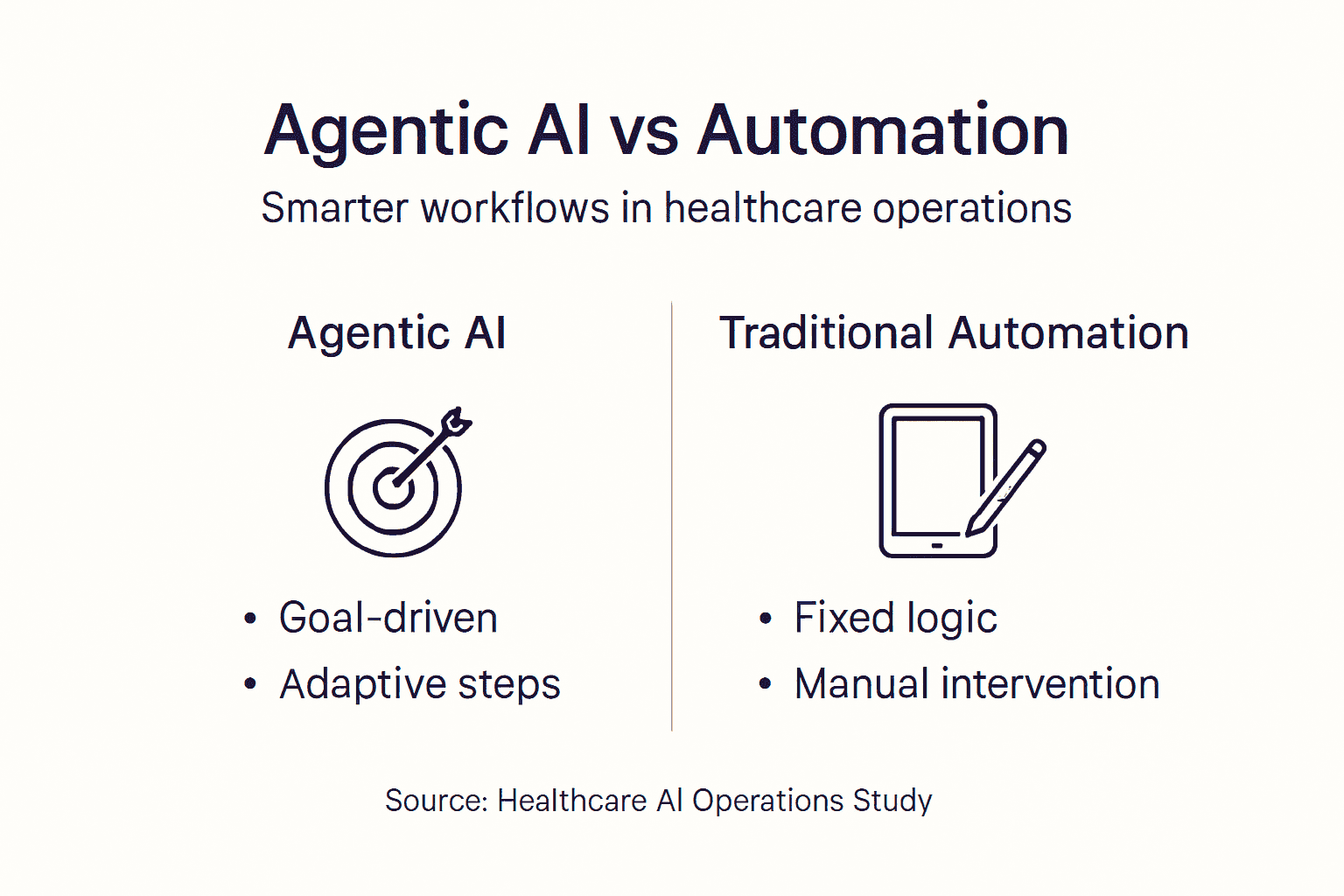
Agentic AI systems operate differently. They organize workflows around goals rather than rigid steps, enabling flexible, context-aware automation suited for dynamic environments like yours. Instead of following a predetermined path, agentic AI perceives what’s happening, reasons through options, and acts with minimal oversight.
What Sets Agentic AI Apart
Agentic AI refers to semi- or fully autonomous systems that perceive, reason, and act independently. This matters for healthcare operations because your workflows rarely follow a single pattern.
Consider patient scheduling. An agentic AI agent could:
- Monitor incoming appointment requests in real time
- Check provider availability across multiple systems simultaneously
- Detect conflicts and propose alternatives autonomously
- Update records, send confirmations, and flag exceptions for human review
- Learn from patterns to optimize future scheduling
Unlike chatbots or simple automation tools, agentic AI handles complex, multistep workflows by integrating with your existing systems, CRM platforms, and scheduling software.
Key Differences From Traditional Automation
Standard automation is reactive and linear. Agentic AI is proactive and adaptive.
- Traditional bots: Follow explicit instructions, stop when facing exceptions, require manual intervention for edge cases
- Agentic AI: Reasons about context, adjusts approach based on conditions, escalates thoughtfully when human judgment is needed
For operations managers, this means fewer workflow interruptions, less manual rework, and more consistent outcomes across your organization.
Here’s a quick comparison of traditional automation and agentic AI in healthcare operations:
| Aspect | Traditional Automation | Agentic AI Automation |
|---|---|---|
| Workflow Approach | Fixed, rule-based sequences | Goal-driven, adaptive actions |
| Exception Handling | Stops when facing unexpected | Adjusts and escalates as needed |
| Integration | Limited system connections | Coordinates across platforms |
| Learning Capability | Static, no learning | Learns and improves over time |
| Human Involvement | Frequent manual intervention | Minimal oversight, escalates only |
Agentic AI doesn’t replace your team—it removes friction from the work they already do, freeing staff to focus on patient care rather than administrative tasks.
Why This Matters for Healthcare Operations
Healthcare organizations operate under intense pressure: limited staff, complex regulations, competing priorities. Administrative overhead directly impacts your bottom line and staff burnout.
AI-enabled business processes address these pain points by automating the coordination work that consumes your team’s time. Document processing, appointment coordination, billing inquiries, compliance checks—these are precisely where agentic AI delivers measurable value.
The result isn’t just faster processing. It’s consistency, accuracy, and the ability to scale operations without proportional increases in headcount.
Pro tip: Start by mapping your highest-friction workflows—the processes that generate the most manual work, exceptions, and rework—and evaluate whether agentic AI could handle the routine portions while your team manages the complex decisions.
Key Capabilities and How Agentic AI Works
Agentic AI operates on a fundamentally different architecture than traditional automation tools. Instead of following a single script, these systems perceive their environment, reason through multiple options, and act autonomously to achieve goals.
Think of it as the difference between a vending machine and a receptionist. The vending machine follows fixed logic: coin inserted, button pressed, item dispensed. A receptionist assesses situations, prioritizes requests, handles exceptions, and makes judgment calls. Agentic AI functions more like the receptionist.

Core Capabilities That Define Agentic AI
Agentic AI systems demonstrate autonomy, adaptability, proactive planning, and continuous learning from feedback. These aren’t independent features—they work together to transform how workflows operate.
The key capabilities include:
- Long-term planning: Moving beyond single-step tasks to coordinate sequences of actions across multiple systems and timeframes
- Contextual memory: Retaining information about prior interactions, patient histories, and organizational patterns to inform decisions
- Adaptability: Adjusting approach when conditions change, exceptions occur, or new information emerges
- Proactive decision-making: Identifying problems before humans notice them and taking corrective action independently
- Multi-agent orchestration: Coordinating specialized AI agents to work together on complex workflows
For healthcare operations, this means agentic AI can manage patient intake, flag scheduling conflicts, process billing discrepancies, and coordinate approvals—all while learning from patterns to improve over time.
How the System Actually Works
Agentic AI architectures come in two primary forms. Symbolic models emphasize algorithmic planning with persistent state, making decisions through logical reasoning. Neural models leverage generative capabilities, using language understanding and pattern matching to navigate complex, ambiguous situations.
In practice, most healthcare implementations blend both approaches. The system perceives incoming data—a patient request, a document submission, a scheduling conflict. It reasons through available options using both rule-based logic and learned patterns. Then it acts, executing tasks or escalating to human staff when judgment is required.
The critical difference from traditional automation: agentic AI can complete multistep tasks independently with minimal human oversight. A traditional bot might process one insurance authorization. Agentic AI follows that authorization through pre-approval, patient notification, appointment scheduling, and follow-up—adjusting when complications arise.
Agentic AI systems operate as collaborative partners that continuously adapt to achieve organizational goals, not as rigid tools that execute predetermined steps.
What This Means for Your Workflows
These capabilities translate directly to operational efficiency. Patient intake that previously required staff intervention now flows automatically, with the system flagging only true exceptions. Billing inquiries get addressed instantly without human review of routine cases. Compliance documentation gets flagged proactively before audit deadlines approach.
The system doesn’t replace decision-making—it handles the repetitive coordination work that consumes your team’s attention, freeing staff for complex cases requiring clinical or administrative judgment.
Pro tip: Map your workflow steps by complexity: routine tasks (70-80% of work) are ideal candidates for agentic AI automation, while exception handling and high-judgment decisions should remain with your team.
Top Healthcare Applications for Office Automation
Healthcare organizations generate enormous administrative overhead. Patient scheduling, admission and discharge processing, insurance verification, billing, documentation updates—these tasks consume staff time without directly improving patient care.
Office automation in healthcare leverages AI to streamline admission, discharge, and routine administrative tasks, significantly reducing processing times and freeing clinical staff to focus on care delivery.
Where Agentic AI Delivers Immediate Value
Not all workflows benefit equally from automation. The highest-impact applications share common traits: high volume, clear rules, repetitive execution, and multiple system interactions.
Priority automation opportunities include:
- Patient scheduling and rescheduling: Coordinate availability across multiple providers, detect conflicts, send notifications, and manage cancellations automatically
- Insurance pre-authorization: Verify coverage, submit authorization requests, track approvals, and notify clinicians when status changes
- Admission and discharge processing: Update records across EHR and billing systems, generate required documentation, and trigger follow-up workflows
- Billing inquiry handling: Route routine questions to automation, process payment plans, and escalate complex cases to staff
- Documentation requests: Auto-generate required forms, populate known fields from existing records, and manage submissions
- Compliance monitoring: Flag upcoming audit deadlines, track required training completion, and alert managers to policy violations
These applications share a critical trait: they involve coordination across multiple systems and stakeholders, making them ideal for agentic AI systems that reduce inefficiencies affecting patients, clinicians, and staff.
The following table summarizes top healthcare office automation areas and their respective business impacts:
| Automation Area | Business Impact | Efficiency Benefit |
|---|---|---|
| Patient Scheduling | Fewer no-shows, better access | Faster booking, real-time updates |
| Insurance Pre-Auth | Reduced claim denials | Quicker approvals, fewer delays |
| Admission/Discharge | Smoother patient transitions | Automatic updates, timely follow-up |
| Billing Inquiries | Lower workload, improved revenue | Immediate responses, less manual review |
| Compliance Monitoring | Fewer violations, safer audits | Proactive alerts, streamlined tracking |
Real-World Implementation Focus
Successful automation prioritizes administrative tasks that directly impact operational performance. Patient intake automation, for example, reduces time from registration to first clinical encounter. Insurance verification automation eliminates claim denials from coverage gaps.
The key is targeting workflows where bottlenecks create visible pain. If your intake coordinator spends four hours daily on scheduling, that’s where automation delivers immediate value. If your billing team manually verifies coverage on 80% of patients, pre-authorization automation becomes a priority.
Start with high-volume, low-complexity administrative tasks that create visible delays or rework. These deliver quick wins and build organizational confidence in automation.
Implementation Considerations
Automation success depends on clear workflow understanding. Before implementation, map your current process: what steps happen, who performs them, which create exceptions, and where delays cluster.
Identify where human judgment is actually required versus where you’ve kept human involvement out of habit. Many organizations discover that routine approvals, documentation assembly, and scheduling can be fully automated, while exception handling and patient communication should remain with staff.
Pro tip: Begin with one high-friction workflow that generates measurable metrics—track time savings, error reduction, and staff capacity freed up—to quantify ROI before scaling to additional processes.
Integration with Existing Systems and Human Teams
Agentic AI doesn’t exist in isolation. It must connect to your EHR, scheduling platform, billing system, and other operational tools while working alongside your staff, not against them. This integration—both technical and human—determines whether automation succeeds or creates new friction.
Successful implementation requires navigating two critical challenges: making AI systems talk to your existing tools, and building trust with your team.
Technical Integration: Connecting Your Systems
Most healthcare organizations run on a patchwork of systems. Your EHR doesn’t fully integrate with your scheduling platform. Your billing system operates separately from your patient communication tool. Agentic AI must orchestrate work across these disconnected systems seamlessly.
This integration typically involves:
- API connections: Enabling direct data exchange between agentic AI and your existing platforms
- Data standardization: Translating information formats so systems understand each other
- Real-time synchronization: Ensuring records update instantly across platforms when changes occur
- Error handling: Detecting integration failures and escalating appropriately
The good news: agentic AI systems are designed for exactly this challenge. They can monitor multiple systems simultaneously, pull information from one platform, process it, and push results to another—all while maintaining data accuracy and compliance requirements.
Building Human-AI Collaboration
Successful AI integration requires navigating interoperability, building trust, and fostering knowledge exchange between systems and people. This isn’t technical—it’s organizational.
Your team needs to understand what the AI is doing and why. When an agentic AI agent denies a scheduling request, staff should know it’s because the provider is already double-booked, not because it made an arbitrary decision. When automation escalates an exception, your team should see clear reasoning.
Hybrid human-AI collaboration improves processing speed, accuracy, and flexibility more than manual or fully automated workflows alone. The system handles routine work; your team manages judgment calls.
Defining the Right Human-AI Boundary
Clarity about roles prevents frustration and ensures smooth operations. The AI should handle:
- Routine scheduling coordination
- Standard documentation assembly
- Predictable compliance flagging
- Initial triage of requests
Your team should retain:
- Patient communication and relationship management
- Complex exception resolution
- Policy interpretation and exceptions
- Approval decisions requiring clinical judgment
This division isn’t static. As your team learns what the AI can handle reliably, you’ll adjust boundaries. But start conservatively—automate what’s clearly routine, escalate everything else.
Change Management Matters
Implementation fails when staff feel blindsided or threatened. Your team needs training, clear communication about why changes are happening, and evidence that automation makes their work easier, not harder.
Involve staff from planning through deployment. Frontline users understand workflow realities that managers miss. Their input improves system design and builds buy-in.
Pro tip: Pilot automation with volunteer teams first, gather feedback, iterate on configuration, then expand; staff who shaped the solution become champions who help others adopt it.
Security, Compliance, and Risk Mitigation Essentials
Healthcare operates under intense regulatory scrutiny. HIPAA, state privacy laws, insurance regulations, and accreditation standards all demand strict controls over patient data and operational processes. When you introduce agentic AI into these workflows, security and compliance become non-negotiable.
Automation doesn’t eliminate your compliance obligations—it transforms them. You’re now responsible for how the AI makes decisions, what data it accesses, and how it protects sensitive information.
Healthcare-Specific Compliance Requirements
Healthcare AI systems must satisfy multiple overlapping requirements. Patient data protection comes first. HIPAA mandates encryption, access controls, and audit trails. Your agentic AI must log every decision, every data access, and every escalation for compliance verification.
Beyond HIPAA, consider:
- State privacy laws: California, Virginia, and others impose additional restrictions on data handling and patient rights
- Insurance regulations: Payers have specific requirements for authorization decisions and documentation
- Accreditation standards: Joint Commission and similar bodies audit your automation controls
- Anti-discrimination rules: AI systems cannot discriminate in scheduling, billing, or care access decisions
Building secure AI systems for compliance from the start prevents costly remediation later. Security and compliance must be embedded in system design, not bolted on afterward.
Data Security and Access Control
Agentic AI systems handle sensitive information constantly. Patient schedules, insurance details, medical histories, billing data—all flow through the automation. You need multiple layers of protection.
Essential controls include:
- Encryption in transit and at rest: Data protected whether moving between systems or stored
- Role-based access: The AI accesses only data required for its specific task
- Audit logging: Every action creates a record showing who accessed what, when, and why
- Segregated environments: Testing and production systems kept completely separate
- Regular security assessments: Penetration testing and vulnerability scanning identify weaknesses
These aren’t optional. They’re baseline requirements for healthcare operations.
Decision Transparency and Explainability
When agentic AI denies a pre-authorization or flags a compliance violation, your team must understand why. Regulators demand this transparency too. A patient challenging a denied claim should receive clear explanation of the decision logic.
Compliance violations happen when automation makes decisions that are correct technically but unexplainable to regulators or patients. Build systems that can justify every significant decision.
Managing AI-Specific Risks
Automation introduces risks that traditional workflows don’t have. What happens if the AI makes systematic errors affecting hundreds of patients? How do you detect that bias has crept into scheduling or billing decisions? What’s your incident response plan when the system malfunctions?
Risk mitigation requires:
- Continuous monitoring of automation outcomes for patterns indicating problems
- Human review of high-impact decisions, especially those affecting patient care or billing
- Clear escalation procedures when the system encounters situations it cannot handle
- Documentation of configuration and decision logic for audit purposes
Start conservatively. Automate routine decisions first, monitor results carefully, then expand to higher-risk processes.
Pro tip: Establish a compliance review process before deployment: have legal and compliance teams audit AI workflows to catch configuration issues early, preventing violations after go-live.
Transform Your Healthcare Workflows with True Agentic AI
The article highlights the challenges healthcare operations face with traditional automation that stalls at exceptions and rigid scripts. If you are seeking to eliminate administrative bottlenecks like patient scheduling conflicts, insurance pre-authorizations, and billing delays, agentic AI offers a smarter solution. By shifting to goal-driven, adaptive systems that reason, plan, and act autonomously, you achieve consistent, scalable results without overburdening your staff.
At Ailerons.ai, we specialize in deploying agentic AI that seamlessly integrates with your existing systems and works alongside your human teams. Our solutions reduce manual rework, handle complex multi-step tasks, and maintain strict compliance across healthcare workflows. Deliver faster scheduling, streamlined billing, and proactive compliance monitoring designed for your dynamic environment.
Explore how intelligent orchestration can free your staff to focus on patient care instead of paperwork. Ready to overcome workflow frustrations and automate with confidence? Discover the future of healthcare operations at Ailerons.ai and unlock efficiency today.
Frequently Asked Questions
What are AI-enabled business processes?
AI-enabled business processes refer to intelligent, adaptive systems that utilize artificial intelligence to make decisions and automate workflows, moving beyond rigid, predefined sequences to adapt dynamically in response to varying conditions.
How does agentic AI differ from traditional automation?
Agentic AI operates on a goal-driven and adaptive basis, making proactive decisions and adjusting to changes in real-time, whereas traditional automation adheres to fixed rules and typically halts when encountering exceptions or unexpected situations.
What are some key applications of agentic AI in healthcare operations?
Key applications include patient scheduling, insurance pre-authorization, admission and discharge processing, billing inquiry handling, and compliance monitoring, all of which streamline administrative tasks and improve operational efficiency.
What considerations are important for implementing agentic AI successfully?
Successful implementation requires a clear understanding of existing workflows, effective integration with current systems, building trust among staff regarding AI decisions, and ensuring compliance with healthcare regulations to protect patient data and ensure operational integrity.
Recommended
- Improving Business Workflows with AI: Achieve Automation | Ailerons IT Consulting
- AI in Business Process Management: Unlocking Efficiency | Ailerons IT Consulting
- Step-by-Step Guide to AI-Driven Office Automation Success | Ailerons IT Consulting
- Process Automation Tutorial for Agentic AI in Compliance Workflows | Ailerons IT Consulting