
TL;DR:
- AI-driven process optimization uses artificial intelligence to redesign entire workflows, reducing coordination costs and delivering fundamentally better-organized work. It relies on process intelligence, governance frameworks like CAIS, and end-to-end task chaining to ensure scalable, compliant automation across complex operations. Proper governance and process mapping are essential to avoid common pitfalls and achieve sustainable, high-value AI deployment.
AI-driven process optimization is the practice of using artificial intelligence and machine learning to redesign and automate workflows, reducing coordination costs and accelerating output across business operations. Unlike traditional automation, which targets individual tasks, this approach treats the entire workflow as the unit of improvement. Tools like the Microsoft Agent Governance Toolkit, platforms like ARIS, and frameworks like CAIS (Controlled Agentic AI Systems) give operations managers the architecture to deploy AI that reasons, plans, and executes across multi-step processes. The result is not just faster work. It is fundamentally better-organized work.
What is AI-driven process optimization and why does it matter?
AI-driven process optimization, known in enterprise architecture circles as intelligent workflow automation, is defined by one core principle: AI delivers more value when applied to entire workflow sequences than to isolated tasks. This distinction separates organizations that see modest efficiency gains from those that achieve structural improvements in how work gets done.
The mechanism is task chaining. Rather than automating a single approval step or data entry field, AI agents handle end-to-end sequences, from document intake through classification, routing, approval, and record update, without requiring a human checkpoint at each stage. MIT Sloan research confirms that continuous AI task chaining eliminates frequent human handoffs and accelerates output even when individual steps perform at slightly lower quality than a human specialist would achieve.
For operations managers, this reframes the question. The goal is not “which tasks can AI handle?” It is “which task clusters can AI own from start to finish?” That shift in framing is where the real efficiency gains live.
What prerequisites and tools do you need before starting?
Before deploying any AI agent or automation layer, organizations need operational transparency. You cannot optimize what you cannot see. The ARIS platform advocates building process intelligence from event logs before scaling any AI automation, and this sequencing is not optional. Skipping it produces brittle systems that fail when real-world variability appears.
The foundational requirements fall into three categories:
- Process visibility. Event-log analysis and process mining identify where bottlenecks occur, which handoffs are redundant, and which task clusters are genuinely AI-compatible. ARIS process intelligence provides this diagnostic layer before any agent is trained or deployed.
- Governance infrastructure. The Microsoft Agent Governance Toolkit provides runtime governance with deterministic policy enforcement, execution sandboxing, and tamper-evident audit trails. This is not optional for regulated industries. It is the difference between a governed AI system and an uncontrolled one.
- Compliance architecture. The CAIS framework formalizes governance by embedding constraints directly into AI decision pipelines as a deterministic projection operator, ensuring every agent action is admissible, auditable, and reproducible.
Without these three layers in place, AI deployment becomes a liability rather than an asset. Organizations that treat governance as a post-deployment concern consistently face audit failures, compliance gaps, and agent behavior they cannot explain or reproduce.
Pro Tip: Before selecting any AI tooling, spend two to four weeks on event-log analysis using a process mining platform. The patterns you find will determine which workflows are worth automating and which need redesigning first.
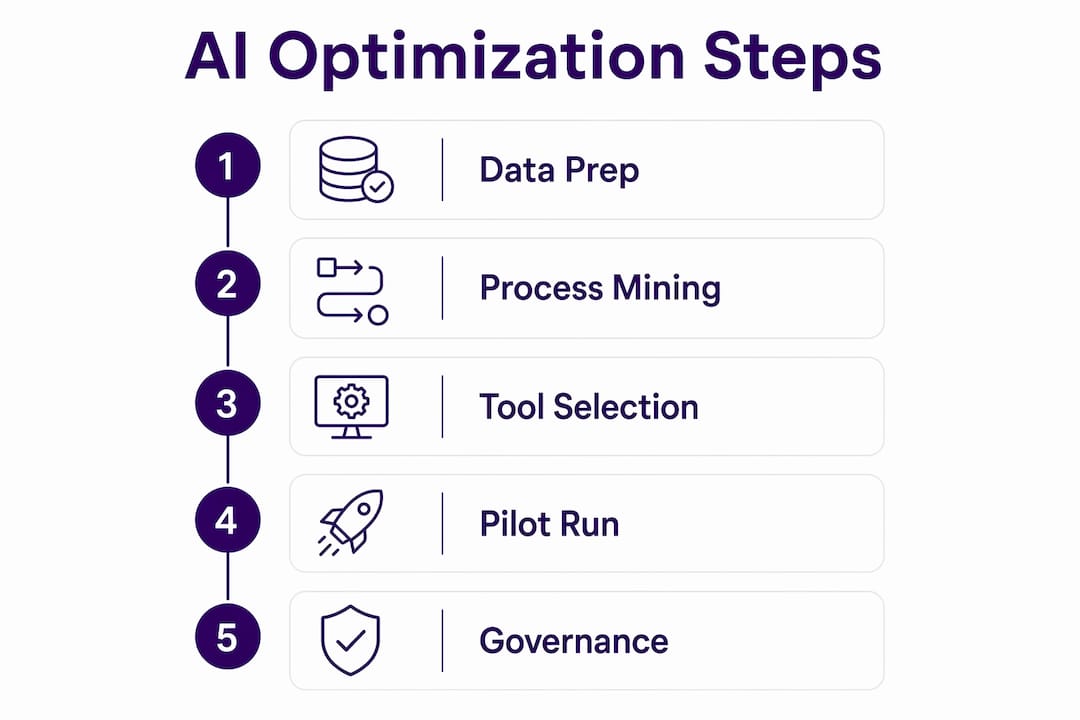
How to implement AI-driven process optimization step by step
A structured implementation sequence prevents the most common failure modes. The following five steps reflect how mature organizations approach automated process improvement without creating new operational risk.
-
Analyze and map current workflows. Use process mining tools to extract event logs from your ERP, CRM, or document management systems. Identify task clusters where AI can own a full sequence rather than a single step. This is the foundation that prevents brittle automation from failing under real conditions.
-
Design agent workflows for end-to-end ownership. Group AI-compatible tasks into sequences that minimize human-AI handoffs. According to MIT Sloan, AI workflow redesign requires grouping tasks into chains rather than automating isolated steps. A billing workflow, for example, should have the AI agent handle invoice receipt, data extraction, matching, exception flagging, and routing as one continuous sequence.
-
Deploy governed AI agents with runtime policy enforcement. Use the Microsoft Agent Governance Toolkit or equivalent infrastructure to enforce deterministic policies at runtime. This means execution sandboxing, privilege rings, kill switches, and audit logs are active from day one, not added later. The CAIS framework provides the architectural model for embedding these constraints directly into the agent’s decision pipeline.
-
Implement human-in-the-loop oversight for high-risk decisions. AWS outlines four HITL constructs for safely integrating human governance into agentic workflows. Match the oversight pattern to the risk profile. A routine invoice approval needs minimal human review. A contract exception or compliance flag requires a structured approval gate before the agent proceeds.
-
Monitor, audit, and iterate continuously. AI process efficiency does not plateau after deployment. Establish performance baselines, review audit logs on a defined cadence, and use workflow monitoring data to identify new optimization opportunities. Robust workflow monitoring amplifies AI optimization by maintaining process transparency over time.
Pro Tip: Start your first deployment with a single high-volume, low-risk workflow such as accounts payable processing or document classification. Prove the governance model works at small scale before expanding to regulated or customer-facing processes.
What are common mistakes in AI-driven process optimization?

The most expensive mistake operations leaders make is retrofitting AI onto existing fragmented workflows. MIT Sloan’s research on AI implementation failure modes is direct: when AI is placed around existing handoffs rather than used to redesign them, coordination costs increase rather than decrease. The AI becomes another node in a broken process, not a fix for it.
Other high-impact mistakes include:
- Treating governance as an afterthought. The CAIS framework is explicit that governance must be an intrinsic architectural component, not a layer added after deployment. Organizations that bolt on compliance controls after the fact face audit gaps and agent behavior they cannot reproduce or explain.
- Skipping the process intelligence phase. ARIS experts consistently find that organizations which skip event-log diagnostics deploy automation against a misunderstood process. The result is automation that performs well in testing and fails in production.
- Mismatching human oversight to risk level. AWS HITL constructs are designed to align oversight patterns with workflow risk profiles. Applying the same approval gate to every agent action creates bottlenecks. Applying no oversight to high-risk decisions creates liability.
- Neglecting auditability from the start. Runtime governance with tamper-evident logs is not a compliance checkbox. It is the mechanism that allows you to diagnose failures, demonstrate regulatory compliance, and build organizational trust in AI systems.
“Governance must be a first-class runtime control with deterministic enforcement, sandboxing, kill switches, and tamper-evident audit logs.” This principle, drawn from the Microsoft Agent Governance Toolkit and the CAIS framework, defines the difference between AI systems that scale and those that create new operational risk.
The pattern across all these mistakes is the same: organizations treat AI deployment as a technology project rather than an organizational design exercise. The technology is the easier part. The process architecture and governance model are where implementations succeed or fail.
How does AI-driven optimization compare with traditional automation?
Traditional automation and AI-driven optimization are not the same category of tool. Understanding the distinction helps operations managers allocate investment correctly and set realistic expectations for each approach.
| Dimension | Traditional automation | AI-driven optimization |
|---|---|---|
| Workflow scope | Single task or rule-based step | End-to-end task sequences with dynamic decision logic |
| Adaptability | Rigid scripts that break on exceptions | Context-aware agents that handle variability |
| Governance model | Manual audit, post-hoc review | Runtime enforcement with deterministic policy and audit trails |
| Human oversight | Required at most decision points | Targeted HITL constructs matched to risk level |
| Scalability | Requires re-scripting for new processes | Agent frameworks extend to new workflows with shared governance |
| Process intelligence | Not required | Event-log analysis required before deployment |
Traditional automation tools, including rule-based RPA platforms, deliver value in highly structured, low-variability environments. They are predictable and auditable but cannot adapt when process conditions change. AI-driven approaches, by contrast, use machine learning for optimization decisions and can handle the exceptions, edge cases, and multi-system coordination that break rigid scripts. The trade-off is that AI systems require more rigorous governance infrastructure upfront. The payoff is a system that scales without proportional increases in manual oversight or re-scripting effort.
Key takeaways
AI-driven process optimization succeeds when organizations treat workflow redesign, process intelligence, and runtime governance as inseparable foundations rather than sequential phases.
| Point | Details |
|---|---|
| Redesign workflows, don’t retrofit | Group AI-compatible tasks into end-to-end sequences to reduce coordination costs, not just automate individual steps. |
| Build process intelligence first | Use event-log analysis and process mining via platforms like ARIS before deploying any AI agent. |
| Embed governance at runtime | Use frameworks like CAIS and tools like the Microsoft Agent Governance Toolkit to enforce policies from day one. |
| Match human oversight to risk | Apply AWS HITL constructs based on workflow risk profile, not uniformly across all agent actions. |
| Start small, scale with monitoring | Deploy in one high-volume workflow first, establish performance baselines, then expand with audit data guiding decisions. |
Why governance is the real differentiator, not the AI itself
I have seen enough AI deployments go sideways to know where the real risk lives. It is rarely in the AI model. It is almost always in the governance layer, or the absence of one.
Operations leaders tend to focus on capability questions: what can the AI do, how fast, at what cost? Those are valid questions. But the organizations that sustain gains from data-driven process enhancement are the ones that treated governance as a design constraint from the first conversation, not a compliance task to handle before go-live.
The CAIS framework’s concept of embedding governance as a deterministic projection operator sounds academic until you are in a post-incident review trying to explain why an AI agent approved a transaction it should not have. At that point, having a replayable audit trace is not a nice-to-have. It is the only thing standing between you and a regulatory finding.
My practical recommendation: before you evaluate any AI vendor or platform, write down the three workflows where an AI error would cause the most damage. Then ask every vendor how their system handles those scenarios at runtime, not in theory. The answer tells you everything about whether their governance model is real or decorative.
The organizations getting the most from intelligent workflow automation are not the ones with the most advanced AI. They are the ones with the clearest process maps, the most disciplined governance, and the most honest assessment of where human judgment is still required.
— Sam
How Ailerons helps you build AI-driven operations that last
Ailerons designs and deploys agentic AI systems for organizations that need more than task automation. The work covers end-to-end workflow design, process intelligence development, and governance architecture built to meet audit and compliance requirements from day one. Whether you are starting with a single operational workflow or scaling across front-office, billing, and document management processes, Ailerons provides the implementation and oversight frameworks that make AI deployment sustainable. If you are ready to move from fragmented automation to governed agentic workflows, contact Ailerons at ailerons.ai to schedule a consultation.
FAQ
What is AI-driven process optimization?
AI-driven process optimization is the use of artificial intelligence and machine learning to redesign and automate multi-step workflows, reducing coordination costs and improving operational efficiency. It differs from traditional automation by targeting entire task sequences rather than individual steps.
How long does it take to see results from AI workflow automation?
Most organizations see measurable efficiency gains within three to six months of deploying a governed AI agent in a high-volume workflow, provided the process intelligence foundation is built before deployment. Skipping the event-log analysis phase typically extends this timeline significantly.
Why is governance so important in AI process optimization?
Governance is what makes AI agent behavior auditable, reproducible, and compliant with regulatory requirements. The CAIS framework and Microsoft Agent Governance Toolkit both demonstrate that runtime policy enforcement must be embedded in the agent architecture, not added after deployment.
What is human-in-the-loop oversight in agentic workflows?
Human-in-the-loop (HITL) oversight is a structured pattern where human review is required at specific decision points within an AI-managed workflow. AWS outlines four HITL constructs designed to align the level of human oversight with the risk and compliance demands of each workflow type.
How is AI-driven optimization different from RPA?
RPA (robotic process automation) executes fixed scripts against structured data and breaks when process conditions change. AI-driven optimization uses context-aware agents that handle variability, chain tasks end-to-end, and operate under runtime governance frameworks that RPA tools do not provide.