

Mid-sized businesses lose thousands of hours annually to fragmented workflows, manual data entry, and administrative bottlenecks that slow decision-making and drain resources. Operations managers face mounting pressure to do more with less while maintaining accuracy and compliance across increasingly complex systems. Agentic AI systems offer a transformative solution by autonomously managing multi-step workflows, coordinating tasks across platforms, and making context-aware decisions that eliminate operational friction. This guide walks you through understanding the problem, preparing your organization, implementing agentic AI step by step, and measuring sustained efficiency gains.
Table of Contents
- Key takeaways
- Understanding the problem: inefficiencies in traditional office operations
- Preparing for AI-driven operations: prerequisites and key considerations
- Executing the implementation: step-by-step guide to deploying agentic AI systems
- Verification and optimization: measuring success and continuous improvement
- Explore tailored AI consulting services for your business
- Frequently asked questions
Key Takeaways
| Point | Details |
|---|---|
| Agentic AI capabilities | Agentic AI can autonomously manage multi step workflows across platforms and adjust decisions without constant human oversight. |
| Preparation for deployment | Map current workflows in detail, identify suitable processes, and confirm data and organizational readiness before deployment. |
| Measure efficiency gains | Track efficiency gains to verify reductions in admin overhead and support ongoing improvements. |
| Value for mid sized firms | Intelligent automation can reclaim staff time, reduce bottlenecks from manual handoffs, and scale operations without proportional headcount increases. |
Understanding the problem: inefficiencies in traditional office operations
Most mid-sized businesses operate with workflows stitched together from disconnected systems, spreadsheets, and manual handoffs. Each task requires human attention to move information between platforms, verify data accuracy, and trigger the next step. This fragmentation creates delays, increases error rates, and consumes valuable staff time on repetitive coordination work.
Common administrative tasks that drain productivity include:
- Scheduling meetings across multiple calendars and time zones
- Processing invoices and matching them to purchase orders
- Updating customer records across CRM, billing, and support systems
- Routing documents for approval through email chains
- Generating reports by pulling data from separate databases
- Escalating exceptions to managers for manual review
These workflows fail when someone is out of office, information gets lost in email threads, or systems require constant babysitting. The cumulative impact shows up as missed deadlines, frustrated customers, and teams spending more time managing processes than delivering value. Intelligent automation cuts administrative overhead by up to 72% when organizations shift from manual execution to intelligent systems.
Agentic AI represents a fundamental shift from traditional automation. Where robotic process automation follows rigid scripts and chatbots handle single interactions, agentic AI operates with goal orientation and decision logic. These systems understand context, plan multi-step actions, and adapt to changing conditions without constant human oversight. An agentic AI system can receive a request, determine the necessary steps, execute tasks across multiple platforms, handle exceptions intelligently, and escalate only when human judgment is truly needed.
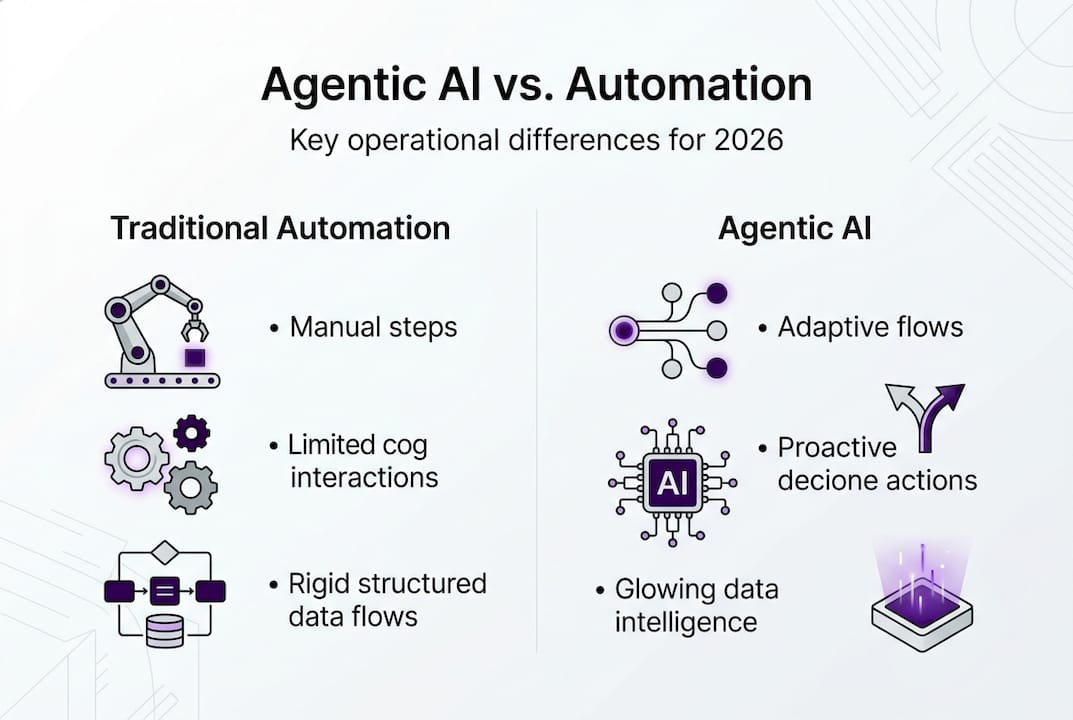
The difference matters because office work rarely follows predictable patterns. Approvals get delayed, data is missing, priorities shift mid-process. Agentic AI navigates these realities by reasoning through obstacles and adjusting its approach, functioning as an autonomous digital collaborator rather than a brittle script. This capability makes it possible to automate workflows that previously seemed too complex or variable for technology to handle effectively.
For operations managers, the promise is clear: reclaim staff time from coordination overhead, eliminate bottlenecks caused by manual handoffs, and scale operations without proportional headcount increases. The challenge lies in preparing your organization and implementing these systems correctly.
Preparing for AI-driven operations: prerequisites and key considerations
Successful agentic AI deployment starts well before any technology goes live. You need clarity on which workflows to automate, data that AI systems can actually use, and organizational readiness to work alongside intelligent automation.

Start by mapping your current workflows in detail. Document every step, handoff, decision point, and exception that occurs in processes you want to automate. Identify where delays happen, where errors creep in, and where staff spend time on repetitive coordination. Not every workflow is equally suited for agentic AI. Prioritize processes that are high-volume, rule-based with clear decision logic, and involve multiple system interactions. Business process management efficiency improves dramatically when you target the right workflows first.
Data quality determines whether your agentic AI will succeed or struggle. AI systems need clean, structured, accessible data to make accurate decisions. Audit your current data sources for completeness, consistency, and accuracy. Fix data quality issues before deployment, not after. Ensure your AI will have proper access permissions to read from and write to necessary systems. Poor data quality leads to incorrect decisions, which erodes trust and forces manual intervention, defeating the purpose of automation.
Cross-functional involvement is non-negotiable. Operations staff who execute workflows daily understand nuances that aren’t visible in process diagrams. IT teams manage system integrations and security requirements. Compliance officers ensure regulatory alignment. Finance tracks ROI and budget. Bring these stakeholders together early to define requirements, address concerns, and build buy-in. Resistance often stems from fear of job displacement or loss of control. Address this directly by positioning agentic AI as removing tedious work so staff can focus on higher-value activities.
Security and compliance requirements must shape your implementation from day one. Agentic AI systems will access sensitive data and make decisions with business impact. Define what data the AI can access, what actions it can take autonomously, and what requires human approval. Ensure logging and audit trails meet your compliance obligations. Align with modern identity standards and cloud security practices to protect against unauthorized access or data breaches.
Set measurable goals before you begin. Define specific KPIs like time saved per process, error rate reduction, cost per transaction, or customer satisfaction scores. Establish baseline measurements so you can demonstrate improvement. Vague goals like “improve efficiency” make it impossible to verify success or justify continued investment. A thorough AI integration checklist ensures smoother deployment and better outcomes by covering these prerequisites systematically.
Pro Tip: Engage with experienced AI consultants early in your planning phase. They’ve seen common pitfalls across dozens of implementations and can help you avoid costly mistakes, accelerate deployment, and optimize your approach based on what actually works in production environments.
Executing the implementation: step-by-step guide to deploying agentic AI systems
Implementation follows a structured path from workflow analysis through pilot testing to full rollout. Each step builds on the previous one, reducing risk while proving value incrementally.
-
Map and prioritize workflows for automation. Document current state processes in detail, including all decision points, exceptions, and system interactions. Score each workflow based on automation potential, business impact, and implementation complexity. Start with processes that offer high impact and moderate complexity. Quick wins build momentum and organizational confidence.
-
Select appropriate AI tools and platforms. Evaluate solutions based on your specific workflow requirements, existing technology stack, and team capabilities. Consider whether you need pre-built agentic AI platforms, custom development, or hybrid approaches. Assess integration capabilities with your CRM, ERP, accounting, document management, and communication systems. Vendor lock-in and total cost of ownership matter as much as initial features.
-
Configure and train agentic AI models. Define the goals, decision logic, and action parameters for each workflow. Train models using historical data and real scenarios. Configure how the AI should handle common exceptions and when to escalate to humans. This phase requires close collaboration between AI specialists and operations staff who understand workflow nuances. Business workflows with AI automation improve when configuration reflects actual operational realities, not idealized process maps.
-
Pilot test with controlled user groups. Deploy to a small subset of workflows or users first. Monitor closely for accuracy, performance, and user experience issues. Collect feedback from staff working alongside the AI. Identify gaps between expected and actual behavior. Iterate on configuration based on real-world results. Pilot testing surfaces problems when they’re still cheap to fix.
-
Roll out incrementally with monitoring. Expand deployment in phases, adding workflows or user groups gradually. Maintain close monitoring of performance metrics, error rates, and user satisfaction. Provide training and support as staff adapt to working with agentic AI. Plan for ongoing optimization as you learn what works and what needs adjustment.
| AI Platform Type | Key Features | Scalability | Integration Support | Best For |
|---|---|---|---|---|
| Pre-built agentic platforms | Ready workflows, low-code config | High | Standard APIs | Common business processes |
| Custom AI development | Tailored logic, full control | Very high | Any system | Unique workflows |
| Hybrid solutions | Mix of pre-built and custom | High | Flexible | Complex operations |
| Industry-specific tools | Domain expertise built in | Medium to high | Industry standards | Regulated sectors |
The rollout phase separates successful implementations from failed ones. Organizations that treat deployment as a one-time event struggle with adoption and performance issues. Those that approach it as an iterative process with continuous monitoring and optimization achieve sustained efficiency gains. Your agentic AI will improve over time as it learns from more scenarios and you refine its decision parameters.
Verification and optimization: measuring success and continuous improvement
Deployment is just the beginning. Sustained value comes from measuring outcomes, troubleshooting issues quickly, and optimizing performance over time.
Define KPIs that directly reflect your goals:
- Time savings: hours reclaimed per workflow or per employee
- Error reduction: percentage decrease in mistakes requiring rework
- Cost impact: reduction in operational costs per transaction
- Throughput: increase in tasks completed per time period
- Customer satisfaction: improvement in service delivery metrics
- Staff satisfaction: reduction in time spent on tedious tasks
Establish baseline measurements before AI deployment so you can demonstrate actual improvement. Collect data consistently using the same methods pre and post implementation. Tracking AI impact is key to achieving sustained operational improvements and justifying continued investment.
Use dashboards and reports to monitor AI performance in real time. Track decision accuracy, processing times, exception rates, and system uptime. Set alerts for anomalies that might indicate problems. Make performance data visible to stakeholders so everyone understands how the AI is performing against expectations. Transparency builds trust and helps identify optimization opportunities.
Common troubleshooting scenarios include:
- Inaccurate decisions: Review training data quality, refine decision logic, add more examples of edge cases
- Workflow bottlenecks: Identify where the AI waits for human input or external systems, optimize integrations
- User resistance: Provide additional training, clarify how AI helps rather than replaces, adjust workflows based on feedback
- Integration failures: Check API connections, update authentication credentials, coordinate with IT on system changes
Iterate configurations to improve AI decision-making as you learn from real-world performance. Add new scenarios to training data. Refine rules for when to escalate versus proceeding autonomously. Expand the scope of what the AI can handle as confidence grows. Agentic AI systems get smarter over time when you feed them better data and refine their parameters based on outcomes.
Pro Tip: Schedule regular review cycles, quarterly at minimum, to assess AI performance against business goals and adjust configurations to align with evolving needs. Business priorities shift, systems change, and workflows evolve. Your agentic AI implementation should adapt accordingly rather than becoming another rigid legacy system.
Continuous improvement separates organizations that extract maximum value from AI from those that see initial gains plateau. Treat your agentic AI as a capability that requires ongoing attention, not a project with a finish line. The most successful implementations become learning systems that improve quarter over quarter.
Explore tailored AI consulting services for your business
Implementing agentic AI systems effectively requires expertise in AI architecture, workflow design, system integration, and change management. Ailerons specializes in designing and deploying agentic AI for office and operational workflows, helping mid-sized businesses reduce operational friction and scale without proportional headcount increases. Our managed IT and AI consulting services cover everything from initial assessment through deployment and ongoing optimization. We’ve helped organizations across industries automate front-office coordination, administrative processes, document management, and compliance-driven tasks. Our case studies demonstrate proven results, including the Orangewood Medical Clinic implementation that streamlined patient scheduling and records management. Contact our specialists for a personalized assessment of how agentic AI can transform your operations.
Frequently asked questions
What is agentic AI, and how does it differ from traditional AI?
Agentic AI refers to autonomous systems capable of independent decision-making and action execution within workflows, unlike traditional AI which typically provides recommendations requiring human input. These systems operate with goal orientation, context awareness, and multi-step planning capabilities. They can navigate exceptions, adapt to changing conditions, and complete complex tasks from start to finish without constant oversight. Traditional automation follows rigid scripts, while agentic AI reasons through problems and adjusts its approach dynamically.
What are common challenges in adopting agentic AI for office operations?
Challenges include data quality issues that undermine decision accuracy, employee resistance stemming from job security concerns, integration complexity with legacy systems, and ensuring regulatory compliance across automated workflows. Organizations also struggle with defining appropriate boundaries for autonomous action versus human oversight. Proper preparation through workflow mapping, stakeholder engagement, and phased deployment reduces these risks significantly. Change management and clear communication about how AI augments rather than replaces human work are critical success factors.
How do I measure the ROI of implementing agentic AI in my business?
Track KPIs like time saved per workflow, error rate reduction, cost savings per transaction, productivity gains, and improvements in customer or employee satisfaction. Establish baseline measurements before deployment using the same metrics and data collection methods. Calculate ROI by comparing operational costs and performance before and after implementation. Include both direct savings from reduced manual work and indirect benefits like faster decision-making and improved service quality. Most organizations see measurable improvements within three to six months of full deployment.
Can mid-sized businesses implement agentic AI without in-house AI expertise?
Yes, many mid-sized businesses successfully implement agentic AI by partnering with specialized AI consulting and managed IT services firms that handle planning, deployment, and ongoing optimization. These partnerships provide access to AI expertise, proven implementation methodologies, and technical resources without requiring internal AI specialists. Managed services offer ongoing support, system monitoring, and continuous improvement, reducing the need for permanent in-house AI teams. This approach lets organizations focus on their core business while experts handle the technical complexity of AI implementation.
Recommended
- AI Trends in 2026: Transforming Office Operations | Ailerons IT Consulting
- Intelligent Automation Cuts Admin Overhead 72% in 2026 | Ailerons IT Consulting
- Future of Operational AI 2026: Agentic Systems Transforming Work | Ailerons IT Consulting
- 6 Steps to an Effective AI Integration Checklist for Business Operations | Ailerons IT Consulting