

TL;DR:
- Most organizations treat document management as storage, which limits value and incurs unnecessary costs. AI-driven systems transform static repositories into intelligent, context-aware platforms that automate retrieval, classification, and routing without human intervention. Successful implementation requires planning for auditability, eliminating silos, and managing change to realize measurable productivity gains.
Most organizations still treat document management as a storage problem. Find a good folder structure, maybe add a shared drive, and call it done. That framing costs real money. AI-driven document management, formally known as intelligent document processing (IDP), does something fundamentally different: it turns static file repositories into active, context-aware systems that retrieve, classify, route, and monitor documents without waiting for a human to initiate each step. This guide breaks down exactly how that works, what it costs, and how to deploy it without disrupting the workflows your teams already depend on.
Key Takeaways
| Point | Details |
|---|---|
| AI goes beyond storage | Intelligent document processing automates retrieval, classification, and workflow routing across your document environment. |
| Measurable time savings | Organizations can cut document retrieval time by up to 40% using metadata tagging and full-text OCR search. |
| Auditability must be planned | AI-generated document decisions require structured audit trails built into the system from the start, not added later. |
| Fragmentation undermines value | Deploying AI tools in silos creates isolated data islands that reduce enterprise-wide document intelligence. |
| Deployment takes time | Realistic timelines run about six months for a minimum viable deployment; pricing varies by volume and document complexity. |
What AI-driven document management actually does
The phrase “AI-driven document management” covers a lot of ground, so it helps to understand the specific capabilities that separate it from a traditional document management system (DMS). A conventional DMS organizes files. An AI-powered system understands them.
Here are the core technical capabilities that define the category:
- Metadata tagging and OCR search. AI automatically extracts and tags document attributes like date, author, document type, and key terms. Structured metadata and full-text OCR allow users to find the right document in seconds rather than minutes.
- Semantic understanding. Beyond keyword matching, semantic search interprets intent. Searching for “supplier payment terms” surfaces relevant contracts even if they use different phrasing.
- Version control and audit logging. Every document edit, access event, and approval gets logged automatically. This creates a defensible compliance record without manual tracking.
- Contextual knowledge graphs. Platforms like NetDocuments have built what they call a Legal Context Graph that links documents across matters, clients, and topics so AI can surface related content and support cross-matter drafting.
- AI agents for contract and workflow automation. Tools such as Docusign’s AI assistant Iris can flag contract risks, surface key obligation dates, and automate follow-up tasks using natural language queries.
Pro Tip: When evaluating a platform, ask vendors specifically which of these capabilities are native versus third-party add-ons. A loosely integrated add-on often breaks down when document volumes scale.
Benefits organizations actually see
The case for AI in document management is not theoretical. The gains show up in specific, measurable areas.

Retrieval speed is the most immediate win. Document retrieval time drops by up to 40% when organizations implement metadata tagging and OCR search properly. For a team that pulls 50 documents a day, that adds up fast.
Beyond speed, here is where intelligent document processing delivers compounding returns:
- Elimination of duplicate work. When AI enforces a single source of truth with version tracking, employees stop wasting time reconciling conflicting file versions or hunting down the most recent draft.
- Reduced compliance risk. Automated audit logs and role-based access controls replace the manual governance processes that often get skipped under deadline pressure.
- Contract monitoring at scale. AI assistants can monitor obligations and automate follow-ups across hundreds of active contracts, something no manual process can match at volume.
- Administrative overhead reduction. Routing, approval tracking, and exception escalation happen automatically, freeing staff to focus on work that requires judgment rather than coordination.
The organizations that see the strongest results pair semantic AI capabilities with actual workflow automation. Combining semantic understanding with workflow orchestration consistently produces better ROI than deploying AI search features alone. That distinction matters when you are building a business case.
Common challenges and how to address them
Getting AI document management right is not automatic. There are several patterns that cause implementations to underdeliver.
-
Neglecting auditability from the start. Many organizations deploy AI features quickly and discover later that they cannot explain or defend the AI’s document decisions. NIST’s guidance on agentic AI is clear: audit trails for AI-generated outputs need to be designed into the system architecture from the beginning, not retrofitted. Build the evidence-capture requirements into your product spec before you go live.
-
Creating AI islands. This is more common than most IT leaders admit. When departments deploy separate AI tools against their own document repositories, the result is fragmented AI features across repositories that cannot talk to each other. Enterprise-wide document intelligence requires a unified semantic layer, not a collection of point solutions.
-
Ignoring change management. User adoption breaks down when migration feels like a disruption rather than an upgrade. Platforms that let users toggle between legacy and new experiences without forcing a hard cutover see faster adoption and lower rollout risk. Evaluate this capability explicitly when comparing platforms.
-
Mismatching AI models to document types. Not every document workflow needs a premium large language model. Aligning AI model complexity to specific use cases keeps costs in check and improves accuracy. Simple classification tasks do not need the same model as complex contract extraction.
Pro Tip: Run a pilot on your highest-friction document workflow first. A focused win in one area builds organizational confidence and surfaces integration issues before they affect your full document environment.
Choosing the right solution for your organization
Selecting an AI document management platform is not a features checklist exercise. The right choice depends on your document types, your existing systems, and how much internal capacity you have to manage the deployment.
| Evaluation Factor | What to assess |
|---|---|
| Use case specificity | Does the platform handle your primary document types (contracts, invoices, compliance files) natively? |
| AI model flexibility | Can you swap or tune underlying models for different task types without rebuilding the integration? |
| Integration depth | How well does it connect to your CRM, ERP, or existing document storage? |
| Auditability features | Does it produce structured audit trails that meet your regulatory requirements? |
| Deployment timeline | Plan for approximately six months to reach a minimum viable deployment with realistic accuracy expectations. |
| Pricing structure | Per-page pricing typically ranges from $0.05 to $0.20 depending on volume and document complexity. |
The most common mistake at this stage is starting with platform selection before defining use cases. Know exactly which workflows you need to fix before you evaluate vendors. A platform that excels at contract intelligence may be the wrong choice for an organization whose primary pain point is invoice processing.
Security is another factor worth examining closely. AI systems that handle sensitive documents need strong agent communication controls and permission boundaries that are enforced at the infrastructure level, not just the application layer.
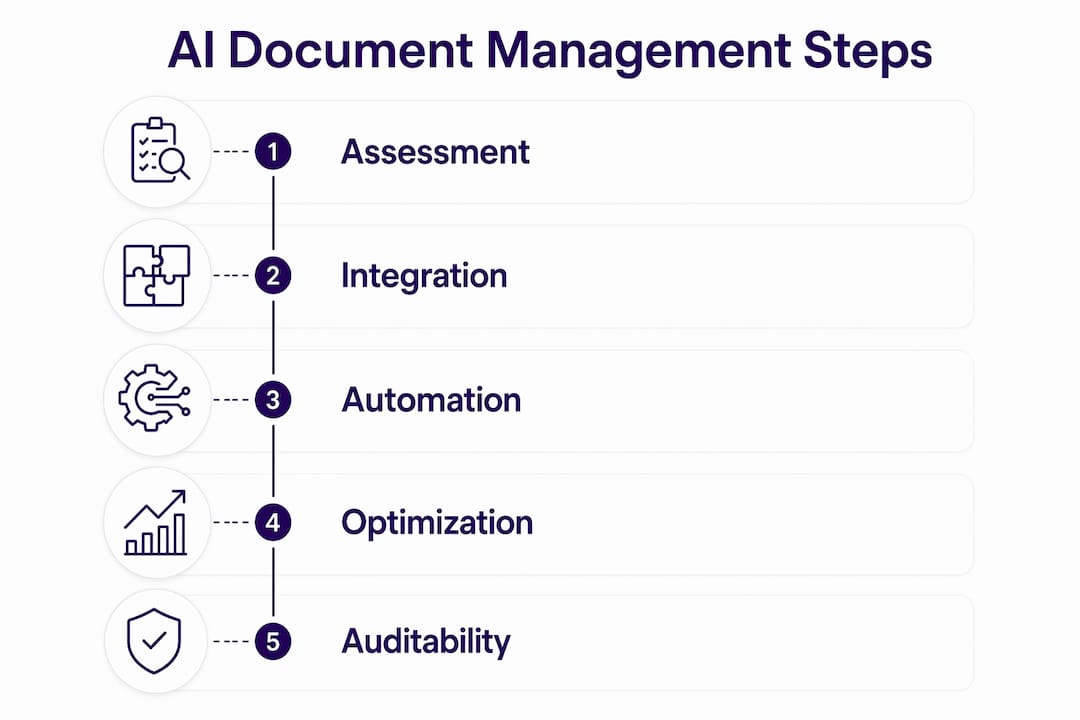
Getting started: from assessment to automation
Moving from interest to implementation requires a structured approach. Here is how to sequence the work:
- Conduct a document management maturity assessment. Map your current document types, volumes, storage locations, and retrieval pain points. This audit reveals where AI will deliver the fastest returns and surfaces integration dependencies you will need to plan around.
- Define metadata and tagging standards first. AI classification is only as good as the schema it works against. Spend time defining the metadata fields that matter for your document types before you configure any AI model. This step is often underestimated and frequently skipped.
- Implement semantic tagging incrementally. Start with your highest-volume document category. Validate accuracy, adjust the model, and expand. Trying to tag everything at once leads to poor accuracy and user distrust.
- Deploy AI agents for contract monitoring and alerts. Once your document foundation is solid, add automated workflow elements. This is where you see productivity gains from AI workflow automation compound: AI agents monitor obligation deadlines, flag anomalies, and escalate exceptions without human prompting.
- Track and report productivity improvements. Measure retrieval time, administrative hours, and compliance incidents before and after deployment. Concrete numbers sustain executive support and justify expanding the program to additional document categories.
For a deeper look at how AI applies specifically to records governance, the AI for record management guide on the Ailerons blog covers the practical classification and retention decisions in detail.
My take on what actually works
I have reviewed a lot of AI document management implementations, and the pattern I keep seeing is this: organizations get excited about the technology and skip the infrastructure thinking. They deploy a capable AI tool on top of a disorganized document environment and then wonder why the results are mediocre.
Auditability is the piece that bites teams hardest. I have seen organizations build out genuinely impressive AI document workflows only to face a legal discovery request or compliance audit and realize they cannot trace how the AI arrived at a particular classification or routing decision. Designing audit capabilities from the start is not optional. It is the difference between a defensible system and a liability.
My other strong opinion is about context. Basic automation features, things like rule-based routing or simple keyword search, deliver modest gains. The real productivity shift comes when AI understands the relationships between documents, the history behind a matter or client, and the organizational permissions that govern access. That contextual layer is what separates genuinely useful AI document management from an expensive search upgrade.
On the change management side: I would take a platform that lets users stay on familiar workflows during transition over a technically superior platform with a forced cutover every single time. Adoption pace matters more than feature sets in the first twelve months. The efficiency gains from agentic AI only materialize if your team actually uses the system.
— Sam
How Ailerons can help with your document management transformation
Ailerons specializes in designing and deploying agentic AI systems for operational workflows, including document management, compliance-driven processes, and administrative coordination. Rather than offering off-the-shelf software, Ailerons builds AI architecture that fits your existing systems and addresses the specific document challenges your organization faces.
For organizations evaluating where to start, the Ailerons case studies show how clients across different industries have moved from manual document processes to AI-orchestrated workflows, with documented outcomes in retrieval speed, compliance accuracy, and administrative overhead.
If you are ready to move from assessment to deployment, the Ailerons AI consulting services page outlines how the team approaches agentic AI design, system integration, and outcome-focused implementation. You can book a consultation directly from that page.
FAQ
What is AI-driven document management?
AI-driven document management, also called intelligent document processing, uses machine learning and semantic AI to automate how organizations classify, retrieve, route, and govern documents. It goes beyond basic file storage by understanding document content and context.
How much time can AI save on document retrieval?
Organizations that implement metadata tagging and full-text OCR search can reduce retrieval time by up to 40% compared to manual search methods, according to Foxit’s 2026 DMS research.
How long does an AI document management deployment take?
Realistic timelines for a minimum viable deployment run approximately six months. Forrester’s 2026 analysis notes that per-page processing costs range from $0.05 to $0.20 depending on document volume and complexity.
Why do AI document management projects fail?
The most common failure points are neglecting auditability, deploying AI tools in silos that cannot share a semantic layer, and underestimating change management. Each of these issues can be addressed with proper planning before deployment begins.
Do I need a new document platform to use AI document management?
Not necessarily. Many organizations layer AI capabilities onto existing document infrastructure through integrations. The key requirement is that the AI system has access to a unified semantic layer across your document repositories rather than operating against fragmented storage locations.