

TL;DR:
- AI decision logic enables faster, higher-quality task completion across various business workflows.
- Agentic AI transforms workflows by autonomously executing structured decisions, reducing errors and cycle times.
- Successful adoption relies on workflow redesign, clear governance, incremental deployment, and staff involvement.
Businesses using AI decision logic are already completing 12.2% more tasks, 25.1% faster, with measurable gains in quality, revenue, and cost efficiency. These results are not reserved for tech giants with massive R&D budgets. Mid-sized companies are achieving them today by applying agentic AI to the workflows that run their operations. This guide breaks down what AI decision logic actually means, how agentic systems apply it in practice, how to find the right level of autonomy for your organization, and what it takes to implement it successfully. If you are evaluating AI for your business, this is where to start.
Table of Contents
- What is AI decision logic in business?
- How agentic AI transforms business workflows
- The autonomy spectrum: Finding the right balance for your business
- Best practices for implementing AI decision logic successfully
- A hard-earned lesson: Why ‘just adding AI’ misses the mark
- How Ailerons can help your organization lead with agentic AI
- Frequently asked questions
Key Takeaways
| Point | Details |
|---|---|
| Transformative productivity | Agentic AI decision logic drives higher workflow speed, capacity, and quality when matched to the right business processes. |
| Balance autonomy wisely | Finding the right mix of AI autonomy and human oversight ensures performance gains without risking accountability or compliance. |
| Workflow redesign is crucial | Redesigning workflows around AI, not merely adding tools, unlocks the biggest ROI improvements and lasting change. |
| Plan for measurable impact | Setting clear outcome metrics and pilot protocols leads to smarter scaling and sustained value from AI decision logic. |
What is AI decision logic in business?
AI decision logic refers to the structured reasoning a system uses to evaluate conditions, weigh options, and take action without waiting for a human to intervene at every step. It is not a simple if-then rule set. It is a framework that allows AI to assess context, apply learned patterns, and choose the most appropriate path forward based on defined goals.
In the context of decision logic in agentic AI, this capability is what separates modern AI systems from legacy automation tools. Traditional rule-based software follows fixed scripts. If a condition falls outside the script, the system fails or escalates to a human. Agentic AI, by contrast, can reason through ambiguity, gather additional context, and still reach a sound decision.
Here are the key business contexts where AI decision logic creates immediate value:
- Workflow approvals: Routing purchase orders, leave requests, or contracts based on policy rules and exception handling
- Customer service triage: Categorizing and prioritizing incoming requests, then resolving or escalating based on complexity
- Supply chain optimization: Evaluating vendor options, inventory levels, and delivery timelines to recommend or execute the best action
- Document processing: Extracting, validating, and routing information from invoices, forms, or compliance documents
- Scheduling coordination: Resolving conflicts across calendars, resources, and priorities without manual back-and-forth
According to research, agentic AI delivers 3-5% productivity gains and 1-2% revenue uplift when decision logic is integrated into workflows rather than bolted on as a side tool.
“The value of AI decision logic is not in replacing judgment. It is in applying consistent, fast judgment to the high volume of structured decisions that currently consume your team’s time.”
Pro Tip: Start with processes that have clear inputs, defined rules, and measurable outputs. Accounts payable, scheduling, and document routing are ideal starting points because the decision criteria already exist. You are not teaching the AI to think from scratch. You are giving it a well-defined problem to solve.
For a broader view of how this fits into your operations, the workflow automation guide from Ailerons offers practical context on where to begin.
How agentic AI transforms business workflows
Understanding what AI decision logic is sets the stage for seeing its effects in action, in particular, how it reshapes everyday workflows.
“Agentic” AI means the system can pursue a goal across multiple steps, tools, and decisions without requiring a human to manage each transition. It does not just answer a question. It takes action, checks results, adjusts, and continues until the goal is reached.
Consider a vendor approval workflow. In a traditional setup, a request arrives, a manager reviews it, sends it to finance, waits for a response, and then confirms or rejects. Each handoff takes time. Errors accumulate. McKinsey found consultants using AI completed tasks 25.1% faster and 12.2% more of them, a direct result of removing friction from decision-heavy processes.

| Factor | Traditional workflow | Agentic AI workflow |
|---|---|---|
| Approval time | 3-5 business days | Hours or less |
| Tasks completed per cycle | Baseline | 12.2% more |
| Error rate | Higher due to manual entry | Reduced through validation logic |
| Cost per transaction | Higher labor cost | Lower with scale |
| Human involvement | Required at each step | Required only for exceptions |
The shift is significant. But the nuance matters: true productivity gains come from redesigning the workflow around AI capabilities, not simply adding an AI layer on top of an existing broken process.
Here is how that redesign typically unfolds:
- Map the current workflow and identify every decision point
- Classify each decision as structured (rule-based) or unstructured (judgment-heavy)
- Assign agentic AI to structured decisions and design clear escalation paths for unstructured ones
- Rebuild the workflow around AI-native steps, not legacy handoffs
- Measure output quality and cycle time continuously
Gartner predicts a leap from under 5% high-autonomy workflows in 2025 to 33% by 2028. That trajectory reflects how quickly organizations are moving from AI as a helper to AI as an operator. Staying current on AI trends for office operations will help you benchmark your own pace against the market.
For a deeper look at process-level improvements, AI business process optimization covers how to structure these changes systematically.
The autonomy spectrum: Finding the right balance for your business
With agentic AI proven to transform workflows, the next step is finding the autonomy sweet spot for your organization.
Not every process should run at full autonomy. The autonomy spectrum runs from assistive tools (AI that suggests, humans decide) through semi-autonomous systems (AI acts, humans review) to fully agentic systems (AI executes end-to-end with minimal human involvement). Each level carries different capabilities and risks.
| Autonomy level | What it does | Best for | Key risk |
|---|---|---|---|
| Assistive | Recommends actions, surfaces data | High-stakes decisions, early adoption | Low; human retains control |
| Semi-autonomous | Executes within defined boundaries, flags exceptions | Approvals, scheduling, routing | Moderate; requires clear escalation rules |
| Fully agentic | Manages complete workflows independently | Repetitive, high-volume, well-defined processes | Higher; demands strong governance |
Only 5% of enterprises had high-autonomy AI in 2025. Gartner expects that to reach 33% by 2028, meaning the window to build this capability ahead of competitors is open right now.
Before raising the autonomy level of any system, ask these questions:
- Is the decision logic well-defined and consistently applied today?
- What is the cost of an error at this decision point?
- Do we have audit trails and rollback mechanisms in place?
- Are our staff prepared to work alongside an autonomous system?
- Can we monitor outcomes in real time and intervene quickly if needed?
Multi-agent systems handle complexity effectively, but they require governance structures that match their capabilities. Without clear accountability, autonomous systems can create new risks even as they eliminate old inefficiencies.
The AI efficiency guide and agentic AI adoption trends from Ailerons offer practical frameworks for assessing where your organization sits on this spectrum.
Pro Tip: Pilot semi-autonomous solutions in low-risk, high-volume domains first. Invoice matching, meeting scheduling, and internal ticket routing are ideal. You build confidence in the system’s judgment before expanding its authority.
Best practices for implementing AI decision logic successfully
Selecting your autonomy level leads naturally to the challenge of getting implementation right. Here is how to ensure success.
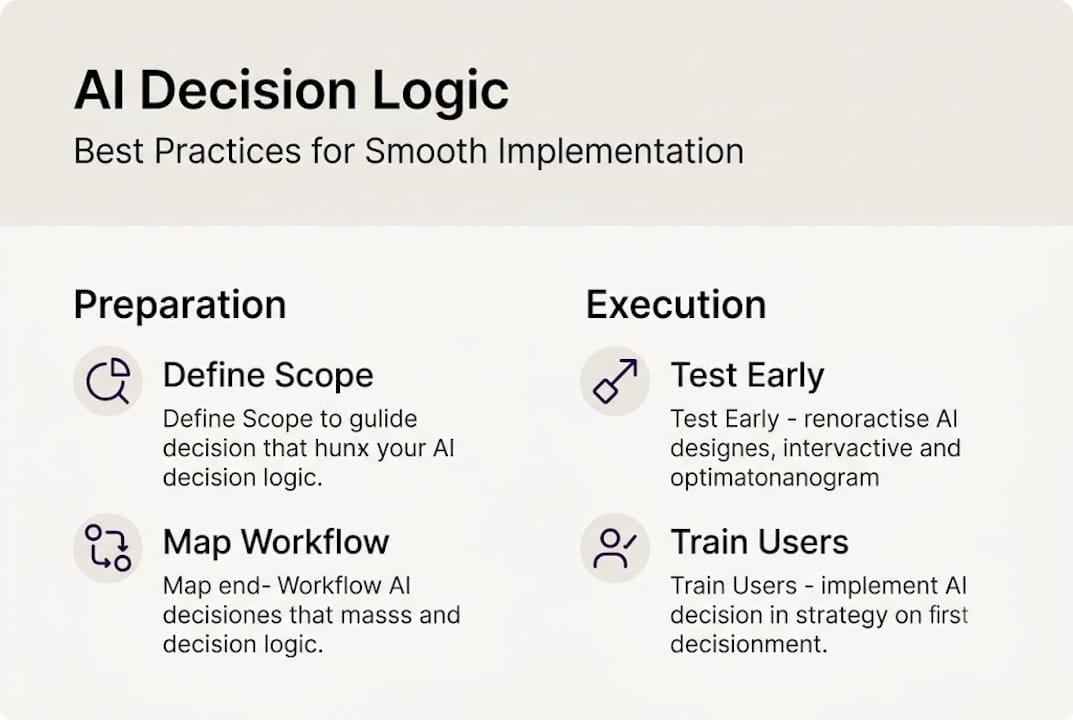
The most common mistake organizations make is treating AI implementation as a technology project rather than an operational change. The technology is rarely the limiting factor. Culture, process design, and measurement discipline are.
Follow this sequence:
- Assess: Audit your current workflows. Identify where decisions are slow, inconsistent, or error-prone. Prioritize processes with clear rules and available data.
- Pilot: Deploy AI decision logic in one contained workflow. Define success metrics before you start, not after.
- Measure: Track task completion rate, cycle time, error rate, and cost per transaction. Compare directly to your pre-implementation baseline.
- Scale: Expand to adjacent workflows once the pilot demonstrates stable, measurable outcomes. Do not scale problems.
Workflow redesign drives 3-5% productivity gains and 1-2% revenue improvement. Bolt-on AI tools applied to unchanged processes rarely deliver those numbers.
Avoid these common pitfalls:
- Skipping staff training: End users who do not understand how to work alongside the AI will work around it instead
- Unclear ROI targets: Without defined metrics, you cannot evaluate success or justify further investment
- Weak governance: No audit trail, no escalation path, and no accountability structure creates compliance exposure
- Over-automating too fast: Moving to full autonomy before validating decision quality in semi-autonomous mode increases risk
- Ignoring data quality: AI decision logic is only as reliable as the data it reasons from
For a step-by-step implementation approach, the AI automation step-by-step guide covers the full rollout process. If you want to understand how AI functions as a collaborator within your team, autonomous digital collaboration offers a useful framework for setting expectations.
Pro Tip: Involve end users in the design phase, not just the testing phase. The people closest to the workflow know where the edge cases live. Their input prevents costly redesigns after deployment.
A hard-earned lesson: Why ‘just adding AI’ misses the mark
Here is a candid point of view based on practical insight into agentic AI.
Most organizations that struggle with AI adoption share one pattern: they treat AI as a feature to install rather than a capability to build. They add an AI layer to an existing process, see modest results, and conclude the technology is overhyped. The problem is rarely the AI.
The real differentiators are culture, governance, and workflow redesign. An organization that redesigns its approval process around AI decision logic will outperform one that simply attaches AI to the same slow, manual chain. The technology is the same. The outcomes are not.
There is also a governance gap that most guides skip over. As you explore AI in professional services, you will notice that the organizations seeing the strongest results are those that treat AI governance as a core operational function, not an afterthought. They define who is accountable when the AI makes a wrong call. They build escalation paths before they need them. That discipline is what separates sustainable AI adoption from a failed pilot.
Right-sized autonomy matters too. Pushing too fast toward full agentic operation without validating decision quality at each stage is how organizations lose trust in their systems and roll back progress. Start smaller than you think you need to. Prove it. Then expand.
How Ailerons can help your organization lead with agentic AI
Ready to move from insight to action? Here is where to begin.
Ailerons specializes in designing and deploying agentic AI systems that handle real office work, from document processing and approvals to scheduling, billing support, and compliance-driven tasks. Our implementations are built around workflow redesign, not bolt-on tools, which is why they deliver measurable outcomes rather than marginal improvements.
If you want to see what this looks like in practice, explore our AI decision logic case studies to review documented results from real deployments. If you are ready to discuss your specific workflows and where agentic AI can create the most immediate value, visit Ailerons AI solutions to start a conversation with our team. We work with mid-sized organizations at every stage of AI adoption, from first pilot to full-scale operation.
Frequently asked questions
What kind of business decisions can AI logic automate effectively?
AI decision logic excels at automating structured, rule-based choices such as invoice approvals, scheduling, customer triage, and supply chain routing. These are high-volume, defined decisions where consistent application of rules creates immediate efficiency gains.
How can I measure ROI when implementing AI decision logic?
Track task completion rate, time saved, error reduction, and cost or revenue changes compared to pre-implementation benchmarks. Case studies show 3-5% productivity gains and 1-2% revenue improvement from well-structured agentic deployments.
Is AI decision logic secure and compliant with data regulations?
Security and compliance depend on proper governance, access controls, and aligning AI usage with regional regulations during rollout. Multi-agent setups challenge accountability, which makes governance design a non-negotiable part of any responsible deployment.
How quickly can mid-sized companies see results with agentic AI?
Implementations focused on clear, well-defined processes can yield ROI within months. Early-stage deployments show 1-2% revenue increases and 5-20% cost reductions, with measurable productivity gains typically visible within the first year.
Recommended
- How to harness decision logic in automation with agentic AI | Ailerons IT Consulting
- AI-driven operations guide: boost efficiency 72% in 2026 | Ailerons IT Consulting
- AI Trends in 2026: Transforming Office Operations | Ailerons IT Consulting
- Improving Business Workflows with AI: Achieve Automation | Ailerons IT Consulting
- AI In Forex Trading: Transforming Profits And Risk