

When you assign agentic AI to critical administrative workflows, the responsibility stretches far beyond simple automation. North American healthcare leaders recognize that every patient record processed carries both a legal burden and a security expectation. With regulations swiftly adapting and oversight split between internal policy and governmental mandates, defining AI compliance and security standards matters more now than ever. This guide untangles where compliance, risk management, and operational efficiency intersect, and how practical, scalable safeguards protect your organization as technology advances.
Table of Contents
- Defining AI Compliance and Security Standards
- Regulatory Frameworks Shaping Healthcare AI
- Integrating Agentic AI Into Administrative Workflows
- Key Security Risks and Mitigation Strategies
- Meeting HIPAA, NIST, and Industry Requirements
Key Takeaways
| Point | Details |
|---|---|
| AI Compliance is Essential | Compliance with healthcare regulations is a fundamental requirement, not an option, especially when handling sensitive patient data. |
| Adaptability is Key | Organizations must build compliance frameworks that are flexible to changing regulations and can seamlessly incorporate AI systems without complete overhauls. |
| Focus on Internal Governance | Establish robust internal policies and validation processes to ensure AI tools are integrated effectively and safely into existing workflows. |
| Risk Management Across Regions | Different regions have varying regulations; understanding local compliance requirements is crucial for organizations operating across borders. |
Defining AI Compliance and Security Standards
AI compliance and security standards in healthcare aren’t luxury features—they’re operational requirements. When you deploy agentic AI to handle patient scheduling, billing workflows, or authorization processes, you’re moving data that requires protection by law.
What compliance actually means extends beyond checking boxes. AI in healthcare demands regulation to ensure safety, efficacy, and fairness, creating a dual responsibility: your organization must self-regulate internally while preparing for external governmental oversight.
You manage three distinct layers:
- Internal governance: Your own policies, validation processes, and monitoring systems
- External compliance: Industry standards, regulatory requirements, and audit frameworks
- Operational security: Data protection, access controls, and incident response procedures
Compliance standards address medium to high-risk AI tools differently. A scheduling agent that coordinates calendar conflicts carries different risk than a system flagging potential drug interactions. Your security framework must scale the controls accordingly.
The Real Challenge in Operations
Your compliance burden isn’t just regulatory—it’s economic. Evaluation and validation for healthcare AI systems costs significant resources, and that expense scales when your AI handles multiple workflows simultaneously. Meanwhile, technology keeps accelerating faster than policies can adapt.
Effective standards require policies, validation, monitoring, and adaptable integration into existing workflows that balance innovation with protection. This means your AI systems must operate transparently, with clear responsibility lines and equity considerations built in from design, not added later.
Compliance also demands transparency across your team. When an agentic AI makes a decision about approvals, denials, or escalations, humans need visibility into why that decision happened. This traceability protects both your organization and the patients whose data the system touches.
What Standards Actually Cover
Modern healthcare AI standards focus on:
- Data handling and privacy safeguards
- Model validation and performance monitoring
- Bias detection and fairness testing
- Documentation and audit trails
- Incident reporting and response procedures
- Staff training and accountability
Your agentic AI systems should integrate into these existing frameworks, not require rebuilding your entire compliance infrastructure. The most practical approach treats AI compliance like any other operational risk—manageable, scalable, and built into normal workflows.
Pro tip: Start compliance planning before deployment, not after. Identify your highest-risk workflows first, validate those systems thoroughly, then expand to lower-risk automation once your internal governance processes are proven.
Regulatory Frameworks Shaping Healthcare AI
Regulatory frameworks for healthcare AI aren’t uniform globally. What works in the United States differs significantly from European Union requirements, which differ again from Canadian or Australian standards. This fragmentation creates real operational complexity for organizations deploying agentic AI across borders or multiple jurisdictions.
AI regulatory approaches vary worldwide, ranging from comprehensive legislation to voluntary guidelines and national strategies. Most regions follow a similar pattern: ethics policies emerge first, then formal legislation follows as risks become clearer. The challenge lies in balancing innovation with meaningful risk management.
Your operational context matters most. North American healthcare organizations face distinct regulatory pressures that differ from European counterparts.
Key Regulatory Players
Several frameworks directly impact your AI deployment decisions:
- United States: FDA oversight of AI-driven medical devices, plus state-level privacy regulations
- European Union: The EU AI Act classifies healthcare AI by risk level, with stricter requirements for high-risk systems
- Canada: Medical device regulations through Health Canada, plus provincial privacy laws
- United Kingdom: Adapted Medical Device Regulations post-Brexit, with ongoing AI governance development
Each region treats AI in medical devices differently, focusing on safety, effectiveness, transparency, and compliance. An agentic AI handling administrative workflows faces less stringent requirements than one making clinical recommendations.
The regulatory landscape shifts faster than most organizations can adapt. Build compliance infrastructure that’s flexible enough to accommodate changes without complete system rebuilds.
For mid-sized North American healthcare organizations, the practical reality is managing multiple compliance obligations simultaneously. Your billing automation agent must comply with privacy laws. Your scheduling system must integrate with state-level identity requirements. Your document handling processes need audit trails for healthcare fraud prevention.
The common thread across all frameworks: transparency and accountability. Regulators want to understand how your AI makes decisions, what data it uses, and how humans can override or interrupt its actions.
The table below clarifies how leading healthcare AI regulatory frameworks approach risk, oversight, and compliance focus:
| Framework | Primary Focus | Oversight Method | Risk Handling Approach |
|---|---|---|---|
| U.S. FDA | Device safety and effectiveness | Pre-market review, post-market surveillance | Greater scrutiny for higher-risk tools |
| EU AI Act | Categorized AI risk management | Risk-based requirements, regulatory audits | Strictest controls for high-risk systems |
| HIPAA | Data privacy and protection | Annual risk assessments, self-regulation | Mandates strong access and audit controls |
| NIST AI RMF | Technical risk mitigation | Voluntary adoption, guidance updates | Emphasizes continuous risk review |
Building for Regulatory Flexibility
Your agentic AI systems should accommodate regulatory requirements through design, not retrofitting. This means:
- Logging every decision point and data access
- Enabling rapid configuration changes for new requirements
- Maintaining clear audit trails for compliance reviews
- Isolating high-risk workflows for specialized oversight
The organizations adapting fastest treat regulatory compliance as a continuous process, not a one-time certification. They monitor emerging guidance, test new requirements in controlled environments, and adjust workflows incrementally.
Pro tip: Map your current regulatory obligations by workflow, then prioritize agentic AI deployment in areas with the clearest compliance requirements first. This builds your internal governance muscle before tackling more ambiguous regulatory territory.
Integrating Agentic AI Into Administrative Workflows
Integrating agentic AI into your healthcare administrative workflows isn’t a plug-and-play installation. It requires deliberate planning around data access, compliance mechanisms, and human oversight. The organizations doing this successfully treat integration as a multi-phase orchestration challenge, not a simple software deployment.

Your administrative workflows hold sensitive patient data constantly. Billing systems, scheduling platforms, authorization processes—all touch Protected Health Information. Agentic AI requires compliance with frameworks like HIPAA through access controls, data sanitization, and complete audit trails. This isn’t optional infrastructure; it’s foundational.
The Integration Framework
Successful agentic AI implementation follows a structured approach:
- Define mission-oriented workflows: Identify which administrative tasks create the most friction and compliance risk
- Unlock data silos: Connect systems that currently operate in isolation, carefully managing access permissions
- Clarify business logic: Document decision rules that your AI agent should follow or escalate
- Establish control mechanisms: Build human oversight points where decisions require approval or review
This structure differs fundamentally from traditional automation. You’re not replacing a human with a bot; you’re creating an autonomous system that reasons through multi-step processes, coordinates across systems, and knows when to escalate.
Where to Start
Begin with workflows that have clear, repeatable decision patterns. Scheduling coordination across departments works better as a starting point than complex billing disputes. Appointment reminders and confirmation tracking suit agentic AI well before tackling authorization workflows.
Designing successful agentic AI systems requires unlocking data silos while managing governance, security, and human oversight carefully. Your IT team needs visibility into what data the AI accesses, when, and why. Your compliance team needs audit trails showing every decision point.
Start integration in low-risk administrative areas where decision patterns are consistent. This proves your governance model before expanding to higher-stakes workflows.
Common integration challenges emerge quickly. Your scheduling system uses one vendor’s API while your ERP uses another. Patient data is scattered across multiple systems with different access controls. Your billing team has tribal knowledge about exceptions that no one documented.
These operational realities demand systematic thinking. Your agentic AI implementation should include a dedicated data governance phase where you map data flows, identify access patterns, and establish which systems can communicate safely.
Organizational restructuring often follows, though it’s rarely discussed. Teams accustomed to handling exceptions manually need new roles focused on monitoring, exception handling, and continuous improvement of the AI’s decision logic.
Here’s how agentic AI integration challenges differ from traditional automation projects:
| Challenge Area | Traditional Automation | Agentic AI Approach |
|---|---|---|
| Decision Logic | Fixed, rule-based | Dynamic, context-aware |
| Data Access | Often isolated systems | Cross-system integration required |
| Human Oversight | Manual exception handling | Built-in escalation and monitoring |
| Compliance Complexity | Generally static | Evolving, multi-layered obligations |
Pro tip: Pilot agentic AI in one specific workflow first—like appointment confirmation across three departments—then document lessons learned about governance, access controls, and human oversight before scaling to other processes.
Key Security Risks and Mitigation Strategies
Agentic AI systems in healthcare expand your attack surface dramatically. When your AI agent accesses billing systems, scheduling platforms, and patient records simultaneously, you’re creating new pathways for breach. The risk isn’t theoretical—it’s operational and immediate.
The primary concern: your AI system gains broad access to electronic protected health information to function effectively. AI integration introduces cybersecurity vulnerabilities including increased attack surfaces as the system touches sensitive data across multiple systems. Adversarial attacks can manipulate AI outputs, and data privacy failures expose patient information at scale.
You face risks that traditional cybersecurity programs don’t address well.
Specific Threats to Agentic AI
Three categories of risk demand attention:
- Data leakage during model training: Your AI learns from real patient data; improper handling exposes PHI
- Adversarial manipulation: Attackers craft inputs that cause your AI to make incorrect decisions or bypass controls
- AI-enabled cyberattacks: Your AI system itself becomes a weapon if compromised
These threats require different defenses than your current security stack provides. A firewall won’t stop adversarial manipulation. Standard encryption won’t prevent a compromised AI from making bad decisions.
Managing cybersecurity and privacy risks in AI adoption involves developing standards, guidelines, and tools tailored to AI vulnerabilities. Your team needs training on AI-specific attack patterns, not just traditional breach response.
Practical Mitigation Strategies
Your defense layers should include:
- Access control implementation: Limit what data your AI can reach; use attribute-based access controls that restrict operations by role and context
- Input validation and sanitization: Screen everything the AI receives to prevent adversarial attacks
- Decision logging and auditability: Capture every action the AI takes so you can detect anomalies and investigate incidents
- Human override capabilities: Build kill switches and approval workflows so humans can interrupt harmful decisions
- Continuous monitoring: Watch for unusual access patterns, decision anomalies, or performance degradation
Your AI’s security posture depends on limiting what it can do, not trusting what it won’t do.
Most breaches exploit the gap between what your security team thinks your AI can access and what it actually can. Map your AI’s data access explicitly. Test those boundaries regularly. Assume your assumptions are wrong.
Organizations that handle this well treat agentic AI security as a continuous operational process, not a one-time implementation. They monitor, adjust, and improve controls based on real usage patterns.
Pro tip: Before deploying agentic AI to production, run a red team exercise where your security team tries to manipulate the system into exposing data or making harmful decisions. Use findings to harden access controls and add human oversight at critical decision points.
Meeting HIPAA, NIST, and Industry Requirements
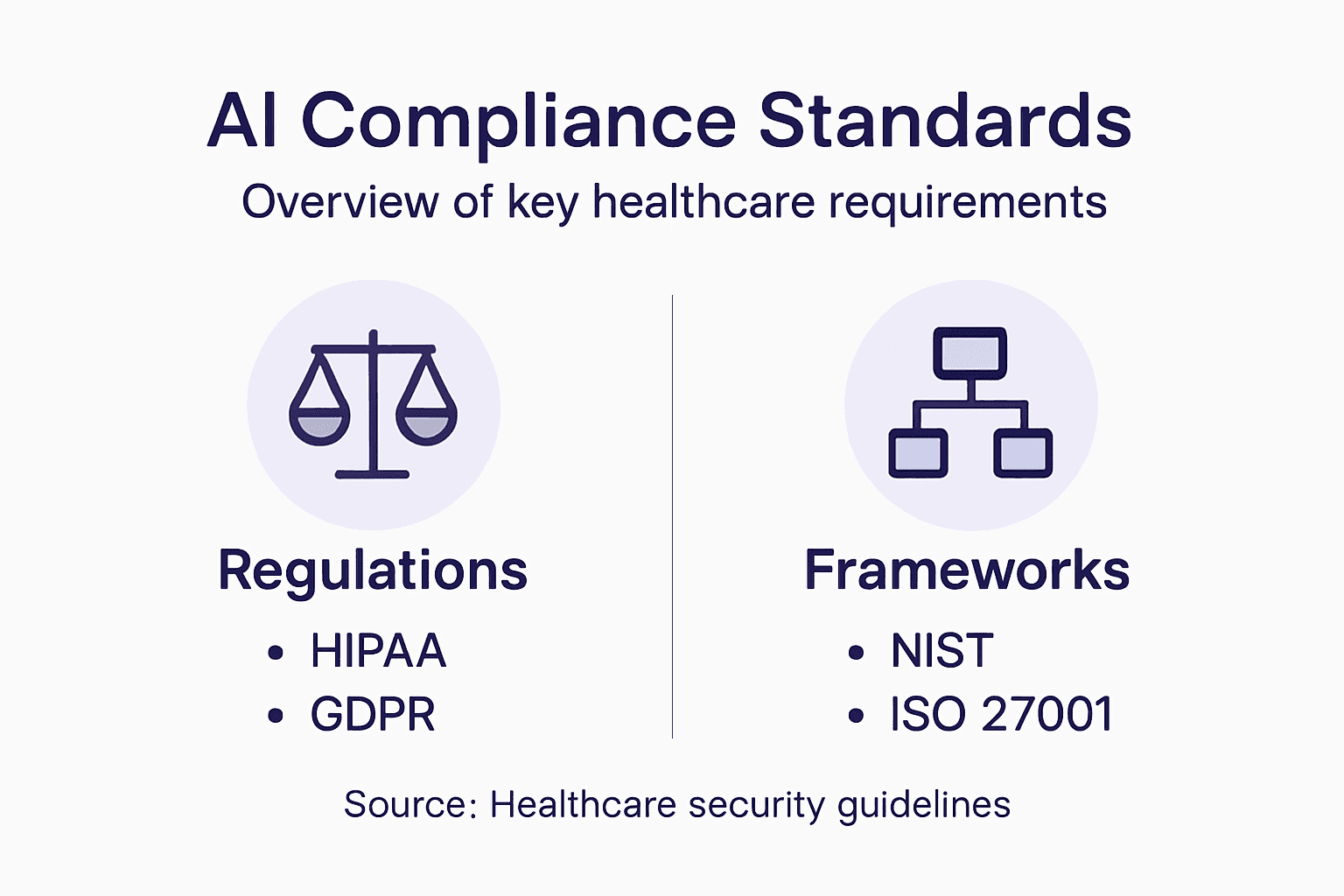
HIPAA compliance isn’t negotiable in healthcare, but agentic AI complicates traditional approaches. Your AI system handles electronic protected health information constantly, yet standard HIPAA policies rarely address AI-specific risks. You need updated frameworks that treat AI as a new compliance category.
The challenge isn’t HIPAA itself—the rule has existed since 1996. The challenge is that AI requires updating security policies to include AI-specific risks while ensuring AI tools support your operations without exposing PHI. Your policies must address how your AI accesses, processes, and stores patient data differently than traditional systems.
NIST frameworks provide the technical foundation your compliance team needs. HIPAA sets the legal requirement; NIST provides implementation guidance.
Building Your Compliance Stack
Three frameworks work together:
- HIPAA: Legal requirement for healthcare organizations protecting ePHI
- NIST Cybersecurity Framework: Technical standards for risk management and controls
- NIST AI Risk Management Framework: Emerging guidance specifically for AI systems
Each layer adds specificity. HIPAA says protect data. NIST says how. Your agentic AI implementation must satisfy all three simultaneously.
Practical Compliance Architecture
A HIPAA-compliant agentic AI framework integrates attribute-based access controls for granular PHI governance, PHI sanitization combining technical and machine learning approaches, and immutable audit trails verifying compliance. This isn’t optional complexity; it’s the operational structure that makes AI deployment legal.
Your implementation should include:
- Attribute-Based Access Control (ABAC): Your AI’s data access depends on context, not just user role
- PHI Sanitization: Remove or obscure identifying information before your AI processes data
- Immutable Audit Trails: Log every access, decision, and data movement permanently
- Transparency Documentation: Show regulators exactly how your AI handles protected information
Compliance succeeds when you build controls into your AI’s architecture, not bolt them on afterward.
Most organizations struggle because they treat compliance as a separate function. Effective approaches embed compliance into how your agentic AI operates from the start. Your security architecture becomes your compliance architecture.
Your HIPAA Risk Analysis should explicitly address agentic AI vulnerabilities. How can your AI’s access be exploited? What happens if the system is compromised? What safeguards limit damage if something goes wrong?
NIST guidance evolves constantly. Organizations adapting successfully monitor emerging standards and test new requirements in controlled environments before full deployment.
Pro tip: Document your agentic AI’s data flows in a HIPAA-compliant architecture diagram showing access controls, sanitization points, and audit logging. Use this during compliance reviews to demonstrate your security framework directly addresses AI-specific risks.
Elevate Healthcare AI Compliance and Security with Agentic AI Solutions
Navigating the complex landscape of AI compliance and security standards in healthcare demands more than basic automation. With agentic AI, you gain context-aware systems that reason through multi-step workflows while ensuring transparency, auditability, and strict data governance. If your organization faces challenges around integrating AI-driven scheduling, billing, or document management workflows that must comply with HIPAA, NIST, and other evolving regulatory frameworks, this is the breakthrough approach you need.
Ailerons.ai specializes in delivering secure, compliant agentic AI systems designed specifically for healthcare administrative workflows. Our solutions:
- Support granular access control and auditing to safeguard Protected Health Information
- Enable real-time decision logging and human oversight to meet regulatory demands
- Provide seamless integration with your existing CRM, ERP, and scheduling platforms
Discover how to reduce operational risk while accelerating innovation with agentic AI architecture and deployment. Visit Ailerons.ai today to explore how your healthcare organization can build compliance into AI workflows from day one and confidently scale intelligent automation across your operations.
Frequently Asked Questions
What are AI compliance and security standards in healthcare?
AI compliance and security standards refer to the legal and operational requirements that healthcare organizations must follow when deploying AI technologies. These standards ensure the protection of patient data, promote transparency, and maintain safety and fairness in AI systems.
Why is compliance important when using AI in healthcare?
Compliance is crucial in healthcare AI because it helps protect sensitive patient information, meets regulatory requirements, and ensures the safe and effective operation of AI systems. Non-compliance can lead to legal ramifications and compromises patient safety and trust.
How can healthcare organizations ensure AI compliance?
Healthcare organizations can ensure AI compliance by implementing robust internal governance policies, adhering to external regulatory standards, and continuously monitoring AI performance. It is essential to validate AI systems and integrate compliance frameworks from the design phase onwards.
What are the potential risks of deploying AI in administrative workflows?
Deploying AI in administrative workflows can lead to risks such as data leakage, adversarial manipulation, and increased vulnerabilities in cybersecurity. It is crucial to implement access controls, input validation, decision logging, and continuous monitoring to mitigate these risks.
Recommended
- Step-by-Step Guide to AI-Driven Office Automation Success | Ailerons IT Consulting
- Ailerons IT Consulting | Enterprise IT Solutions
- Ailerons IT Consulting | Enterprise IT Solutions
- Ailerons IT Consulting | Enterprise IT Solutions
- Cybersecurity in ERP Explained: Data Protection That Matters
- Top 4 Industry-Specific AI Software in 2026 for Healthcare Leaders Seeking Innovative Solutions | Artificial Intelligence