

TL;DR:
- AI is now central to compliance operations in 2026, with over 80% of firms integrating it into risk management and regulatory response. Regulatory enforcement has hardened globally, with the EU AI Act imposing strict penalties, and organizations must develop adaptable, jurisdiction-specific governance frameworks to remain compliant. Successfully operationalizing AI requires organizational oversight, clear policies, and executive ownership, ensuring AI functions as a trustworthy, regulation-aligned force multiplier rather than a compliance risk.
The compliance function has crossed a threshold. AI and compliance in 2026 are no longer separate discussions. AI is now woven into how organizations detect risk, manage cases, and respond to regulators. Over 80% of investment management firms now use AI in their compliance operations, up from just 20% three years ago. For compliance officers and risk managers, the question is no longer whether to adopt AI. The question is whether your governance framework is ready for what comes with it.
Table of Contents
- Key Takeaways
- AI and compliance in 2026: the regulatory landscape
- Operationalizing AI within compliance functions
- Risks and pitfalls in AI compliance implementation
- Building scalable AI governance for multiple jurisdictions
- The future outlook for AI governance
- My take: what operationalization actually requires
- How Ailerons supports AI compliance transformation
- FAQ
Key Takeaways
| Point | Details |
|---|---|
| AI is foundational, not experimental | In 2026, AI operates as core compliance infrastructure, not a pilot project. |
| EU AI Act penalties are live | Non-compliance with the EU AI Act from August 2026 carries fines up to 35 million euros or 7% of global turnover. |
| Supervised autonomy is the standard | Human oversight at critical decision points is required to avoid regulatory and operational risk. |
| Data hygiene drives AI accuracy | Poor data quality degrades AI outputs and creates audit trail vulnerabilities. |
| Multi-jurisdiction programs need configurable governance | A single rigid compliance framework cannot satisfy the EU, U.S., and UK simultaneously. |
AI and compliance in 2026: the regulatory landscape
The enforcement environment has hardened significantly. Regulators across major jurisdictions are no longer issuing warnings. They are issuing penalties.
The EU AI Act is the most structurally significant development. It becomes fully applicable on August 2, 2026, with penalties reaching up to 35 million euros or 7% of global annual turnover for the most serious violations. Organizations deploying high-risk AI systems in areas like credit scoring, employment decisions, or critical infrastructure now face mandatory conformity assessments, transparency requirements, and ongoing monitoring obligations. This is not aspirational regulation. It is active enforcement.
| Jurisdiction | Regulatory Approach | Key Compliance Risks |
|---|---|---|
| European Union | Risk-tiered AI Act with mandatory obligations | Fines up to 35M euros; non-conforming high-risk AI systems |
| United States | Fragmented federal and state laws | State-level AI bias laws (e.g., Colorado SB24-205); FTC enforcement on deceptive AI claims |
| United Kingdom | Sector-specific principles; no single AI law yet | Growing FCA and ICO scrutiny; greenwashing and algorithmic accountability |
The U.S. environment remains fragmented. There is no single federal AI law, but enforcement pressure is real. The FTC has pursued cases involving deceptive AI claims. State legislatures, particularly Colorado with SB24-205, are imposing obligations on AI developers and deployers. Fragmented global AI regulations require organizations to build jurisdiction-specific controls rather than assume a single policy covers all markets.
In the UK, sector regulators like the FCA and ICO are increasing scrutiny without waiting for unified legislation. AI governance is now a boardroom compliance emergency as enforcement accelerates across all three major blocs.
The core compliance challenge is not understanding any one regulation in isolation. It is managing the overlap and conflict between them, often simultaneously, across product lines, vendors, and geographies.
Operationalizing AI within compliance functions
The expert conversation has shifted from “what is AI?” to “how do we safely operationalize it?” That shift matters because the answer requires infrastructure thinking, not just tool selection.

Embedding AI into core workflows with what practitioners call supervised autonomy is now the accepted model. Supervised autonomy means AI handles high-volume, pattern-dependent tasks while humans retain control over high-stakes decisions. Misconduct findings, regulatory disclosures, and escalations to senior leadership still require human sign-off. AI prepares the analysis. A qualified professional approves the outcome.
Here is how compliance teams are structuring AI integration across their operations:
- Risk detection and monitoring. AI continuously scans transaction data, communications, and third-party activity to surface anomalies. Automated transaction classification and confidence scoring replace manual sampling, shifting teams from reactive to proactive.
- Case management and triage. Intake workflows use AI to categorize and prioritize incoming reports, including whistleblower submissions, before routing to the appropriate investigator.
- Regulatory change tracking. AI tools monitor legislative and regulatory feeds, flag relevant changes, and map them against existing policy libraries.
- Analytics and reporting. AI aggregates compliance metrics across business units and surfaces risk concentration patterns that manual reporting would miss.
Governance does not happen automatically once you plug AI into these functions. Policy must be embedded directly into AI configuration. If your AI tool does not reflect your current policies, it will produce outputs that conflict with your obligations.
Pro Tip: Before deploying any AI compliance tool, conduct a policy mapping exercise. List every active regulatory obligation, map it against the AI system’s decision logic, and document where human review is mandatory. Review this map every quarter.
Compliance teams must define clear escalation triggers: the threshold at which an AI-generated flag becomes a human investigation, and the threshold at which a human investigation requires executive or legal involvement. Without those triggers defined in writing, supervised autonomy becomes ambiguous in practice.
Risks and pitfalls in AI compliance implementation
48% of global organizations cite regulatory compliance as their top risk priority in 2026, yet many are operating with flat budgets and limited staff. That combination creates a pressure to over-automate, and over-automation is where compliance failures originate.
The risks compliance officers encounter most frequently include:
- Data quality gaps. Poor data hygiene degrades AI performance in compliance applications. Incomplete records, inconsistent formatting, and legacy system data gaps cause AI systems to generate inaccurate classifications. In a regulatory audit, an erroneous AI output without a clear audit trail is a material risk.
- Audit trail deficiencies. AI-assisted decisions must be reconstructable. If your system cannot explain why a specific transaction was flagged or cleared, regulators will question the reliability of your entire monitoring program.
- Vendor risk exposure. Many compliance tools are built on third-party AI models. If your vendor’s model changes, your compliance logic may change without your knowledge. Contract provisions should require notification of material model updates.
- Overreliance on automation. Teams that reduce human review too aggressively create blind spots. AI is effective at pattern recognition in structured data. It is not effective at catching novel, context-dependent misconduct that does not resemble historical patterns.
Pro Tip: Require every AI compliance vendor to provide a model change log as part of your service agreement. Treat undisclosed model updates the same way you would treat an undisclosed change in a third-party risk assessment.
ESG and AI-related greenwashing investigations add another layer. Compliance teams working in sectors where AI supports sustainability claims must coordinate directly with product and engineering teams to validate those claims before publication. Regulators are actively pursuing cases where AI-generated outputs informed misleading disclosures.
Building scalable AI governance for multiple jurisdictions
A compliance program that satisfies the EU AI Act will not automatically satisfy Colorado’s SB24-205 or the UK’s FCA guidance. Scalable programs require configurable governance architecture, not monolithic policy documents.
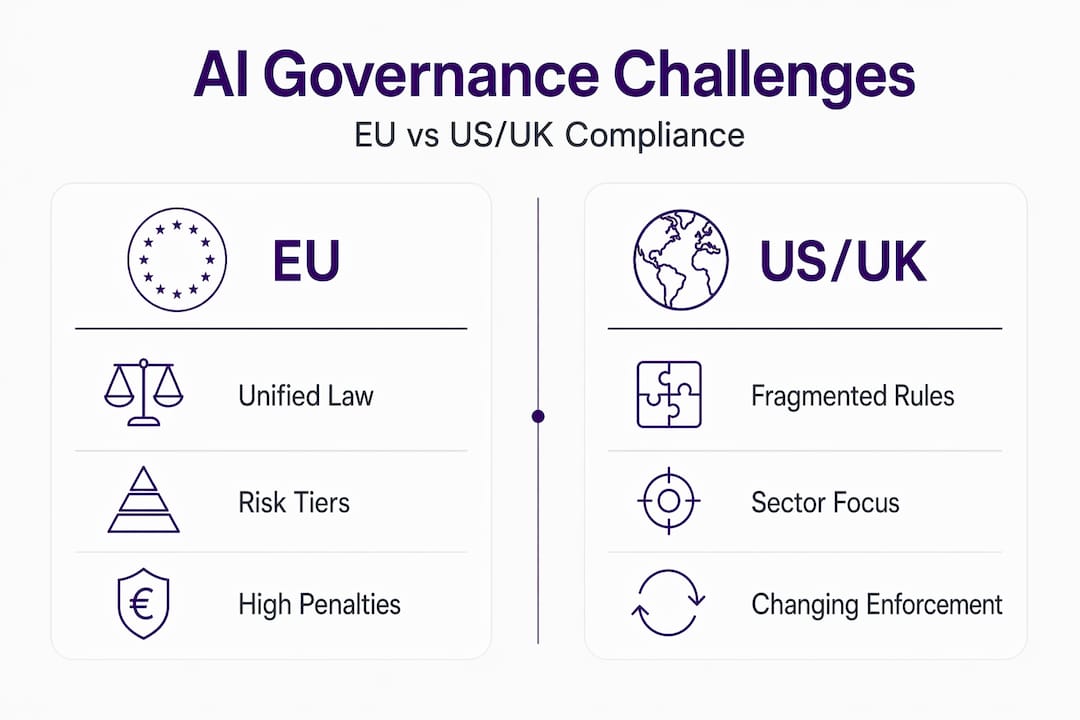
Configurable governance layers map specific jurisdictional requirements to operational controls, allowing compliance teams to activate or adjust obligations by region without rebuilding the entire framework. Think of it as modular compliance: a core policy architecture with jurisdiction-specific modules attached.
Building that architecture requires the following steps:
- Inventory all AI systems in use. Classify each by risk level under applicable regulatory frameworks. High-risk systems require significantly more documentation and oversight than low-risk tools.
- Map obligations by jurisdiction. Create a jurisdiction matrix that lists each regulation, the obligations it imposes, and which AI systems or workflows it governs.
- Assign control ownership. Each obligation needs a named owner accountable for testing, monitoring, and documentation. Unowned controls fail silently.
- Establish release gates. Before any new AI feature goes into production, require sign-off from compliance, legal, and where relevant, information security. Human feedback integration during testing validates that AI behavior aligns with regulatory requirements before deployment.
- Implement continuous monitoring. Deploy AI monitoring tools that track model performance, flag anomalies, and generate audit-ready logs. Monitoring is not a post-deployment afterthought. It is a compliance control.
Cross-functional collaboration is not optional. Compliance officers who work in isolation from engineering and product teams will consistently discover regulatory problems after products have shipped. Embedding compliance review into development cycles, the same way security teams do, is how mature programs prevent violations rather than respond to them.
The future outlook for AI governance
Looking ahead, several trends will define how AI and compliance evolve past 2026.
- Explainability requirements will expand. Regulators are increasingly demanding that organizations demonstrate not just what an AI system decided, but why. Black-box models will face growing legal exposure.
- Regulators will use AI to monitor compliance. Several financial regulators are already deploying AI to analyze submission data for inconsistencies. The regulator’s AI will interact with your AI. That changes the nature of the compliance relationship.
- Procurement as governance. Market-driven accountability is accelerating. Enterprises are writing AI governance requirements into vendor contracts and procurement criteria. If your AI systems cannot meet these standards, you risk losing business relationships.
- Algorithmic accountability laws are proliferating. Beyond sector-specific rules, new laws targeting algorithmic decision-making in hiring, lending, and housing are advancing at both state and national levels. Compliance teams need to track legislative pipelines, not just enacted laws.
- Ongoing education is now a program requirement. The regulatory environment for ethical AI in compliance changes fast. Organizations that treat AI governance as a one-time implementation project will find themselves out of compliance within 12 to 18 months of deployment.
The future of AI compliance belongs to organizations that build adaptive programs, not fixed ones.
My take: what operationalization actually requires
I’ve spent significant time working through how organizations attempt to integrate AI into their compliance programs, and the pattern I see most often is the same. Teams focus heavily on selecting the right tool and almost not at all on the governance infrastructure the tool requires to function correctly.
In my experience, the compliance officers who get this right treat AI as they would treat a new employee. They onboard it with documented expectations, train it on current policies, supervise its outputs, and hold it accountable when something goes wrong. The ones who struggle treat AI as a vending machine: insert a compliance problem, receive a resolution, move on.
What I’ve found is that the hardest part of operationalizing AI is not technical. It is organizational. Getting legal, compliance, product, and engineering to share accountability for AI behavior requires executive mandate. Without it, each team optimizes for its own priorities and the governance gaps accumulate quietly.
The organizations I’ve seen navigate this well have one thing in common: a named executive who owns AI governance, reports to the board, and has authority over deployment decisions. That single structural choice resolves more cross-functional friction than any tool selection.
AI is not a threat to the compliance function. It is the most significant force multiplier available to compliance teams operating under resource constraints. But only when it is governed with the same rigor you apply to every other control.
— Sam
How Ailerons supports AI compliance transformation
For organizations working through the practical side of AI governance, Ailerons designs and deploys agentic AI systems built with secure, compliant AI design as a core principle. Unlike off-the-shelf automation tools, Ailerons builds systems with context awareness and decision logic that align with your specific regulatory obligations. Services cover workflow integration across compliance-driven tasks, document management, case handling, and approval routing. Every deployment is structured around audit-readiness, policy alignment, and operational consistency. You can review real-world deployment outcomes across industries to understand how these programs perform in practice. To discuss your compliance environment directly, contact the Ailerons team at ailerons.ai.
FAQ
What are the biggest AI compliance challenges in 2026?
The top challenges are regulatory fragmentation across the EU, U.S., and UK, data quality gaps that degrade AI accuracy, and governance structures that lag behind AI adoption. Organizations must address all three simultaneously to avoid enforcement exposure.
When does the EU AI Act become enforceable?
The EU AI Act becomes fully applicable on August 2, 2026. Organizations deploying high-risk AI systems face penalties of up to 35 million euros or 7% of global annual turnover for violations.
What is supervised autonomy in AI compliance?
Supervised autonomy is a governance model where AI handles high-volume, pattern-dependent compliance tasks while humans retain decision authority over high-stakes outcomes like misconduct findings and regulatory disclosures.
How should compliance teams manage multi-jurisdiction AI regulations?
Configurable governance layers that map jurisdiction-specific obligations to individual AI systems and workflows are the most effective approach. A single monolithic policy cannot satisfy the EU AI Act, Colorado’s SB24-205, and UK sector guidance simultaneously.
Why does data hygiene matter so much for AI compliance tools?
AI systems trained or operating on incomplete, inconsistent, or poorly structured data produce unreliable outputs. In a regulated environment, those outputs become audit evidence. Poor data hygiene creates both compliance failures and legal liability.
Recommended
- Secure AI Systems for Compliance: Minimizing Regulatory Risks | Ailerons IT Consulting
- AI compliance tips for law firms: boost accuracy | Ailerons IT Consulting
- Compliance in AI Automation: Reducing Risk and Ensuring Trust | Ailerons IT Consulting
- Secure, Compliant AI Design: Building Trustworthy Agentic Systems | Ailerons IT Consulting