

TL;DR:
- Most AI tools in operations are just scripted chatbots, not truly adaptable agents.
- Agentic AI observes, plans, acts, and learns across systems, improving complex workflows.
- Successful deployment requires careful pilot design, governance, and ongoing human oversight.
Most AI tools running in operations today are not as intelligent as advertised. Most ‘agents’ used in business workflows are costly chatbots that follow scripts, not systems that reason and adapt. The gap between what operations managers expect and what these tools actually deliver is significant. This guide explains what true agentic AI is, how it differs from legacy automation, where it produces measurable results, and what risks you need to manage before deploying it. If you want to move from hype to real operational improvement, this is where to start.
Table of Contents
- What is agentic AI and how is it different?
- How agentic AI streamlines operations: Real-world impact
- Challenges, limitations, and effective governance of agentic AI
- Best practices: Launching agentic AI for measurable operational improvements
- Why most operations fail with agentic AI: Our take
- Partner with experts for your agentic AI journey
- Frequently asked questions
Key Takeaways
| Point | Details |
|---|---|
| Agentic AI vs. Automation | Agentic AI uniquely adapts, learns, and integrates across operations, unlike rigid automation. |
| Proven Efficiency Gains | Empirical studies show agentic AI can reduce effort by 40% and lead times by 60%. |
| Manage Risks Proactively | Oversight and pilot discipline are key to avoiding common pitfalls in agentic AI deployments. |
| Start with Measurable Pilots | Successful adoption begins with targeted, results-driven pilot projects in operations. |
What is agentic AI and how is it different?
The term “agentic AI” gets used loosely, so let’s define it clearly. Agentic AI refers to systems that can observe what is happening in an operation, form a plan to achieve a goal, take action across multiple tools or platforms, and learn from the outcomes. This is fundamentally different from traditional automation, which follows fixed rules and requires clean, predictable inputs to function.
Traditional automation works well for repetitive, linear tasks. Think invoice generation from a template or sending a scheduled email. The moment an exception appears, such as a missing field or an approval that falls outside the normal threshold, traditional automation stops or fails silently. It cannot adapt.
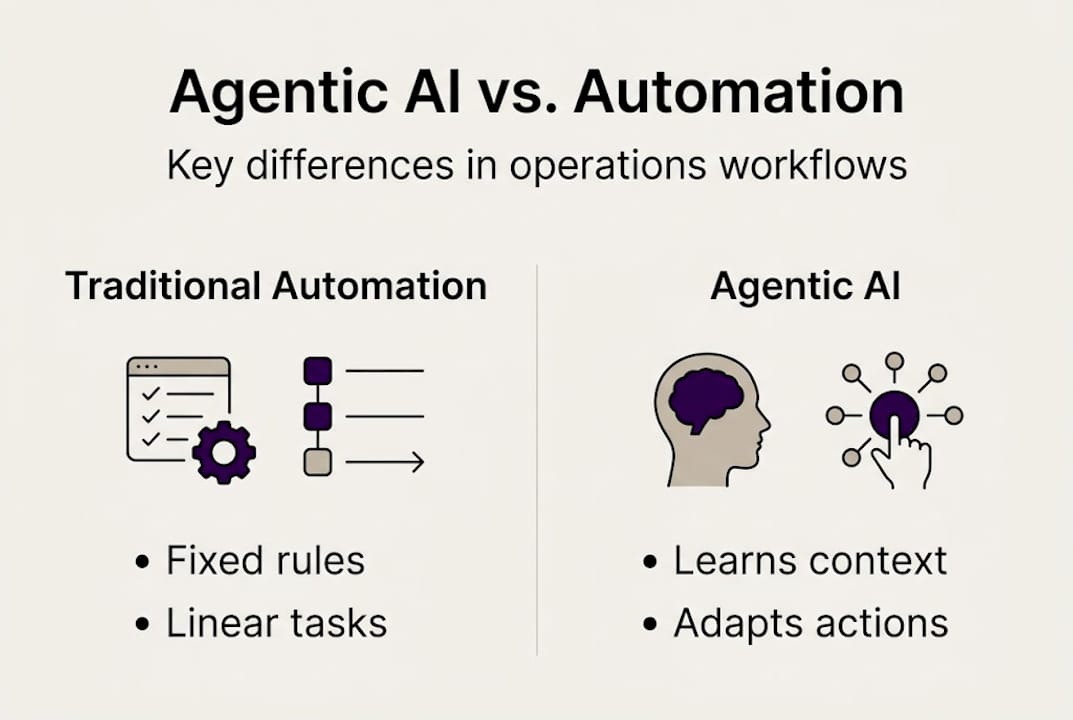
Legacy AI chatbots are a step up in conversational ability but still fall short. They respond to prompts but cannot initiate multi-step actions, coordinate across systems, or handle exceptions with judgment. Agentic AI automates complex workflows with planning, acting, and learning, handling exceptions and integrating enterprise systems in ways that chatbots simply cannot.
Here is a direct comparison to make the distinction concrete:
| Capability | Traditional automation | Legacy chatbot | Agentic AI |
|---|---|---|---|
| Follows fixed rules | Yes | Partial | No (goal-driven) |
| Handles exceptions | No | No | Yes |
| Learns from outcomes | No | No | Yes |
| Integrates across systems | Limited | No | Yes |
| Initiates multi-step tasks | No | No | Yes |
| Requires human input per step | Yes | Yes | No |
For operations managers, the practical difference shows up in process-heavy work. Consider payroll anomaly resolution, telecom sales coordination, or complex engineering change orders. These involve branching decisions, multiple systems, and frequent exceptions. That is exactly where agentic AI earns its place.
Core functions exclusive to agentic AI include:
- Goal-oriented planning: The system sets sub-tasks to reach an outcome, not just respond to a trigger.
- Cross-system execution: It can update a CRM, send a notification, and flag an approval in one coordinated sequence.
- Exception handling: When something unexpected happens, it reasons through options rather than stopping.
- Feedback loops: It adjusts behavior based on what worked and what did not.
For a deeper look at how this plays out in practice, the agentic AI efficiency guide and a breakdown of automation vs agentic AI are worth reviewing before scoping any project.
How agentic AI streamlines operations: Real-world impact
Distinguishing agentic AI from legacy solutions is useful. But what does the data actually show when it gets deployed?
The results from early enterprise and SMB deployments are striking. Agentic AI drove a 40% effort reduction, up to 60% lead time decrease in engineering workflows, and a 5x increase in digital sales in telecom environments. Payroll exception management, a task that typically requires manual review and back-and-forth communication, was handled autonomously with significantly fewer errors.

For SMBs specifically, productivity lifts of 30-45% are achievable, with ROI possible within months when pilots are designed correctly. These are not projections. They reflect measured outcomes from structured deployments.
| Domain | Measured impact |
|---|---|
| Engineering change management | Up to 60% lead time reduction |
| Telecom digital sales | 5x sales volume increase |
| Payroll exception handling | 40% effort reduction |
| SMB general operations | 30-45% productivity improvement |
Why do these results occur? Agentic AI removes the coordination overhead that slows human teams. Instead of a person checking three systems, writing a summary, and routing an approval, the agent handles the full sequence. Humans stay involved for judgment calls, but the mechanical work disappears.
Operational tasks best suited for agentic AI include:
- Multi-step approval workflows with variable routing logic
- Document processing that requires cross-referencing multiple data sources
- Exception handling in billing, HR, and procurement
- Customer onboarding sequences that span CRM, scheduling, and communications
- Compliance checks that require pulling data from multiple regulated systems
The business process management with AI framework helps teams identify which workflows carry the highest potential for agentic AI impact. Looking ahead, the future of operational AI points toward broader orchestration across entire departments, not just individual tasks.
Pro Tip: Start with a single, repeatable process that has measurable inputs and outputs. Approval workflows with clear exception patterns are ideal first pilots. They generate proof of ROI quickly and reveal integration gaps before you scale.
Challenges, limitations, and effective governance of agentic AI
As agents become more capable, understanding their failure modes and how to govern them is not optional. It is a prerequisite for safe deployment.
The most common risks in agentic AI deployments include:
- Tool misuse: The agent selects the wrong tool or API call for a given situation, producing incorrect outputs that propagate through connected systems.
- Planning errors: The agent misinterprets a goal and builds a flawed task sequence, often compounding mistakes across steps.
- Memory drift: Over long sessions or repeated tasks, the agent loses context from earlier steps, leading to inconsistent behavior.
- Prompt injection: Malicious or poorly structured inputs can redirect the agent’s behavior, particularly in customer-facing workflows.
- Overgeneralization: The agent applies a learned pattern to a situation where it does not fit, producing confident but wrong results.
Agentic AI deployment risks including tool misuse, planning errors, memory drift, and prompt injection require human oversight and rollback systems as core design requirements, not afterthoughts.
“Most enterprises are not ready for agentic AI, citing maturity gaps in data, governance, and true delegation to autonomous systems.”
This matters because agentic AI errors can cascade. One bad decision in step two of a ten-step process can corrupt every downstream action. Safe autonomy in agentic AI requires explicit design choices around when the agent acts alone and when it stops for human review.
Effective governance starts with a “least agency” policy: give the agent only the permissions and tools it needs for a specific task, nothing more. Pair that with rollback capability so any action can be reversed if the output is wrong. Set clear review triggers for high-stakes decisions.
For teams improving workflows with AI, governance design should happen before deployment, not after the first failure. Reviewing automation trends in office operations also helps teams understand where governance frameworks are maturing fastest.
Pro Tip: Define a short list of decisions the agent is never allowed to make without human sign-off. Start conservative. You can always expand agent authority as trust builds through consistent performance.
Best practices: Launching agentic AI for measurable operational improvements
With the risks and requirements understood, here is how to move forward and generate real results.
Success with agentic AI requires careful pilot design, orchestration, measurable goals, and ongoing human oversight. That is not a suggestion. It is the pattern that separates deployments that deliver ROI from those that stall.
Follow these steps for a structured rollout:
- Conduct a needs analysis. Map your highest-friction workflows. Look for processes with frequent exceptions, multiple handoffs, and measurable cycle times.
- Design a focused pilot. Select one process. Define success metrics before you start: effort hours saved, error rate reduction, cycle time improvement.
- Select tasks with decision density. Agentic AI adds the most value where judgment is required repeatedly, not just where volume is high.
- Build orchestration with guardrails. Define tool access, escalation triggers, and rollback procedures as part of the initial build, not an add-on.
- Set benchmarks and measure consistently. Long-context comprehension benchmarks, such as Claude’s 76% accuracy on complex tasks, give you a realistic baseline for what agents can handle reliably.
- Run feedback loops. After each pilot cycle, review what the agent got right, what it missed, and adjust the task scope or oversight rules accordingly.
Common adoption pitfalls to avoid:
- Deploying without defined success metrics
- Granting too much system access too early
- Skipping integration readiness checks with existing CRM or ERP systems
- Treating the first deployment as a finished product rather than a learning cycle
- Underestimating the change management required for human teams working alongside agents
Enablers that accelerate adoption:
- Clear executive sponsorship with operational ownership
- A dedicated pilot team with authority to iterate quickly
- Pre-mapped integration points with existing business systems
Reviewing types of AI automation helps clarify where agentic AI fits relative to other tools already in your stack. For sector-specific context, AI trends in professional services covers how similar organizations are structuring their rollouts in 2026.
Why most operations fail with agentic AI: Our take
Here is what the data and deployment experience consistently show: when agentic AI projects fail, the technology is rarely the primary cause.
The real problem is operational immaturity. Teams launch agentic AI into processes that are not well-documented, governed, or measured. The agent inherits the chaos and amplifies it. What looked like a workflow becomes a series of undocumented exceptions that no one has ever mapped.
Change management is the harder challenge. Getting the AI to function is often faster than getting the team to trust it, use it correctly, and provide the feedback needed to improve it. Most organizations underestimate this by a wide margin.
Agentic AI is not a turnkey transformation. It is an ongoing orchestration effort. The teams that see the best results treat it as a continuous improvement program, not a one-time technology purchase. They invest in pilot discipline, governance design, and iterative learning. The agentic AI transformation journey rewards commitment, not just adoption.
If your operation is not ready to dedicate real effort to process clarity and governance, the technology will not save you. But if you are willing to do the foundational work, the productivity gains are real and reachable.
Partner with experts for your agentic AI journey
Understanding agentic AI is the first step. Deploying it effectively is where the real work begins. At Ailerons.ai, we design and deploy agentic AI systems built for office and operational workflows, from document management and billing support to compliance tasks and front-office coordination. Our approach is outcome-focused: we start with your specific processes, build toward measurable results, and design governance in from the start. If you want to see how agentic AI has delivered results in real operational environments, explore our agentic AI case studies or reach out to discuss your specific workflow challenges with our team.
Frequently asked questions
What’s the main difference between agentic AI and classic automation in operations?
Agentic AI can observe, plan, act, and learn, adapting to new situations and handling exceptions. Classic automation follows rigid rules and stops when inputs fall outside its programmed parameters.
How can operations managers measure the ROI of agentic AI projects?
Track effort hours saved, lead time reduction, and error rates across the piloted process. SMB adoption can yield 30-45% productivity gains with ROI achievable within months when pilots are well-scoped.
What risks should be considered before deploying agentic AI?
Prepare for planning errors, tool misuse, memory drift, and prompt injection. Agentic AI edge cases require human oversight protocols and rollback mechanisms built into the deployment design.
How do you pick the right processes for agentic AI pilots?
Prioritize multi-step workflows with frequent exceptions and measurable cycle times. Decision-rich, exception-prone workflows give agentic AI the most opportunity to demonstrate adaptive value over traditional automation.
Recommended
- AI-driven operations guide: boost efficiency 72% in 2026 | Ailerons IT Consulting
- AI in Business Process Management: Unlocking Efficiency | Ailerons IT Consulting
- Future of Operational AI 2026: Agentic Systems Transforming Work | Ailerons IT Consulting
- AI Trends in 2026: Transforming Office Operations | Ailerons IT Consulting