

TL;DR:
- Agentic AI is an autonomous, goal-driven system that plans, adapts, and executes complex workflows with minimal human input.
- Its strategic deployment targets workflow bottlenecks, providing scalable efficiency, cost reduction, and end-to-end process transformation.
Agentic AI is defined as an autonomous, goal-driven AI system that independently plans, decides, and executes complex multi-step workflows with minimal human oversight. This architecture, sometimes called autonomous AI or agent-based AI, moves well beyond traditional automation by giving AI systems the ability to reason across context, coordinate between tools, and adapt when conditions change. Enterprise spending on agentic AI has surged into the hundreds of billions in 2026, yet only 30% of organizations report measurable financial impact. That gap is not a technology problem. It is a strategy problem, and understanding the difference is where real digital transformation begins.
How agentic AI differs from traditional automation and AI
Traditional automation executes fixed scripts. Traditional AI assists with specific tasks, such as classifying text or generating a summary. Agentic AI systems autonomously plan and execute complex workflows, breaking down goals, coordinating across tools and platforms, and adjusting actions independently when something changes mid-process. That distinction matters enormously for digital transformation strategy.

A rules-based bot can process an invoice if every field is in the right place. An agentic AI system can receive an invoice, detect a discrepancy, cross-reference the purchase order in your ERP, flag the exception to the right approver, update the accounting record, and log the resolution, all without a human touching the queue. That is not incremental optimization. That is process redesign.
The architectural implications are significant. Traditional automation requires rigid workflow maps and frequent human maintenance. Agentic AI operates with runtime decision logic, meaning the system determines the next best action based on current context rather than a pre-written rule. For business leaders, this means the cost of changing a process drops substantially once an agentic system is in place.
| Feature | Traditional automation / AI | Agentic AI |
|---|---|---|
| Task scope | Single-step or rule-based | Multi-step, goal-oriented |
| Decision making | Pre-programmed logic | Real-time reasoning and adaptation |
| Human involvement | Required at each exception | Escalates only when necessary |
| Process flexibility | Rigid, high maintenance | Adapts to changing context |
| Business impact | Incremental efficiency | End-to-end process transformation |
What are the key business benefits of agentic AI?
Agentic AI shifts organizational roles from task execution to defining intent and governance. Humans focus on strategy and judgment. AI handles execution with speed and consistency. That redistribution of responsibility is the core mechanism behind the productivity gains organizations are beginning to report.
The business benefits span every sector. In financial services, agentic AI manages loan processing workflows from document intake through compliance checks to approval routing, cutting cycle times from days to hours. In manufacturing, it coordinates procurement, monitors supplier performance, and triggers reorder workflows without manual intervention. In retail, it handles customer escalations, updates inventory records, and adjusts fulfillment routing in real time. These are not isolated efficiency wins. They represent a fundamental shift in how work gets done.
“Most businesses underestimate both the potential and the complexity of agentic AI transformation.” — Andrew Ng, via Bain & Company
That observation from Andrew Ng captures the central tension facing business leaders today. The upside is real, but so is the execution risk. Organizations that treat agentic AI as a plug-and-play tool consistently underperform those that treat it as an operating model change.
The most consistently cited business benefits include:
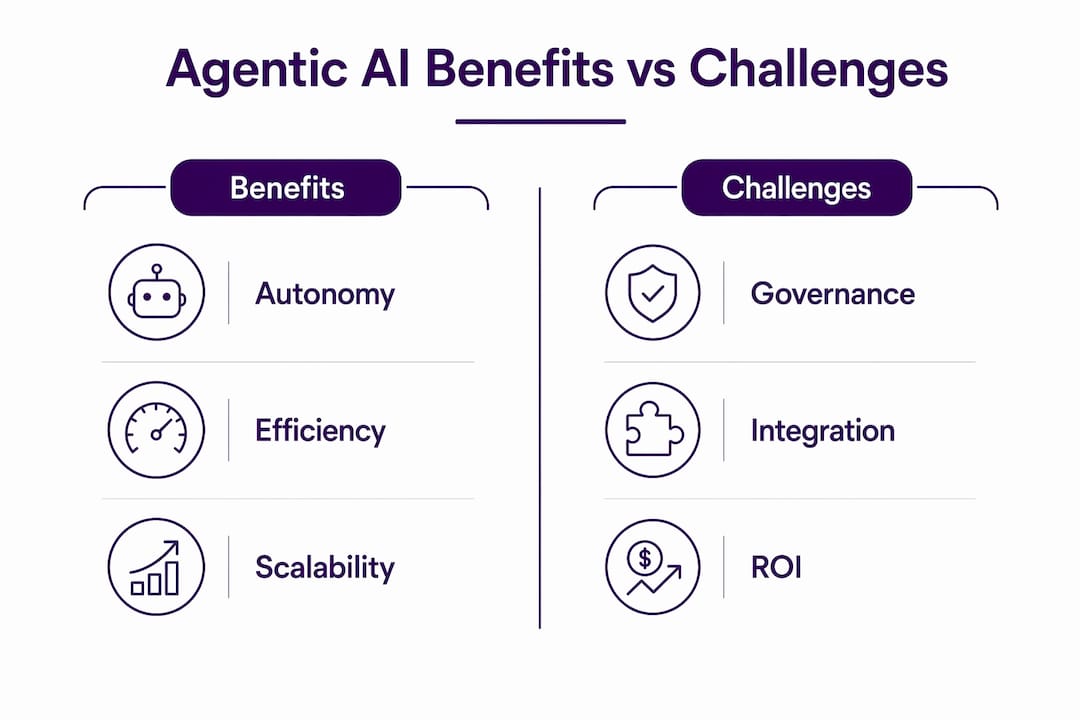
- Throughput at scale: Agentic systems process work continuously without fatigue, enabling organizations to handle volume spikes without adding headcount.
- Cost reduction through exception handling: By resolving routine exceptions autonomously, agentic AI reduces the labor cost of manual review cycles.
- Faster cycle times: End-to-end workflow automation compresses multi-day processes into hours or minutes.
- Consistency and auditability: Every action an agentic system takes is logged, creating a reliable audit trail that supports compliance and quality control.
- Scalability without proportional staffing: Organizations grow operational capacity without a corresponding increase in administrative overhead.
AI value pools disproportionately concentrate around agentic capabilities, driving new business model evolution. Companies that capture this value early build structural advantages that are difficult for slower-moving competitors to close.
What are practical strategies for successful agentic AI integration?
The single most common reason agentic AI investments fail to deliver ROI is misalignment between the technology deployment and actual business constraints. Targeting AI investments at bottlenecks in value chains, rather than isolated tasks, is the critical factor for measurable returns. Improving a non-bottleneck step rarely improves overall throughput. Identifying where work actually stalls, and deploying agentic AI there, is what moves the needle.
Successful implementation follows a clear sequence. Start with a workflow audit to identify where delays, errors, and manual handoffs concentrate. Prioritize the two or three processes where automation of the bottleneck would produce the largest downstream impact. Define specific, measurable success metrics before deployment, not after. Then scale only once those metrics are confirmed.
Pro Tip: Map your current workflow end-to-end before selecting an AI solution. The bottleneck is rarely where leadership assumes it is. A one-week process audit using tools like Celonis or even a structured spreadsheet review will surface the real constraint faster than any vendor demo.
The organizational prerequisites are equally important. Bilingual teams pairing business experts with technical architects accelerate AI-driven workflow redesign because they prevent the most common failure mode: technically sound deployments that solve the wrong problem. Executive sponsorship is not optional. Without a senior leader accountable for outcomes, agentic AI initiatives drift toward impressive pilots that never reach production scale.
A practical implementation sequence for most organizations looks like this:
- Audit and prioritize: Map workflows, identify bottlenecks, and rank by business impact.
- Define success metrics: Establish baseline performance data and target outcomes before any build begins.
- Assemble a bilingual team: Pair process owners with technical architects who understand both the business logic and the AI architecture.
- Deploy in a controlled scope: Start with one high-impact workflow rather than attempting enterprise-wide rollout.
- Measure and validate: Confirm that defined metrics are moving before expanding scope.
- Build governance early: Establish identity controls, escalation protocols, and monitoring frameworks from day one.
Governance deserves particular attention. Agentic AI requires strategic alignment and executive sponsorship not just for adoption, but for ongoing oversight. Without clear accountability structures, agentic systems can make consequential decisions in gray areas without appropriate human review. Defining those boundaries upfront is a leadership responsibility, not a technical one. You can explore how AI decision logic shapes these governance frameworks in practice.
How is agentic AI reshaping enterprise software and operating models?
Enterprise software is evolving from a translation layer to an orchestration model because of agentic AI. Traditional enterprise software, whether SAP, Salesforce, or ServiceNow, was built to translate human intent into structured data operations. Agentic AI moves business logic to real-time runtime, meaning the system determines what to do next based on context rather than waiting for a human to navigate a UI and trigger the next step.
This shift changes what enterprise software is for. Platforms become execution environments rather than decision interfaces. The orchestration layer, where agentic AI coordinates between CRM, ERP, document management, and communication tools, becomes the primary site of business logic. Organizations that understand this are redesigning their software architecture accordingly.
Governance and identity controls break down with dynamic agentic runtimes because static policies cannot anticipate every real-time decision path. This is one of the most underappreciated risks in enterprise agentic AI deployments. A system that can autonomously access records, trigger approvals, and update data across platforms needs continuous monitoring and adaptable security controls, not a one-time policy document. Saviynt and similar identity governance platforms are beginning to address this, but most organizations are still catching up.
The evolution of enterprise software under agentic AI follows a recognizable pattern:
| Stage | Software role | Human role | AI role |
|---|---|---|---|
| Traditional ERP/CRM | Data repository | Manual process execution | None |
| RPA and basic automation | Rule execution engine | Exception handling | Script-based task completion |
| AI-assisted tools | Decision support | Final decision authority | Recommendation and analysis |
| Agentic AI orchestration | Execution environment | Intent definition and governance | End-to-end workflow management |
The skill requirements within organizations shift accordingly. Process owners need to understand what agentic systems can and cannot decide autonomously. IT teams need to manage orchestration layers and integration points rather than individual application configurations. The AI in business process management discipline is becoming a core competency for operations leaders, not just a technical specialty.
Key takeaways
Agentic AI delivers measurable digital transformation only when deployed at workflow bottlenecks, governed by executive-sponsored frameworks, and supported by teams that combine business expertise with technical architecture skills.
| Point | Details |
|---|---|
| Define before deploying | Map workflows and identify bottlenecks before selecting or building any agentic AI solution. |
| Target constraints, not tasks | Deploying AI at non-bottleneck steps rarely improves overall throughput or ROI. |
| Governance is non-negotiable | Static policies fail in dynamic agentic runtimes; build continuous monitoring from day one. |
| Bilingual teams drive success | Pairing business experts with technical architects prevents technically sound but strategically misaligned deployments. |
| Orchestration replaces translation | Enterprise software is shifting from a UI-driven translation layer to an AI-driven orchestration model. |
Why business-led adoption is the only kind that works
I have watched organizations spend significant budget on agentic AI pilots that produced genuinely impressive technology and zero measurable business impact. The pattern is consistent. A technical team identifies an interesting use case, builds a capable system, and then discovers that the process they automated was not actually the constraint. The bottleneck was somewhere else entirely, and the business kept moving at the same pace.
The organizations that get this right start from a different place. They begin with a business outcome, work backward to the process that most constrains that outcome, and then ask what role AI can play in removing that constraint. That sequence sounds obvious, but it requires business leaders to stay in the driver’s seat throughout the entire initiative. Technology teams are essential partners, but they should not be setting the agenda.
The other lesson I keep returning to is that agentic AI is a multi-year operating model change, not a deployment project. The first workflow you automate teaches you how to think about the second. The governance framework you build for one process becomes the template for the next. Organizations that treat each deployment as a discrete project miss the compounding value that comes from building institutional capability over time. The leaders who are winning in this space are the ones who treat agentic AI as a permanent feature of how their organization works, not a one-time initiative.
— Sam
How Ailerons helps organizations deploy agentic AI with confidence
Ailerons specializes in designing and deploying agentic AI systems for office and operational workflows, from front-office coordination and document management to billing support and compliance-driven processes. The work is outcome-focused from day one: Ailerons identifies the workflow constraints that matter most, builds systems that integrate with existing platforms like CRM, ERP, and accounting tools, and establishes the governance frameworks that keep agentic AI operating within defined boundaries. You can review real deployment outcomes across industries to see what measurable impact looks like in practice. For organizations ready to move from pilot to production, Ailerons’ consulting services provide the architecture, integration, and implementation support to get there.
FAQ
What is agentic AI in the context of digital transformation?
Agentic AI is an autonomous AI system that plans, decides, and executes multi-step workflows independently, enabling organizations to redesign end-to-end business processes rather than simply automating individual tasks. It is the foundation of AI-driven digital change that goes beyond traditional automation.
How does agentic AI differ from robotic process automation (RPA)?
RPA executes fixed, rule-based scripts and breaks when conditions change. Agentic AI reasons across context, adapts to exceptions, and coordinates across multiple systems without requiring a human to intervene at each decision point.
Why do most agentic AI investments fail to show ROI?
Only 30% of organizations report measurable financial impact from agentic AI spending because most deployments target non-bottleneck processes. Measurable ROI requires identifying and targeting the actual constraints in a value chain, not the most technically accessible workflows.
What governance controls does agentic AI require?
Agentic AI requires continuous monitoring, adaptable identity and access controls, and defined escalation protocols because static policies cannot cover every real-time decision path an autonomous system may take. Organizations should build these frameworks before scaling any agentic deployment.
Is agentic AI practical for smaller organizations?
Yes. Agentic AI for small business applications is growing because the technology integrates with common platforms like QuickBooks, HubSpot, and Microsoft 365. Smaller organizations benefit most by targeting one high-impact administrative or operational workflow and building from there rather than attempting broad deployment from the start.
Recommended
- AI Trends in 2026: Transforming Office Operations | Ailerons IT Consulting
- Future of Operational AI 2026: Agentic Systems Transforming Work | Ailerons IT Consulting
- AI Trends in Professional Services 2026: Beyond Automation | Ailerons IT Consulting
- 7 Actionable Digital Transformation Tips for SMB Leaders | Ailerons